Since the Fed's hike on Wednesday, we've had a version of the same conversation four times. It goes like this: "Rates are at 7%. I have a pile of vested stock. Should I just sell more of it and borrow less?"
It's a good question, and it's being answered badly all over the internet. Most answers compare a 7% mortgage rate to an expected stock return and stop there. That comparison is wrong in two directions at once, and here the errors are large enough to change the decision.
We wrote recently about when Bay Area tech equity actually turns into cash — lockups, tender offers, double-trigger vesting, and how much of a windfall is genuinely spendable after withholding. This is the next question. Once the money is real, how much of it should go into the house?
Your mortgage does not cost 7.05%
Mortgage interest is deductible, so the rate you pay and the rate you bear are different numbers. For a high-earning Bay Area household, they are very different.
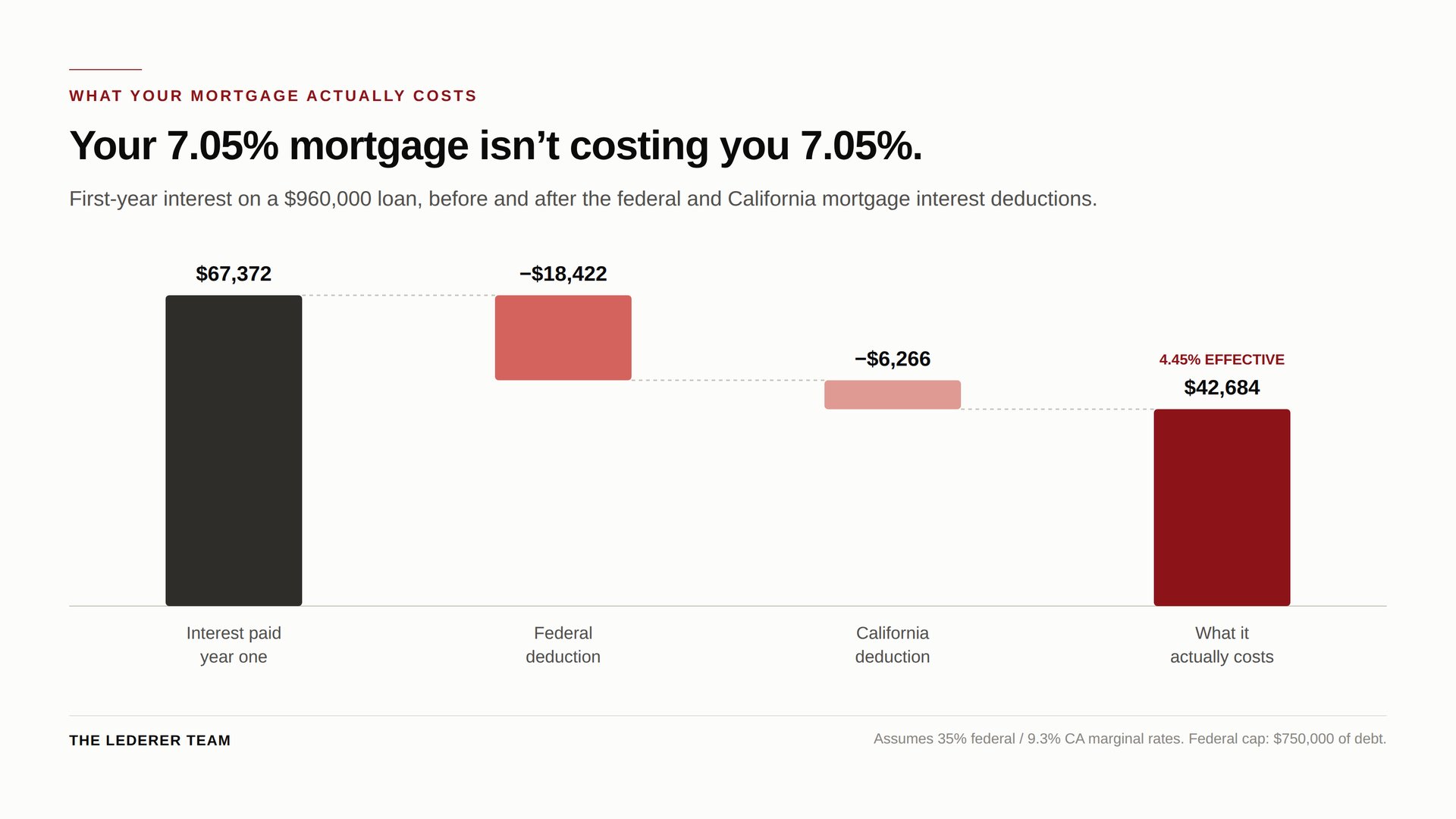
Take that $960,000 loan at 7.05% — a $1.2 million purchase with 20% down. (Indices differ: Freddie Mac's weekly survey has the 30-year at 6.95%, daily trackers run 7.0% to 7.2%. Your lender's quote will be its own number, and none of what follows changes materially.) First-year interest is about $67,400.
Federally, mortgage interest is only deductible on the first $750,000 of acquisition debt. On a $960,000 loan that is 78% of your interest. California, however, still allows the deduction up to $1 million, so the entire balance qualifies at the state level.
Run it through at a 35% federal marginal rate and 9.3% California:
- Federal deduction saves roughly $18,400
- California deduction saves roughly $6,300
- Net after-tax interest: about $42,700
That is an effective after-tax cost of roughly 4.45% — not 7.05%.
The number moves with your bracket. At a 32% federal marginal rate it's about 4.61%. At 37%, about 4.34%. At 24%, about 5.05%. But in every case it starts with a four or a five, not a seven.
This matters enormously, because it resets the hurdle. The question is not whether your stock will outperform 7%. It is whether it will outperform something closer to 4.5%, after the taxes you'd pay to sell it. That is a much lower bar, and it changes the answer for a lot of people.
The $750,000 cliff nobody mentions
Here's a wrinkle worth knowing before you set your down payment.
Because the federal deduction caps at $750,000 of debt, every dollar you borrow above that line is fully undeductible federally. Your marginal borrowing cost above $750,000 is meaningfully higher than your average.
Run the same loan at exactly $750,000 and the effective after-tax rate drops to roughly 3.91%. The gap between 3.91% and 4.45% is the cost of the deductible dollars you don't get.
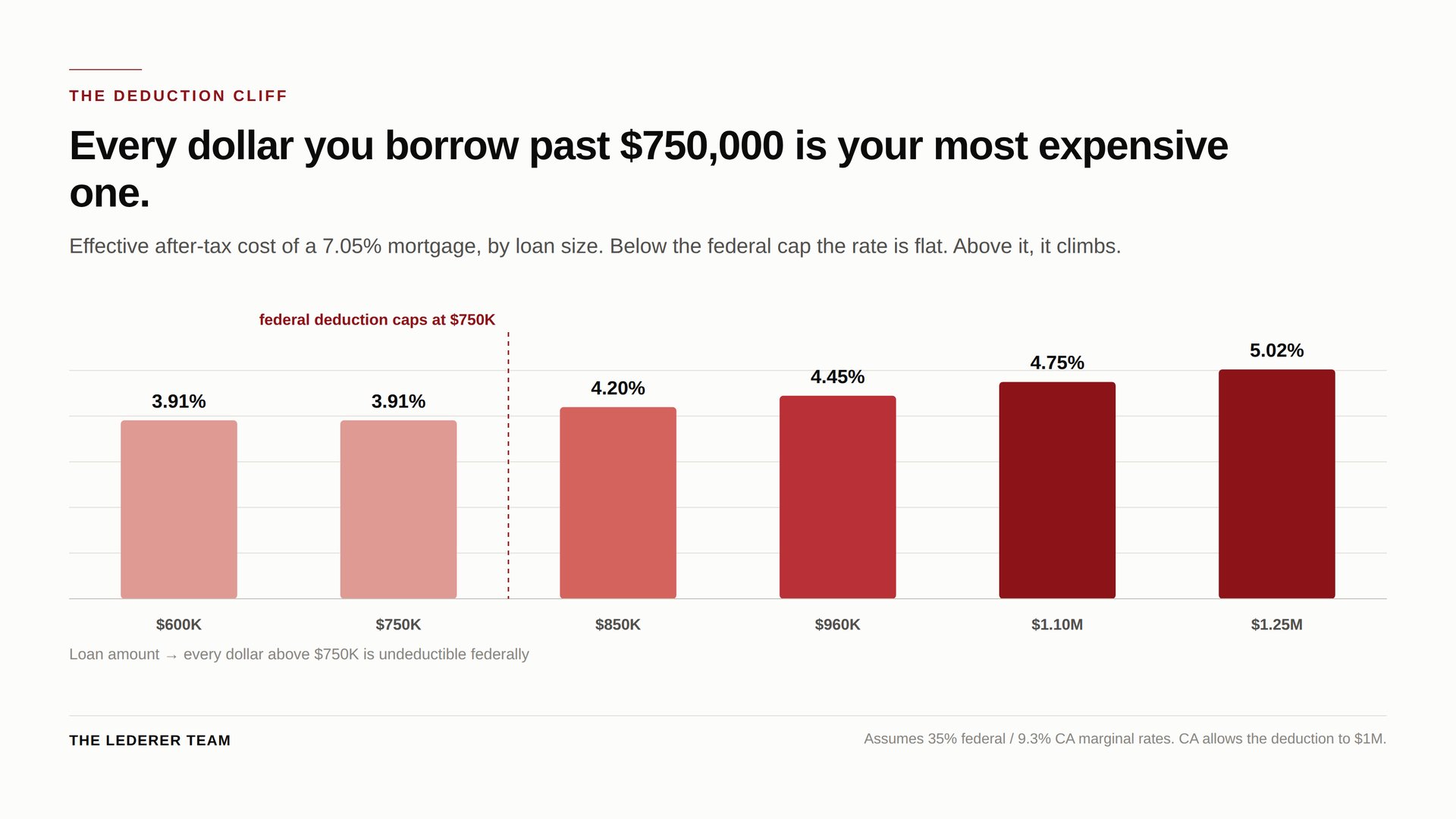
This does not automatically mean you should size your loan at $750,000. It does mean that if you are choosing between a $960,000 loan and an $850,000 loan, the marginal dollars in that range are the least tax-efficient in your whole structure, and that should be part of the conversation rather than an accident.
Now the other side: what does it cost you to sell the stock?
This is where most advice goes wrong, because it treats all equity as interchangeable. It isn't. The tax cost of raising $100,000 depends entirely on which shares you sell.
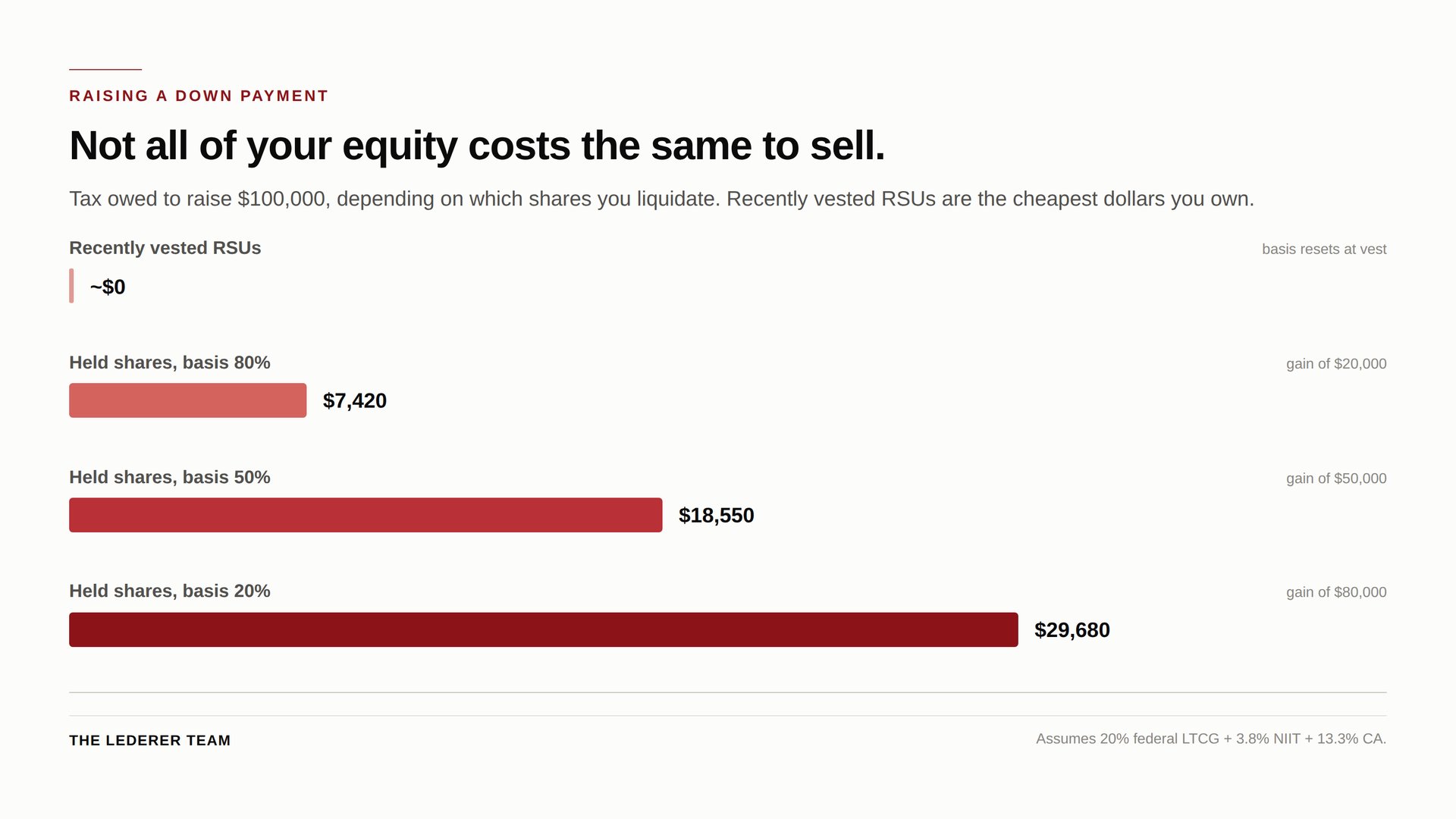
Recently vested RSUs. When RSUs vest, you have already paid ordinary income tax on the full value, and your cost basis resets to the price at vest. If you sell shortly afterward, there is little or no gain — and therefore little or no additional tax. Recently vested shares are, in tax terms, the cheapest dollars you own. Many buyers do not realize this and treat their newest shares as if selling them were as expensive as selling the ones they've held for five years.
Long-held appreciated shares. Very different. A California household at the top brackets faces 20% federal long-term capital gains, plus the 3.8% net investment income tax, plus California's rate — up to 13.3%. Combined, that's roughly 37% of the gain.
On $100,000 of proceeds:
- If basis is 80% of value, tax runs about $7,400 — you net roughly $92,600
- If basis is 50%, tax runs about $18,600 — you net roughly $81,400
- If basis is 20%, tax runs about $29,700 — you net roughly $70,300
So "sell $200,000 of stock for the down payment" can mean liquidating $200,000, or it can mean liquidating $285,000 to net $200,000. Those are different transactions and they produce different answers.
What the extra down payment actually buys you
Concretely, against that $960,000 loan at 7.05%:
- $100,000 more down → payment drops from about $6,419 to $5,751 (saves $669/month)
- $200,000 more down → about $5,082 (saves $1,337/month)
- $300,000 more down → about $4,413 (saves $2,006/month)
Roughly $669 of monthly payment per $100,000. Whether that trade is worth it depends on your bracket, your basis, how concentrated you already are in a single employer's stock, and how much monthly flexibility is worth to you in a year when you may also be making a competitive offer.
The part we won't pretend away
There is a risk consideration here that has nothing to do with taxes, and we think it deserves naming plainly rather than being buried.
Many Bay Area buyers hold a large concentration of a single company's stock and draw their income from that same company. A downturn in one employer can hit your portfolio and your paycheck in the same quarter — at which point a mortgage payment sized to your best year becomes a genuine problem. That's a structural exposure, not a market forecast, and it belongs in the decision.
We are not going to tell you what to do with your securities, and you should be skeptical of any real estate agent who does. What we can do is make sure you're looking at the right numbers before you decide.
How we help with this
Every client of ours can sit down with the tax professional on our team — an IRS Enrolled Agent — and walk through the actual after-tax picture for their own situation: their bracket, their basis, their loan size, their deduction. It's part of how we work, not an add-on, and we accept no referral fees from any partner we introduce you to. That last part matters: our incentive is that you make a good decision, not that you use a particular provider.
In our experience, buyers who have done this work write better offers. They know their real ceiling, they stop second-guessing mid-transaction, and they move decisively when the right house appears — which, against equity-rich competition, is worth more than another $25,000 of pre-approval.
If you'd like to run your own numbers, start with our financial planning and mortgage banking pages, or read about how we represent buyers. You can reach us at 510-774-4231 or [email protected].
This article is general information, not tax, legal, or investment advice, and it is not a recommendation to buy, hold, or sell any security. Tax figures are illustrative and use assumed marginal rates; your own result depends on your complete tax situation. Please consult your own tax professional before acting. Rate figures as of September 17, 2026; payment examples are principal and interest only.