Short answer: On Oakland's median sale price of $898,511, city and county transfer tax comes to roughly $14,466. That is the one closing cost we can compute to the dollar before your house ever lists. Commission, title, escrow and repairs all vary, which is why we break them out individually instead of quoting a single percentage.
Why we will not give you a percentage
Search for what it costs to sell a house and you will find confident claims that sellers pay six percent, or eight, or ten. We publish none of them, because we could not verify one from any authoritative source, and a made-up percentage applied to a $900,000 house is wrong by tens of thousands of dollars.
We can sort the costs into three groups: fixed by government and computable in advance, set by us and published, and genuinely variable. The rest of this post does that in order.
Transfer tax: the number we can compute exactly
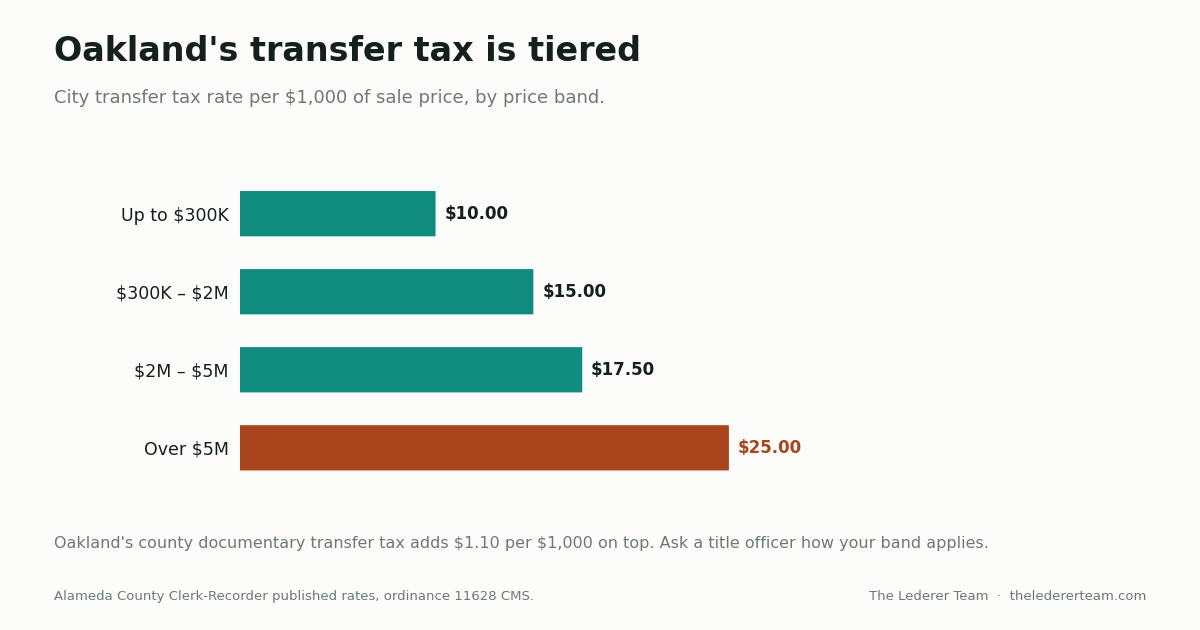
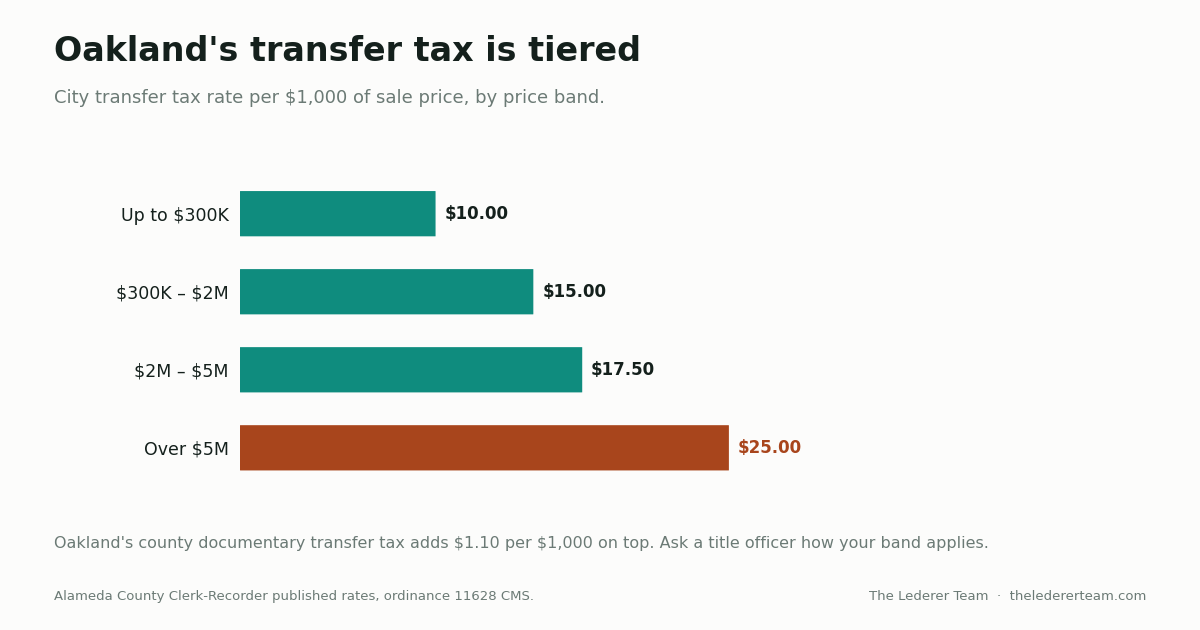
Oakland charges a real property transfer tax on a banded schedule, and Alameda County charges a documentary transfer tax of $0.55 per $500, which is $1.10 per $1,000, on top.
Sale price band | Oakland city rate, per $1,000 |
|---|---|
Up to $300,000 | $10.00 |
$300,000 to $2,000,000 | $15.00 |
$2,000,000 to $5,000,000 | $17.50 |
Over $5,000,000 | $25.00 |
Applied to real prices, city and county combined:
Sale price | Oakland city transfer tax | Alameda County transfer tax | Total |
|---|---|---|---|
$650,000 | $9,750 | $715 | $10,465 |
$898,511 (Oakland median) | $13,478 | $988 | $14,466 |
$1,200,000 | $18,000 | $1,320 | $19,320 |
$1,600,000 | $24,000 | $1,760 | $25,760 |
$1,900,000 | $28,500 | $2,090 | $30,590 |
$2,500,000 | $43,750 | $2,750 | $46,500 |
Two notes. Transfer tax is customarily negotiable between buyer and seller here, so the figure above is what the transaction owes, not necessarily what you write a check for. And the rate follows the price band the sale falls into, so a few thousand dollars near a band edge can move the whole bill. Ask your title officer to run your number.
Oakland's structure is middle-of-the-pack. Berkeley charges more, Hayward less, and unincorporated communities no city tax at all. We lay it out in our city-by-city transfer tax comparison. Berkeley's rates also change on January 1, 2027, covered in our post on the Berkeley transfer tax increase.
County recording fees are also set rather than negotiated, charged per document, and small relative to transfer tax. Your escrow officer has the exact figures for your file, and we would rather send you there than publish a number we cannot verify.

Commission, stated plainly
We charge a 2.5% seller-paid listing commission. On Oakland's $898,511 median that is $22,463. We publish it because a seller comparing agents should be able to compare the number without asking three times.
What a seller offers toward buyer-side compensation is a separate negotiation with no fixed figure, so we do not quote one. Discuss it before your house lists, not after an offer arrives.
One thing belongs here even though it never appears on a closing statement: we accept no referral fees from any partner. When we recommend a lender, inspector, stager or contractor, we are paid nothing for the introduction. That does not lower your escrow charges. It does mean the vendor list is the one we actually believe in. Our approach page explains the model.

The costs that genuinely vary
These are real, often substantial, and anyone quoting them as a fixed percentage before seeing your house is guessing.
- Title insurance and escrow fees. Set by the companies involved, and who pays which portion is customary but negotiable. Ask for a written estimate early.
- Inspection reports. Most Bay Area sellers order reports up front so buyers can bid with information. Cost depends on the house and how many specialists it needs.
- Repairs and pre-sale work. The widest-swinging line on the list. A well-maintained house may need nothing; a deferred-maintenance house can absorb a serious budget.
- Staging, photography and marketing. Varies with the size of the house and what the property needs.
- Natural hazard disclosure report. A third-party report, ordered per transaction.
The variable costs are where your decisions change your net; the fixed ones are where they do not. You cannot negotiate the transfer tax schedule. You can decide what to spend on preparation, and that decision deserves care.
Disclosures are an obligation, not an optional expense
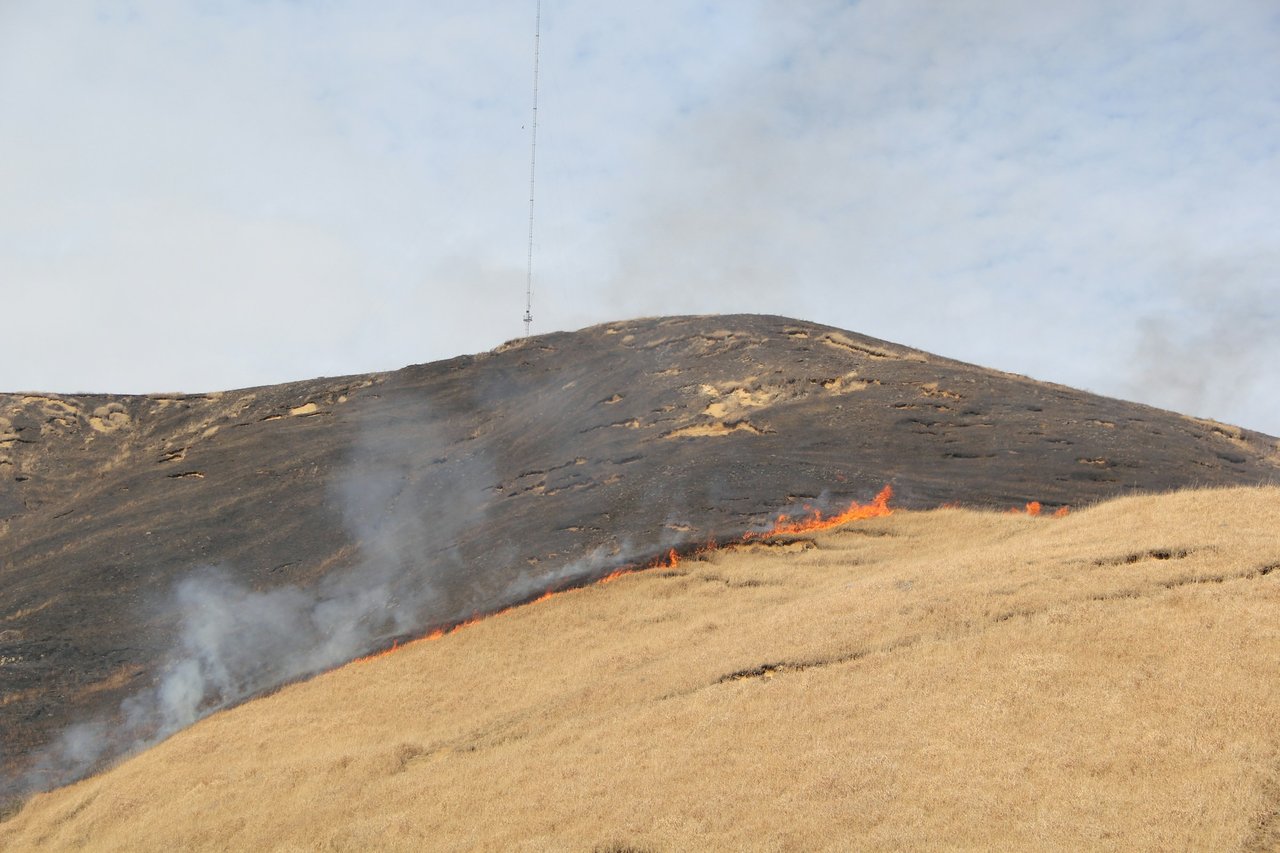
The Transfer Disclosure Statement is statutory, required by Civil Code section 1102 and following on most residential sales of one to four units. The Seller Property Questionnaire is a C.A.R. form most Bay Area sellers also complete; it is not a statute, and the difference matters. The Natural Hazard Disclosure, under Civil Code section 1103.2, covers six zones: FEMA flood, dam-failure inundation, High or Very High Fire Hazard Severity Zone, State Responsibility Area wildland, Earthquake Fault Zone, and Seismic Hazard Zone. In the Oakland hills, the fire and seismic items commonly trigger.
What escrow settles, and what you may owe later
Prorations and the property tax calendar
Beyond costs, escrow settles balances. Your mortgage payoff, any liens and property taxes are prorated to the closing date.
California property taxes run on a fiscal year of July 1 to June 30, with a January 1 lien date. The first installment is due November 1 and delinquent after December 10, carrying a 10% penalty. The second is due February 1 and delinquent after April 10, carrying a 10% penalty plus a $10 cost. Whether you have paid the installment covering your closing date determines whether escrow credits or debits you. It is not an extra cost, but it moves your settlement statement and it surprises people.
We are deliberately not publishing an effective property tax rate for Alameda County, because we could not verify one, and an unverified rate times a real assessed value produces a real error.
Capital gains after closing
The federal primary residence exclusion under Internal Revenue Code section 121 lets a single filer exclude up to $250,000 of gain and married filers filing jointly up to $500,000, if you owned the home 24 of the last 60 months and used it as a residence 24 of the last 60 months.
Where long-held Oakland homes carry decades of appreciation, $500,000 does not always cover the gain. California adds a layer: per the Franchise Tax Board, it taxes all capital gains as ordinary income, with no preferential long-term rate. We will not assert how California treats the section 121 exclusion, because the FTB page does not state it. Ask your CPA about the California treatment. We go deeper in our post on capital gains on a Bay Area home sale.
None of this is tax or legal advice. Confirm your situation with your CPA or attorney before you sign anything.
What the Oakland market is doing while you decide
Costs matter less than the price they are subtracted from. Per Redfin, for the three months ending June 2026, Oakland's median sale price was $898,511, up 5.7% year over year, on 805 sales, with a median 20 days on market, 68.5% of homes selling above list and $537 per square foot. Redfin's Compete Score for Oakland is 83, the same score it gives San Francisco.
A caveat on that year-over-year figure: Zillow's home value index for Oakland showed an 8.8% decline as of February 2026, the opposite direction from Redfin's 5.7% increase. They measure different things, and when two credible sources disagree this sharply the responsible answer is to say so rather than pick the flattering one.
On supply, Houzeo data via JVM Lending put Oakland at 0.92 months of supply in January 2026, with new listings down 35% year over year. That is the oldest figure cited here, so treat it as a January reading.
Frequently asked questions
How much is the transfer tax when selling a house in Oakland?
Oakland charges a banded city rate: $10 per $1,000 up to $300,000, $15 up to $2 million, $17.50 from $2 million to $5 million, and $25 above that. Alameda County adds $0.55 per $500, or $1.10 per $1,000. On Oakland's $898,511 median, city and county together come to about $14,466. Transfer tax is customarily negotiable between buyer and seller. Confirm your figure with a title officer.
What is the average cost to sell a house in Oakland?
We do not publish a percentage, because no authoritative source verifies one and an invented figure is wrong by tens of thousands of dollars on a typical Oakland sale. What we can quantify: transfer tax of about $14,466 on the median sale, and our 2.5% listing commission, which is $22,463 at that price. Title, escrow, repairs and staging vary by property and are negotiable.
What commission does The Lederer Team charge to sell a home?
A 2.5% seller-paid listing commission, which is $22,463 on Oakland's $898,511 median sale price. What a seller offers toward buyer-side compensation is a separate negotiation with no fixed figure, and it should be settled before the house lists. We also accept no referral fees from any partner we introduce you to, including lenders, inspectors, stagers and contractors.
Do I pay capital gains tax when I sell my Oakland home?
Possibly. Internal Revenue Code section 121 excludes up to $250,000 of gain for a single filer and $500,000 for married filers filing jointly, if you owned the home 24 of the last 60 months and lived in it 24 of the last 60 months. Gain above the exclusion is taxable. California taxes capital gains as ordinary income per the Franchise Tax Board. Confirm the California treatment with your CPA.
What disclosures does an Oakland seller have to provide?
The Transfer Disclosure Statement is statutory under Civil Code section 1102 and following for most residential sales of one to four units. The Natural Hazard Disclosure under Civil Code section 1103.2 covers six zones, including fire hazard severity, earthquake fault and seismic hazard, which commonly trigger in the Oakland hills. The Seller Property Questionnaire is a C.A.R. form most Bay Area sellers complete, not a statute.
How are property taxes handled when I sell?
They are prorated to the closing date through escrow. California's fiscal year runs July 1 to June 30. The first installment is due November 1 and delinquent after December 10, with a 10% penalty; the second is due February 1 and delinquent after April 10, with a 10% penalty plus a $10 cost. Depending on what you have already paid, escrow will credit or debit you at closing.
Sources
- City of Oakland, real property transfer tax schedule, 2026 — oaklandca.gov
- Alameda County Clerk-Recorder, documentary transfer tax, 2026 — acgov.org
- Redfin, Oakland housing market data, three months ending June 2026 — redfin.com
- Zillow Home Value Index, Oakland, February 2026 — zillow.com
- Houzeo via JVM Lending, Oakland months of supply and new listings, January 2026 — jvmlending.com
- IRS Topic No. 701, sale of your home — irs.gov
- California Franchise Tax Board, capital gains treatment — ftb.ca.gov
- California Civil Code sections 1102 et seq. and 1103.2, seller disclosures
Mark Lederer leads The Lederer Team at Red Oak Realty, with 25+ years and more than 1,000 closed transactions across Oakland and the greater East Bay. If you want the real version of this list for your specific house, with the transfer tax computed on a realistic price rather than a median, start at theledererteam.com/home-valuation, call 510-774-4231 or email [email protected].