Short answer: Per the Consumer Financial Protection Bureau, a mortgage broker does not underwrite or fund — it is an intermediary. A mortgage banker, a correspondent lender and a bank all underwrite and fund in their own name and appear as the payee on your note. In Alameda and Contra Costa counties, where the 2026 one-unit conforming ceiling is $1,249,125, that difference wins more offers than a rate quote.
Who underwrites, who funds, and whose name is on the note
The CFPB's plain-language version is two sentences. "A lender is a financial institution that makes direct loans." And: "A broker does not lend money. You can use a broker to find different lenders or mortgage loans." With a lender you repay under the loan's terms; with a broker, "you pay them a loan-specific fee for their services."
The technical version, from the CFPB's 2014 mini-correspondent guidance, separates three things buyers treat as one:
- A mortgage broker "renders origination services and serves as an intermediary between a borrower and lender" and does not fund from its own resources — it neither underwrites nor funds.
- A creditor is the payee named on the note, finances the transaction "out of the creditor's own resources, including by drawing on a bona fide warehouse line of credit," and makes the final credit decision.
- A correspondent lender takes the application, provides disclosures, underwrites and makes the credit decision, "closes loans in its name, funds them (often through a warehouse line)," then sells the closed loan to an investor.
Two more definitions follow. A mortgage banker is the non-depository creditor: it underwrites, closes and funds in its own name on a warehouse line, then typically sells the loan and often the servicing. It is the creditor of record at closing and does not hold your deposits. A retail bank or credit union is a depository: it underwrites and funds from its own balance sheet and may keep the loan in portfolio.
Structure | Who underwrites | Who funds at closing | Payee on the note | After closing |
|---|---|---|---|---|
Mortgage broker | The wholesale lender it submits to | The wholesale lender | The wholesale lender | Held or sold by that lender; broker's role ends |
Mortgage banker | Itself | Itself, on a warehouse line | The mortgage bank | Typically sold, often with the servicing |
Correspondent lender | Itself | Itself, often through a warehouse line | The correspondent | Sold to an investor, usually right away |
Retail bank or credit union | Itself | Itself, from its balance sheet | The bank or credit union | May keep in portfolio, or sell |
Table funding versus a warehouse line, and why your servicer changes
A warehouse line is a facility a creditor draws on to fund your loan out of its own resources — the CFPB's phrase is "a bona fide warehouse line of credit." That is the line its mini-correspondent guidance draws: legitimate warehouse funding on one side, table funding on the other, where the loan closes in one entity's name but is funded at the table by the party that made the credit decision.
This also answers the question buyers ask a month after closing: why they are paying a company they never spoke to. With a correspondent, the loan is usually sold to an investor right after closing, so the servicer may change almost immediately.
Why underwriting certainty, not the rate, is what a seller is buying
Per Freddie Mac's Primary Mortgage Market Survey, week ending August 20, 2026, the 30-year fixed averaged 6.65% and the 15-year 5.95%, against 6.67% and 5.96% the prior week and 6.58% and 5.69% a year earlier. The 30-year moved two basis points in a week, seven in a year.
The listing agent on the other side never sees that rate. They see whether an underwriter has reviewed your income, assets and credit; which conditions remain and whether they depend on you or the property; how much loan and appraisal contingency you want; and who the creditor will be. A quarter-point is your problem for thirty years. Whether the loan closes is the seller's problem for thirty days, and that is the risk being priced.
Over the three months ending June 2026, per Redfin, 91.3% of Piedmont sales, 90.4% of El Cerrito sales and 83.1% of Berkeley sales closed above list, on medians of 13, 14 and 15 days; Oakland ran 68.5% above list on 20 days. Inventory was 20% to 25% below last year as of June 2026, per RE/MAX Accord. A seller holding four offers need not take the thinnest financing story, the logic in how we compare offers.
Five questions worth asking a loan officer before you write:
- Who underwrites this loan — you, or a wholesale lender?
- Has an underwriter read my documents, or is this automated?
- Who will be the payee named on my note?
- Do you fund on your own warehouse line, or is this table-funded?
- Which conditions remain, and which depend on the property rather than me?
The $1,249,125 line, and why structure matters more above it
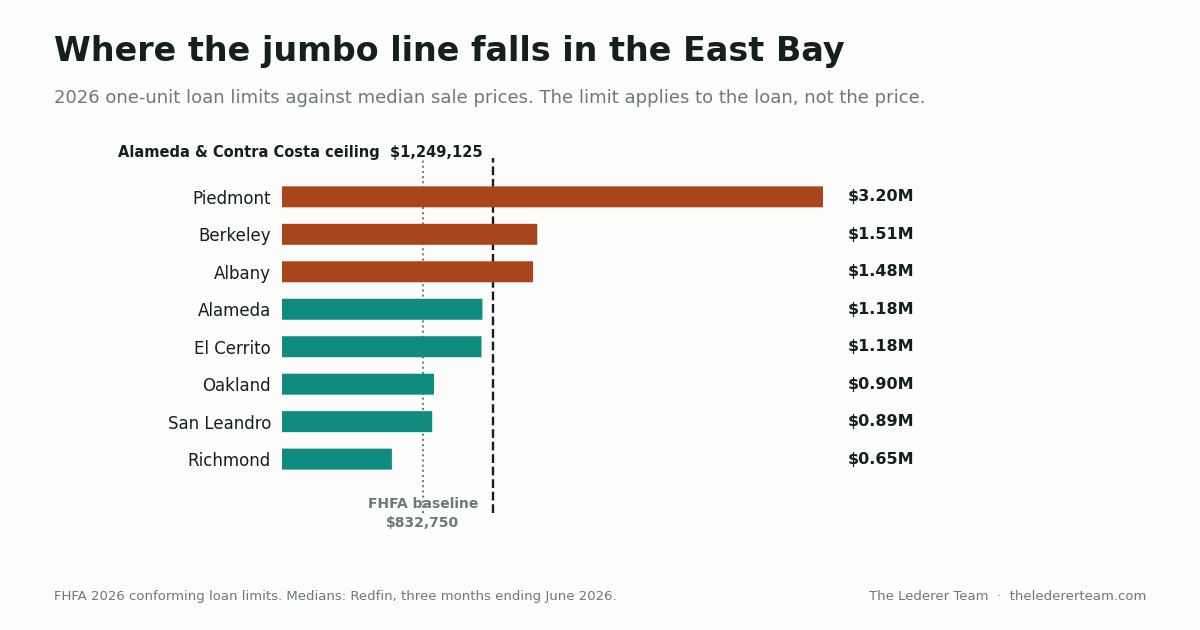
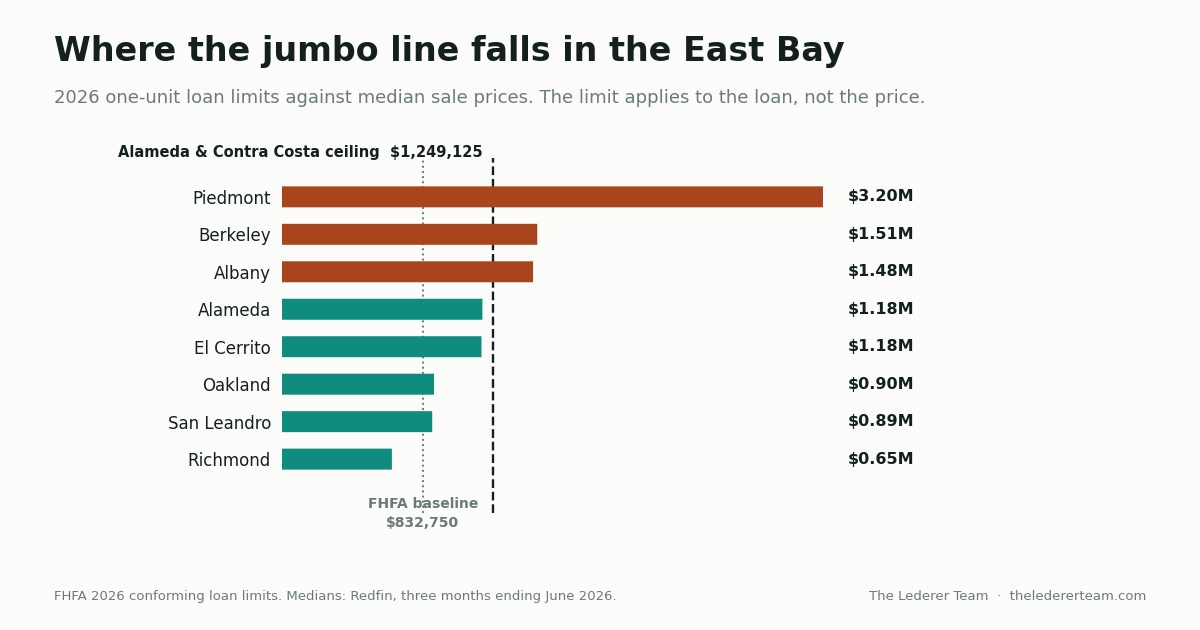
FHFA announced the 2026 conforming loan limits on November 25, 2025. The one-unit baseline is $832,750; the high-cost ceiling is $1,249,125, and Alameda County and Contra Costa County are both at that ceiling. Two-unit is $1,599,375, three-unit $1,933,200, four-unit $2,402,625. A one-unit loan above $1,249,125 in either county is a jumbo.
The line applies to the loan, not the price, so it lands in unintuitive places. Berkeley's median sale over the three months ending June 2026 was $1,509,179, per Redfin — with 20% down, a loan of roughly $1.21 million, under the ceiling. Piedmont's $3,198,260 median is jumbo at any realistic down payment. Albany's $1,484,192 median is where the down payment decides it: 20% down leaves a loan near $1.19 million, under the ceiling, while anything under roughly 16% down makes it a jumbo. Alameda at $1,184,855 and El Cerrito at $1,179,358 sit below the ceiling outright — a one-unit loan there is conforming at any down payment. The math is worked through in jumbo versus conforming. Above the line, who makes the credit decision matters more, not less. Programs and qualifying rules vary by lender — confirm your own file with your lender.
How we handle it
Our mortgage banking practice is 20-plus years old, in-house because of the structural point above. A mortgage bank processes, underwrites, documents and funds its own loans, and can also underwrite to the guidelines of most institutions — so it can move to the preferred lender and program while keeping control of the transaction. Our mortgage advisors integrate with our financial planning advisors and act as a fiduciary.
That sits inside a team of nine: three real estate advisors and six dedicated specialists in finance, mortgage, insurance, estate planning and renovation, with 60-plus years combined. Most buyers assemble that cast one referral at a time, and the pieces never talk to each other. These consultations are complimentary. In 2025 the team's sales stats placed it in the top 1.5% of agents nationwide, and it was recognized in 2025 as one of the Top Producing Teams at Red Oak Realty out of 120-plus agents. Here is how mortgage banking fits the rest, and the preparation around it in writing fewer offers. To settle financing first, start with a conversation.
Frequently asked questions
Is a mortgage broker cheaper than a mortgage banker?
Not necessarily, and price is not the whole comparison. Per the CFPB, with a broker "you pay them a loan-specific fee for their services," and the broker neither underwrites nor funds — a wholesale lender does both. A banker, correspondent or bank does both itself. Compare each offer in writing, and ask who makes the credit decision.
Does the seller see who my lender is?
Yes. Your preapproval letter goes with the offer and names the institution. What matters more is what it says: whether an underwriter reviewed your documents, what conditions remain, and who will fund. In a market this competitive, that is much of what separates two similar offers.
Why was my loan sold right after closing?
Because that is how correspondent lending works. Per the CFPB, a correspondent underwrites, closes the loan in its own name, funds it — often through a warehouse line — then sells it to an investor. Mortgage bankers typically sell too, often with the servicing. Ask before closing whether yours expects to sell.
What is a warehouse line of credit?
A credit facility a lender draws on to fund your loan out of its own resources. The CFPB's creditor definition includes financing the transaction "out of the creditor's own resources, including by drawing on a bona fide warehouse line of credit." It contrasts that with table funding, where the loan closes in one name but is funded by whoever made the credit decision.
What is the conforming loan limit in Alameda County in 2026?
$1,249,125 for a one-unit property. Alameda and Contra Costa are both at the FHFA high-cost ceiling for 2026, announced November 25, 2025, against a baseline of $832,750. Two-unit is $1,599,375, three-unit $1,933,200, four-unit $2,402,625. Above the one-unit ceiling in either county, the loan is a jumbo.
Sources
- CFPB, mortgage lender versus mortgage broker — link
- CFPB, guidance on mini-correspondent lenders, July 2014 — link
- Freddie Mac Primary Mortgage Market Survey, week ending August 20, 2026 — link
- FHFA 2026 conforming loan limits, announced November 25, 2025 — link
- Redfin city market data, three months ending June 2026
- RE/MAX Accord, East Bay inventory, June 2026
Mark Lederer leads The Lederer Team at Red Oak Realty, with 25-plus years and 1,000-plus closed transactions across Berkeley, El Cerrito, Oakland, Piedmont and Alameda. To have financing underwritten before you write rather than explained after you lose, call 510-774-4231 or email [email protected].