Short answer: Three paths, three problems. Selling realizes the gain and may exclude up to $500,000 federally under IRC § 121, but California taxes the rest as ordinary income. Renting keeps your Proposition 13 base and the step-up at death, and runs down the § 121 clock. Borrowing keeps everything, except a HELOC lender can freeze the line.
Necessary line first: none of this is investment, tax or legal advice, and nothing here is a recommendation. I am a licensed real estate professional, not a licensed investment adviser. What follows is mechanics, for a sharper conversation with your CFP and CPA.
The three paths on one page
Sell | Rent it out | Borrow against it | |
|---|---|---|---|
Liquidity | Full proceeds at close | Monthly income only | Cash without a sale |
Tax on gain | Realized now; § 121 may exclude $250,000/$500,000, California taxes the rest as ordinary income | Not yet; the § 121 clock runs | Not triggered |
Prop 13 base | Gone; the buyer's resets | Unchanged | Unchanged |
If a child inherits | Cash, no basis question | Basis steps up under § 1014, but Prop 19 fully reassesses a rental | Basis steps up; balance owed |
Reversibility | Effectively none | You can sell later | Repay or refinance |
Main risk | Buying back into this market | Landlording, plus Prop 19 reassessment | The lender can freeze the line |
Path one: sell
IRC § 121 excludes up to $250,000 of gain if single and $500,000 if married filing jointly, requiring ownership and residential use for 24 of the last 60 months, each tested separately. California is the surprise: the Franchise Tax Board taxes capital gains as ordinary income, with no preferential rate. Have your CPA compute both.
On cost: the sale carries our 2.5% seller-paid listing commission plus the buyer's side, which since the NAR settlement practice changes of August 17, 2024 is negotiated rather than posted — offers of compensation are no longer permitted on the MLS, though seller concessions still are. The only citable benchmark is Redfin's 2.42% U.S. average buyer's agent commission for Q3 2025, and 2.22% on sales of $1 million and up, published December 8, 2025 — from Redfin's own transaction book, a convenience sample rather than a census. No verified California average exists. Transfer taxes are city by city; see Berkeley's transfer tax.
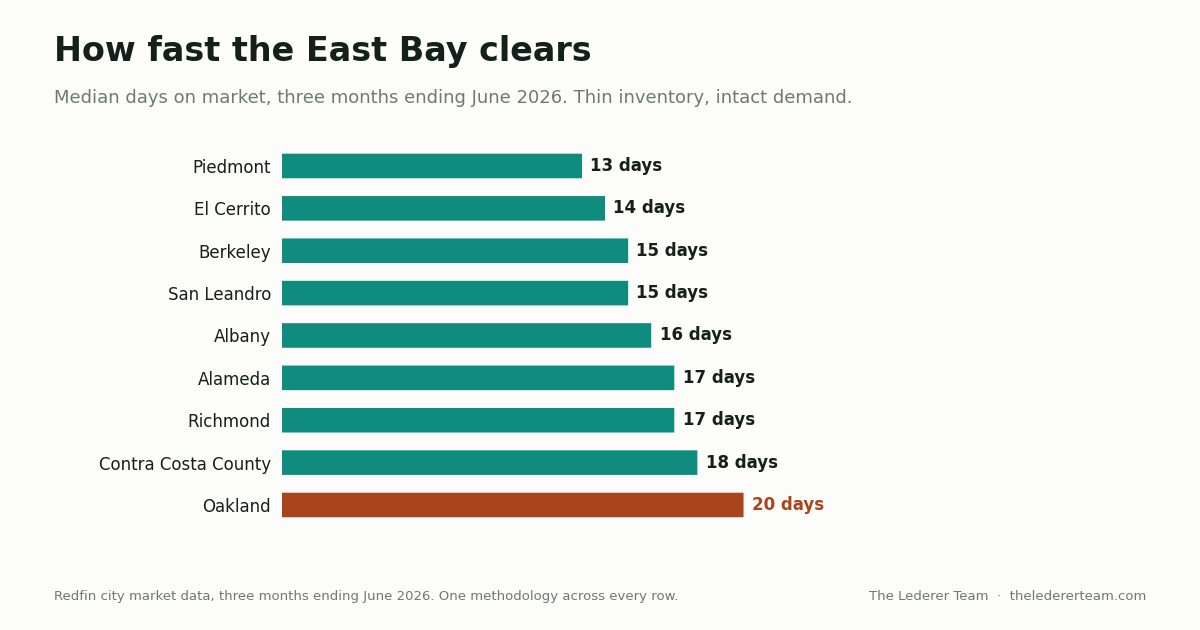
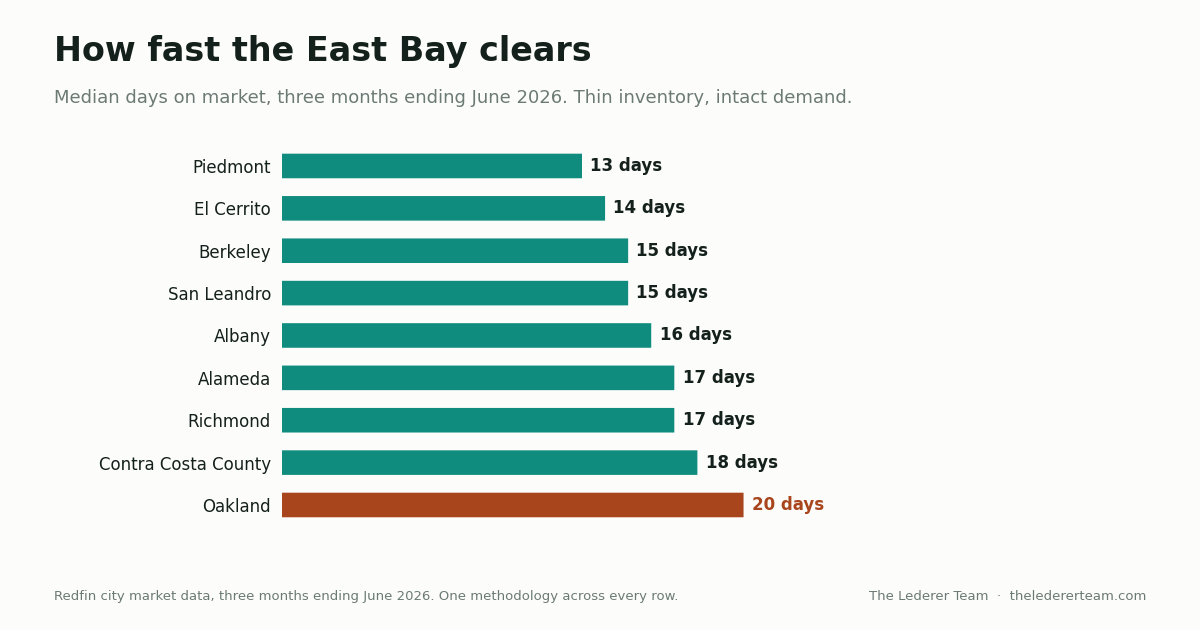
The sell path is fast here: days on market for the three months ending June 2026 ran from 13 in Piedmont to 20 in Oakland, per Redfin, and RE/MAX Accord reported inventory 20% to 25% below the prior year that June. Timing within the year is its own question: fall versus spring.
Path two: rent it out
Renting looks like the path with no downside. Its downsides arrive late.
The § 121 clock runs whether you watch it or not. The exclusion requires residential use for 24 of the last 60 months. Rent long enough and you no longer meet that test, and the $250,000 or $500,000 is not there when you sell. Depreciation and partial exclusions are a CPA question, best asked before the tenant moves in.
What renting preserves. Renting resets nothing. It is not a purchase, new construction, or a change in ownership, so the Proposition 13 base carries on under article XIII A. And under IRC § 1014, property acquired from a decedent takes a basis equal to fair market value at the date of death.
Now the part almost nobody has been told. Under old Proposition 58 rules a parent could transfer up to $1,000,000 of assessed value in rentals, vacation homes or commercial property to a child without reassessment. Proposition 19 eliminated that exclusion for parent-child transfers on or after February 16, 2021. A parent's Oakland duplex or Richmond rental transferred to a child is now fully reassessed to market value, regardless of amount. Keep it, rent it, leave it to the kids — that plan is gone.
What survives is narrow: the transferor's principal residence, which must become the transferee's principal residence within one year, with the homeowners' or disabled veterans' exemption filed within one year. Nor is it permanent — when the child stops living there the property is reassessed as of that date, so a child who inherits and rents it out loses it. Full mechanics, including the $1,044,586 limit, are in Prop 19 and inherited property. Confirm with your CPA and an attorney.
One item catches landlords especially. AB 1455 sets earlier Zone 0 deadlines than most coverage mentions — rentals immediately, properties for sale on sale or three years, whichever is sooner. On August 19, 2026 the Board of Forestry approved the final draft of its Zone 0 regulations, which now go to the Office of Administrative Law for review; as of August 26, 2026 there is no effective date, so those clocks start from a date that does not exist yet.
Path three: borrow against it
The CFPB defines a HELOC as "a line of credit that allows you to borrow against your home equity." Its booklet is unusually blunt about the risks.
- It is secured by your home, so "failure to repay the amounts you've borrowed, plus interest, could mean the loss of your home."
- HELOCs "typically involve variable rather than fixed interest rates."
- At the end of the draw period "you may have to pay the entire balance owed, all at once… You must be prepared to make this 'balloon payment'."
- And the clause almost nobody knows: "Plans generally permit lenders to freeze or reduce a credit line if the value of the home 'declines significantly' or when the lender 'reasonably believes' that you will be unable to make your payments due to a 'material change' in your financial circumstances."
Read that last one against how HELOCs get used here: the down payment, the renovation budget, the reserve behind a competitive offer. It is a plan a third party may withdraw, and a freeze is triggered by the conditions in which you would most need the money. A load-bearing HELOC needs a fallback.
For comparison, fixed first-mortgage pricing was 6.65% on the 30-year and 5.95% on the 15-year, per Freddie Mac's Primary Mortgage Market Survey for the week ending August 20, 2026 — fixed, and not subject to a freeze clause. Confirm structure and deductibility with your lender and CPA.
How to actually model it
Which path wins is rarely a theoretical question. It turns on five: what the cash is for and when; whether you qualify carrying the obligation; where you sit in the § 121 window; who inherits, and whether Proposition 19 reassesses in their hands; and whether you want to be a landlord — a preference, not a number.
Our financial planning advisors model exactly that, using proprietary software that assembles a client's Total Financial Picture — real estate, private businesses, loans, stocks and bonds in one view, modeled before the transaction. The team includes a Certified Financial Planner™ and Chartered Financial Analysts®, and consultations are complimentary. That describes a service; it is not a recommendation to take any of these paths. It works because the specialists are already in the room — nine of us, three real estate advisors and six dedicated specialists in finance, mortgage, insurance, estate planning and renovation, instead of a cast assembled one referral at a time. To price the sell path, start with a valuation; otherwise get in touch.
Frequently asked questions
Should I sell my East Bay home or rent it out?
That depends on facts specific to you, and no article should answer it. What decides it: what the cash is for, where you sit in the IRC § 121 24-of-60-month use window, who inherits, and whether you want to be a landlord.
Can my lender freeze my HELOC?
Yes. Per the CFPB, "plans generally permit lenders to freeze or reduce a credit line if the value of the home 'declines significantly' or when the lender 'reasonably believes' that you will be unable to make your payments due to a 'material change' in your financial circumstances."
Do I lose the $500,000 home sale exclusion if I rent my house out?
You can. IRC § 121 requires ownership and residential use for 24 of the last 60 months, each tested separately, so a long enough rental period means you no longer meet the use test at sale. Ask your CPA before renting, not after.
Will my kids keep my low property taxes if I leave them a rental?
No. Proposition 19 eliminated the exclusion for property other than a principal residence, for parent-child transfers on or after February 16, 2021. A rental transferred to a child is now fully reassessed to market value, regardless of amount. Under Proposition 58, up to $1,000,000 of assessed value was excluded.
Does renting my house out change my property tax assessment?
No. Renting is not a purchase, new construction, or a change in ownership, so it is not an event that resets full cash value under article XIII A of the California Constitution. The assessment keeps rising by no more than the lesser of California CPI or 2% a year — with one exception: a Proposition 8 decline-in-value assessment that is recovering may rise by more than 2% in a year until it returns to the factored base year value.
Sources
- CFPB, HELOC booklet — link
- Board of Equalization, Proposition 19, 2025 — link
- Freddie Mac PMMS, week ending August 20, 2026 — link
- Redfin, buyer's agent commissions Q3 2025 — link
- NAR, written buyer agreements — link
- Board of Forestry, defensible space Zone 0 — link
- Redfin and RE/MAX Accord, East Bay data 2026
Mark Lederer leads The Lederer Team at Red Oak Realty — 25-plus years and 1,000-plus closed transactions across the East Bay, with six specialists in finance, mortgage, insurance, estate planning and renovation. Call 510-774-4231 or email [email protected] to have all three paths modeled before you pick one. Not investment, tax or legal advice; those decisions belong with your CFP and CPA.