Short answer: For most East Bay households the house is the largest line on the balance sheet — Berkeley's median sale price was $1,509,179 in the three months ending June 2026, per Redfin — and it behaves like nothing else they own: illiquid, undiversified, leveraged, and carrying a Proposition 13 tax basis that is itself worth money. A plan has to account for all four.
The necessary line first: nothing here is investment, tax or legal advice, and none of it is a recommendation to buy, sell, hold or borrow. I am a licensed real estate professional, not a licensed investment adviser. What follows is mechanics, so the conversation with your own CFP and CPA is a better one.
What "asset class" means when the asset is where you live
A plan sorts what you own by the job it does: liquidity, income, growth, tax treatment, correlation. A residence is odd — a consumption good and a large financial position at once. It scores badly on most of those and uniquely well on one.
- Liquidity. You cannot sell 12% of a house to rebalance. The exit is all-or-nothing, and it costs real money in commission, transfer taxes and closing costs.
- Diversification. One asset, one street, inside the economy that pays your salary.
- Leverage. The 2026 conforming ceiling for a one-unit property in Alameda and Contra Costa counties is $1,249,125, per FHFA's November 25, 2025 announcement; above it you are in jumbo underwriting. See jumbo vs. conforming.
- Tax treatment. Here it wins. No brokerage account caps the annual increase in what you are taxed on, or excludes $500,000 of gain.
A plan that lists a market estimate and stops has captured one of the four.
The concentration problem, in East Bay numbers
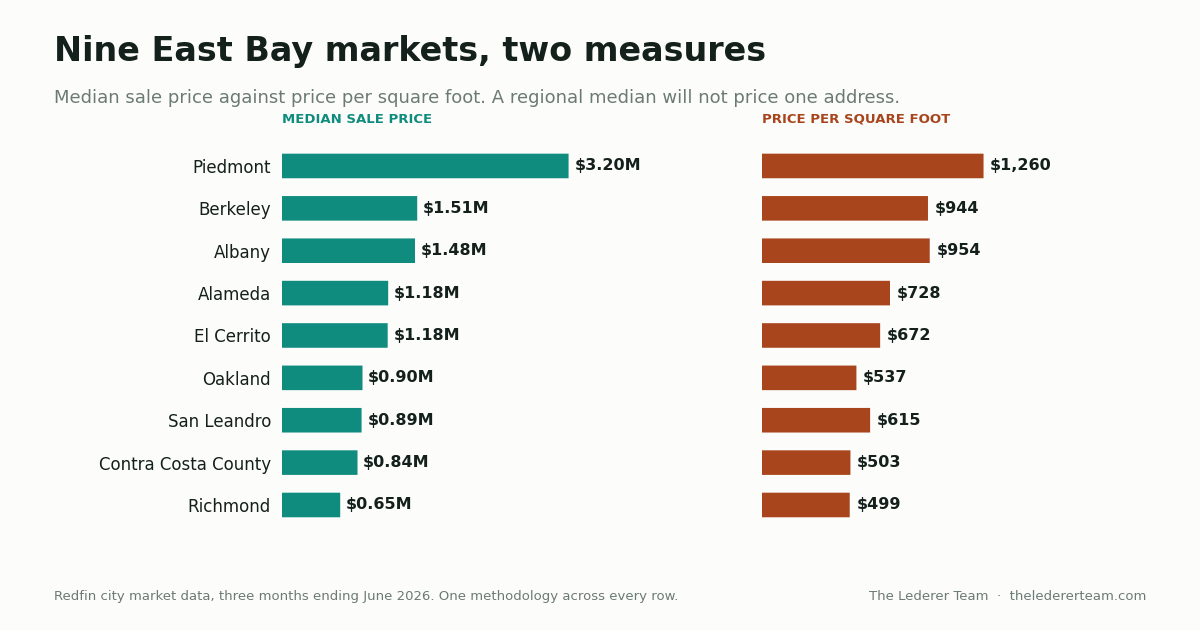
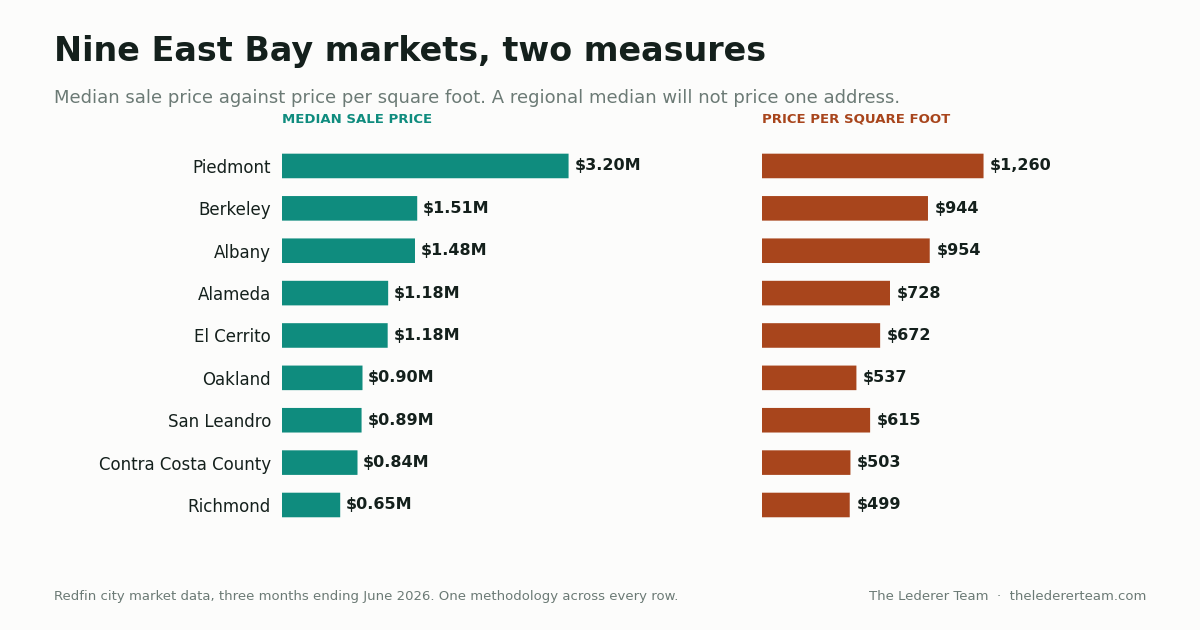
Redfin's city medians, three months ending June 2026, one methodology throughout:
Market | Median sale price | Price per sq ft |
|---|---|---|
Piedmont | $3,198,260 | $1,260 |
Berkeley | $1,509,179 | $944 |
Albany | $1,484,192 | $954 |
Alameda | $1,184,855 | $728 |
El Cerrito | $1,179,358 | $672 |
Oakland | $898,511 | $537 |
San Leandro | $888,017 | $615 |
Richmond | $649,646 | $499 |
Contra Costa County | $842,623 | $503 |
Purely as arithmetic: a household with a Berkeley home at that median and $500,000 in retirement accounts holds roughly 75% of gross assets in one property. A portfolio 75% in one stock gets called a concentrated position, and the planner starts talking about trimming it. Here there is nothing to trim.
Concentration also got worse because the asset performed. The East Bay single-family median was $1,235,000 in May 2026, up 7.4% from $1,150,000 on 1,465 closed sales, per RE/MAX Accord, which also reported inventory 20% to 25% below the prior year in June 2026.
Your Proposition 13 basis is part of the asset
Under article XIII A of the California Constitution the maximum ad valorem property tax is 1% of full cash value, plus voter-approved bonded indebtedness. "Full cash value" is the appraised value when a property is purchased, newly constructed, or on a change in ownership. After that, the annual adjustment is capped at the lesser of California CPI or 2%. Bills commonly run above 1% once bonds and direct assessments are added.
First, if you bought long ago, the gap between assessed and market value is a recurring benefit with a present value — invisible on every statement you get, and destroyed by a sale, because the buyer's full cash value resets to what they pay. That is a real cost of moving, separate from commission and transfer taxes.
Second, the cap is not symmetrical. Under Proposition 8 decline-in-value relief, a reduced assessment can rise by more than 2% in a year until it returns to the factored base year value. Owners who got a reduction and later saw a jump usually assume an error.
Third, the basis can sometimes move with you. Proposition 19 base year value transfers, effective April 1, 2021, are open to owners 55 or older, those severely and permanently disabled, and wildfire or declared-disaster victims, anywhere in California's 58 counties, with the replacement bought or built within two years of the sale, in either order. Thresholds run 100% of the original's fair market value before the sale, 105% in the first year after, 110% in the second; going over does not forfeit the transfer, because the excess is added to the transferred base. More in Prop 19 and inherited property.
Confirm your assessment history and any transfer eligibility with the county assessor, and a move's tax effect with your CPA.
Section 121 and Section 1031 are not the same provision
These get conflated constantly. Different sections, different jobs; only one applies to the house you live in.
IRC § 121 | IRC § 1031 | |
|---|---|---|
What it does | Excludes gain | Defers gain into a replacement property |
Qualifying property | Your principal residence | Real property held for trade, business or investment |
Amount | $250,000 single / $500,000 married filing jointly | No stated dollar cap |
Holding test | Ownership and residential use, 24 of the last 60 months, each tested separately | Held for trade, business or investment |
Deadlines | The 24-of-60-month lookback | 45 days to identify; 180 days from the sale to close |
Third party | None | A qualified intermediary must hold the proceeds |
Works for a primary residence | Yes | No |
Two details people get wrong. The 180 days runs from the sale, not from the end of the 45-day window, and is capped by the return due date including extensions. And the IRS is explicit that "you can not act as your own facilitator" — nor can your agent. Exchanges are reported on Form 8824; the IRS page carrying this was reviewed May 1, 2026.
On the state side, California's Franchise Tax Board taxes capital gains as ordinary income, with no preferential long-term rate, so a federal long-term capital gains estimate is not the whole bill. Run both numbers with your CPA.
What a plan can actually answer
A plan cannot tell you what your house will be worth. What it can do is model the decisions actually in front of you, before the transaction rather than after.
That is the point of the proprietary software our financial planning advisors use to build a client's Total Financial Picture: every asset in one view — residential and commercial real estate, private businesses, loans, stocks and bonds. Real estate is treated as an asset class managed as part of net worth, and life decisions get modeled before the transaction, not after.
The reason we can is the team: nine people, three real estate advisors and six dedicated specialists in finance, mortgage, insurance, estate planning and renovation. Most owners assemble that cast one referral at a time and the pieces never talk to each other. Ours includes a Certified Financial Planner™ and Chartered Financial Analysts®, and financial planning consultations are complimentary. That describes a service; it is not a recommendation to act on anything above.
What to do with the equity itself is the next post: sell, rent out, or borrow against it.
Frequently asked questions
Is my house an investment or an expense?
Both. It is a consumption good you live in and a leveraged, illiquid financial position, usually the largest line on an East Bay balance sheet — Berkeley's median was $1,509,179 for the three months ending June 2026, per Redfin. Listing only market value misses the mortgage, the tax basis and the concentration risk.
Does selling my house reset my property taxes?
It resets the buyer's. Under article XIII A, full cash value is redetermined when a property is purchased, newly constructed, or changes ownership, then rises by no more than the lesser of California CPI or 2% a year. Your own new assessment is based on what you pay, unless you qualify for a Prop 19 base year value transfer.
Can I do a 1031 exchange on my primary residence?
No. The IRS states that "property used primarily for personal use, like a primary residence or a second home or vacation home, does not qualify." Section 1031 covers property held for trade, business or investment. The provision for a home you live in is § 121, which excludes gain instead of deferring it.
How much gain can I exclude when I sell my home in California?
Federally, IRC § 121 excludes up to $250,000 of gain if single and $500,000 if married filing jointly, provided you meet the ownership and residential use tests for 24 of the last 60 months, each tested separately. The state side gets missed: California taxes capital gains as ordinary income. Have your CPA run both.
Can I take my Prop 13 tax base with me if I move?
Sometimes. Proposition 19 base year value transfers are open to owners 55 or older, those severely and permanently disabled, and wildfire or declared-disaster victims, anywhere in California, with the replacement bought or built within two years of the sale. Thresholds are 100%, 105% or 110% by timing. Verify eligibility with your assessor.
Sources
- Redfin, East Bay city market data, three months ending June 2026 — link
- RE/MAX Accord, East Bay median and inventory, 2026 — brokerage reporting, no public URL
- FHFA, 2026 conforming loan limits, November 25, 2025 — link
- IRS, Like-Kind Exchanges, reviewed May 1, 2026 — link
- California Board of Equalization, Proposition 19, 2025 — link
- California Constitution, article XIII A — link
Mark Lederer leads The Lederer Team at Red Oak Realty — 25-plus years and 1,000-plus closed transactions across the East Bay, with six specialists in finance, mortgage, insurance, estate planning and renovation on the team. To have your house modeled as part of your balance sheet, start a conversation, call 510-774-4231, or email [email protected]. This is not investment, tax or legal advice; those decisions belong with your own CFP, CPA and attorney.