Short answer: You cannot turn a financed offer into cash, but you can remove what the seller fears: a financing contingency that fails, and a contingency on the sale of your current home. Four routes do that — a cash-backed program, a bridge loan, a HELOC, or a contingent offer done properly. No regulator has evaluated the cash-offer programs, and Homeward discloses that it does not accept California departing homes.
What the seller is actually buying when they take cash
Over the three months ending June 2026, per Redfin, 91.3% of Piedmont sales, 90.4% of El Cerrito sales, 83.1% of Berkeley and 68.5% of Oakland sales closed above list, on medians of 13, 14, 15 and 20 days. Inventory ran 20% to 25% below last year as of June 2026, per RE/MAX Accord. A seller with several offers is not only reading price.
Cash removes three risks: that the appraisal comes in low, that an underwriter finds something in week three, and that your house does not sell. Nothing else about cash matters to them. You are not competing with a wire transfer but with the absence of those three risks — see how we compare offers.
Cash-backed programs: what is documented, and who documented it
No regulator has evaluated buy-before-you-sell or cash-offer programs. No CFPB study, no FTC action, no California Department of Real Estate review, no consumer-organization evaluation. Everything below is the companies' own published disclosure, terms change, and none of this is an endorsement — verify directly.
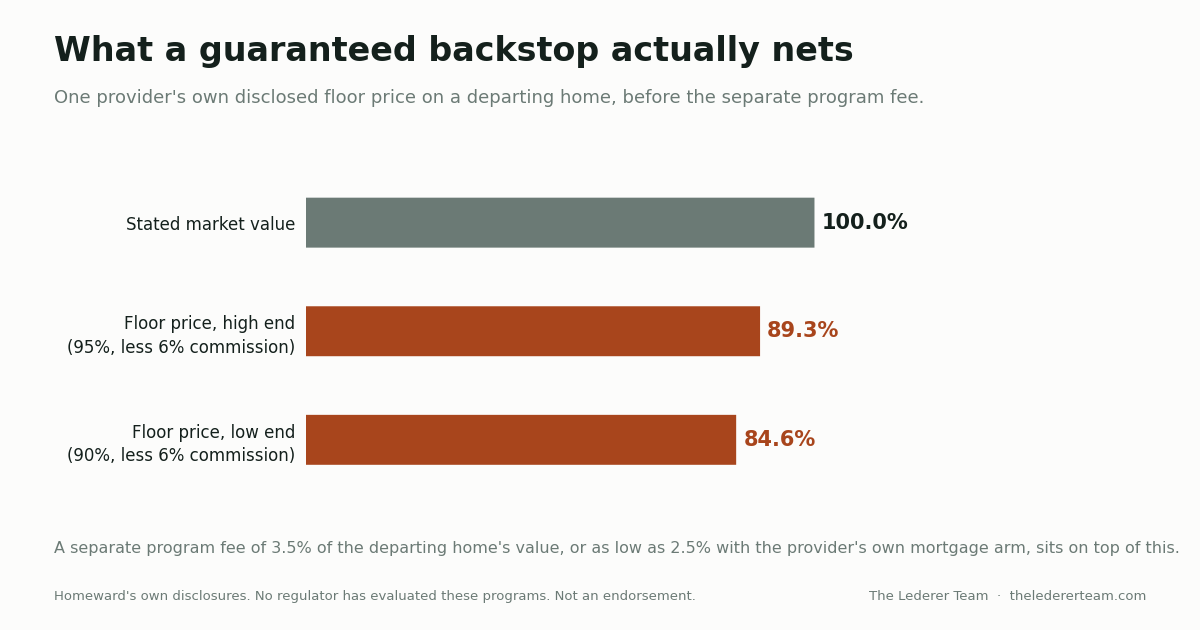
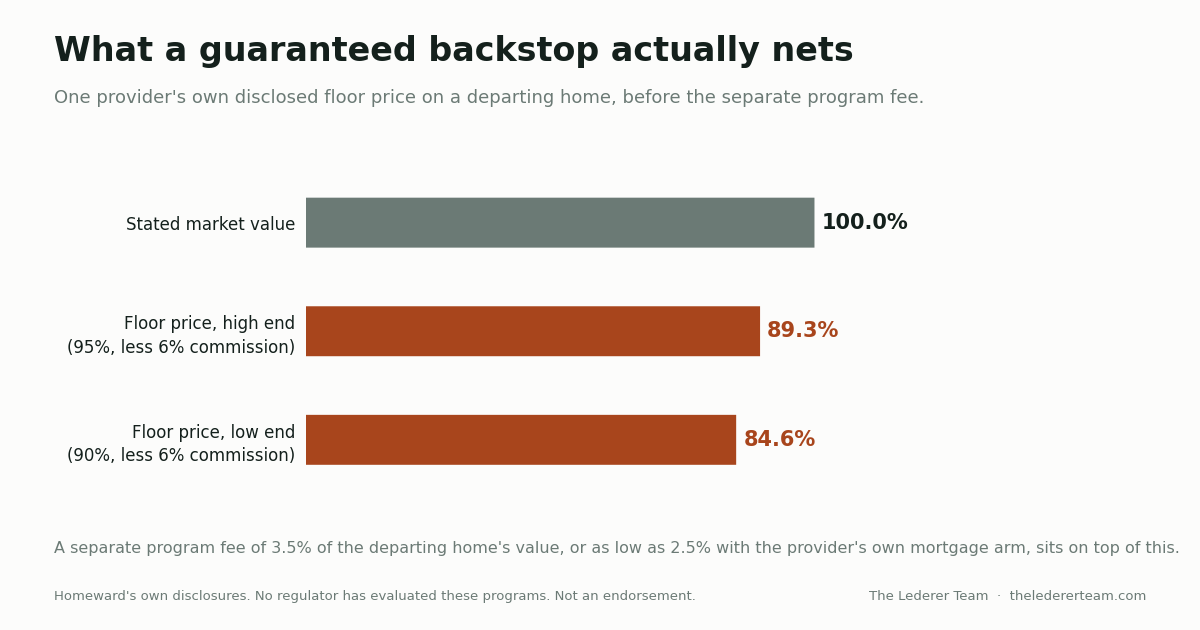
Homeward discloses a fee "starting at 3.5% of your current home's market value," reduced to "as low as 2.5%" if you use its own mortgage arm. It covers the first 90 days after the new home closes, extendable up to three more months at 1% per month. Its backstop purchase is at a floor the company describes as typically 90% to 95% of market value, minus 6% commission. And the point that decides it here: Homeward's program does not accept California departing homes. Its published list: Texas, Florida, Georgia, the Carolinas, Tennessee, Washington, Oregon, Arizona, Colorado and DC. An East Bay departing home is not eligible.
Knock structures its product as a bridge loan plus, on qualifying properties, a backstop it calls a Knock Purchase Offer, and discloses a contract fee based on the listing price. It did not publish a full fee schedule or say where it is available.
Four things hold across the category:
- The fee is charged on the departing home's value, on top of the commissions and closing costs you already owe.
- Extension fees accrue monthly once the covered window ends.
- A "guaranteed" offer is a below-market backstop, not market value. On Homeward's disclosed numbers, if the 6% commission comes out of a 90% floor, roughly 84.6% of stated market value reaches you; at a 95% floor, roughly 89.3%.
- You carry obligations on both homes during the overlap.
Bridge loans, and the two Fannie Mae rules that decide everything
A bridge or swing loan is temporary financing that reaches the equity in your departing residence before it sells. Fannie Mae's Selling Guide B3-4.3-14 sets two rules that decide whether it works.
First, the bridge loan cannot be secured by the new property. It is secured by the home you are leaving, so it must be repaid when that home sells. Second, the lender must "document the borrower's ability to successfully carry the payments for the new home, the current home, the bridge loan, and other obligations." You qualify carrying all of it at once, not on the assumption that the old house sells.
Fannie Mae sets no maximum term, and the risk follows from the structure: if the departing home sells slowly, or below what you modeled, the shortfall and every month of carrying cost land on you. There is also no benchmark to price it against — Freddie Mac's survey covers first mortgages, at 6.65% on the 30-year for the week ending August 20, 2026, not bridge financing. Get the rate, fees and payoff terms in writing, and confirm with your lender.
HELOCs, and the clause that can undo the plan
A HELOC, per the CFPB, is "a line of credit that allows you to borrow against your home equity." Its booklet states the risks plainly: the line is secured by your home, and "failure to repay the amounts you've borrowed, plus interest, could mean the loss of your home"; HELOCs "typically involve variable rather than fixed interest rates"; and at the end of the draw period "you may have to pay the entire balance owed, all at once… You must be prepared to make this 'balloon payment.'"
The clause that matters most, from the same booklet: "Plans generally permit lenders to freeze or reduce a credit line if the value of the home 'declines significantly' or when the lender 'reasonably believes' that you will be unable to make your payments due to a 'material change' in your financial circumstances." A down payment resting on an undrawn HELOC is a plan a third party can switch off. Open it early, confirm in writing with your lender that the line is available, and keep a backup. The equity decision underneath it is modeled in sell, rent out, or borrow.
The four routes side by side
Route | Documented cost | What the seller sees | Who carries the risk |
|---|---|---|---|
Cash-backed program | Fee on the departing home's value — Homeward discloses from 3.5%, or 2.5% with its mortgage arm, plus 1% monthly after 90 days, but does not accept California departing homes; Knock did not publish a fee schedule | No financing or sale contingency | You, if the home sells below the floor or extensions start |
Bridge loan | Interest and fees; no published benchmark | A non-contingent offer, if you qualify carrying it all | You — secured by the departing home |
HELOC | Variable rate; possible balloon at end of draw | Cash for the down payment, no sale contingency | You — the lender may freeze or reduce it |
Contingent offer | Nothing beyond normal costs | A contingency on your home selling | The seller, which is why it competes poorly |
The fourth route gets dismissed too quickly. A contingency on a house already prepared, priced and disclosure-ready is a shorter, more believable contingency than one on a house nobody has touched.
How we handle it
Our mortgage banking practice, 20-plus years in, includes a cohort of private investors who can back buyers so they can present all-cash offers. It is one option of the four, not a free one, and whether it fits depends on the file. Our mortgage advisors act as a fiduciary and work with our financial planning advisors, because this is a balance-sheet decision before it is a loan decision.
The team is nine: three real estate advisors and six dedicated specialists in finance, mortgage, insurance, estate planning and renovation, 60-plus years combined. Most buyers assemble that cast one referral at a time, and the pieces never talk. These consultations are complimentary. In 2025 the team's sales stats placed it in the top 1.5% of agents nationwide. How mortgage banking fits the rest, and the structure behind it, in banker, broker or bank. To model the overlap, start with a conversation.
Frequently asked questions
Can I make a cash offer if I need a mortgage?
Not literally, but you can present an offer with no financing or sale contingency using a bridge loan, a HELOC, or a third-party program that buys the home and sells it back to you. Each costs money and shifts risk to you. Ask what each does if your home sells slowly.
Are buy-before-you-sell programs available in California?
Homeward's program does not accept California departing homes — its published list covers Texas, Florida, Georgia, the Carolinas, Tennessee, Washington, Oregon, Arizona, Colorado and DC. Knock did not publish where it operates. No regulator or consumer organization has evaluated these programs, so what is known comes from the companies.
Does a bridge loan mean I skip qualifying for two mortgages?
No. Per Fannie Mae Selling Guide B3-4.3-14, the lender must document your ability to carry payments for the new home, the current home, the bridge loan and other obligations at once. The bridge cannot be secured by the new property, so it is repaid when the departing home sells.
Can my HELOC be reduced or frozen before I use it?
Yes. The CFPB's HELOC booklet states that plans "generally permit lenders to freeze or reduce a credit line if the value of the home 'declines significantly'" or when the lender "reasonably believes" you cannot pay after a "material change" in your finances. A plan resting on an undrawn line needs a backup.
How much does a cash-offer program cost?
Per Homeward's own disclosure, a fee starting at 3.5% of the current home's market value, or as low as 2.5% using its mortgage arm, covering 90 days after the new home closes and extendable three months at 1% monthly. It is charged on the departing home, on top of normal commissions.
Sources
- Fannie Mae Selling Guide B3-4.3-14, bridge loans — link
- CFPB, What You Should Know About HELOCs — link
- Homeward, buy before you sell, company disclosure — link
- Knock, company disclosure — link
- Freddie Mac Primary Mortgage Market Survey, August 20, 2026 — link
- Redfin city data and RE/MAX Accord inventory, June 2026
Mark Lederer leads The Lederer Team at Red Oak Realty, with 25-plus years and 1,000-plus closed transactions across Berkeley, El Cerrito, Oakland and Alameda. To price the overlap between the house you are buying and the one you are leaving, call 510-774-4231 or [email protected].