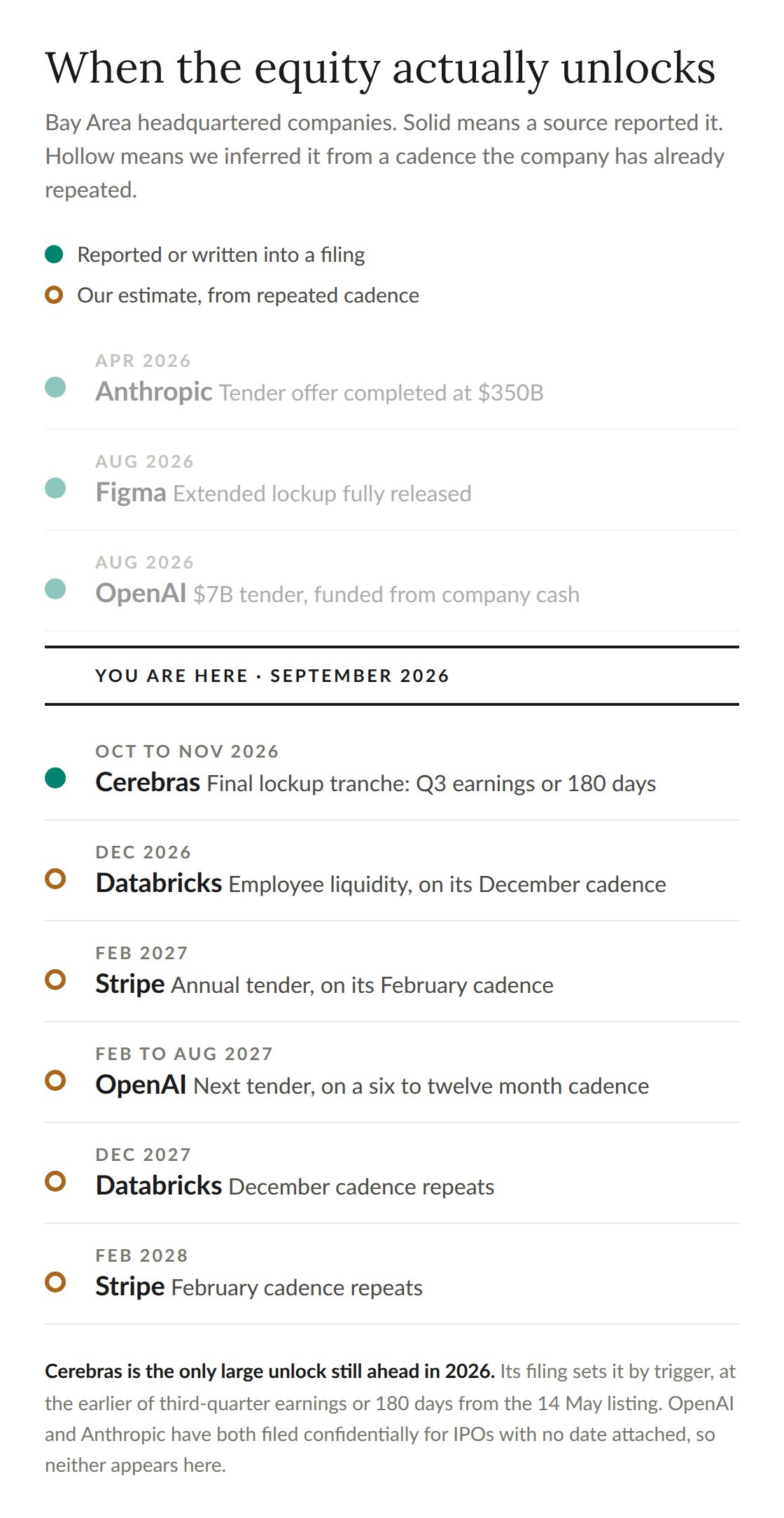
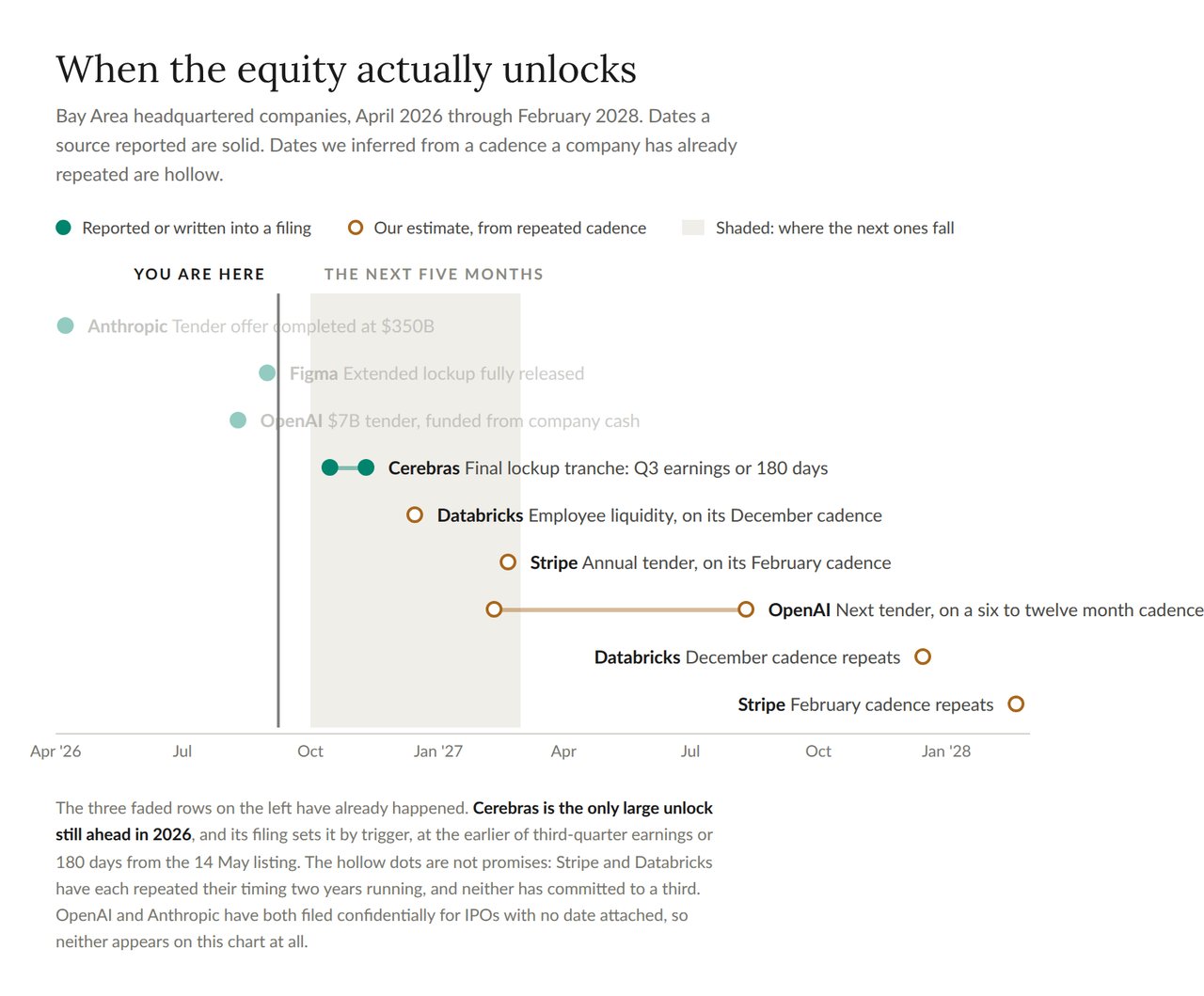
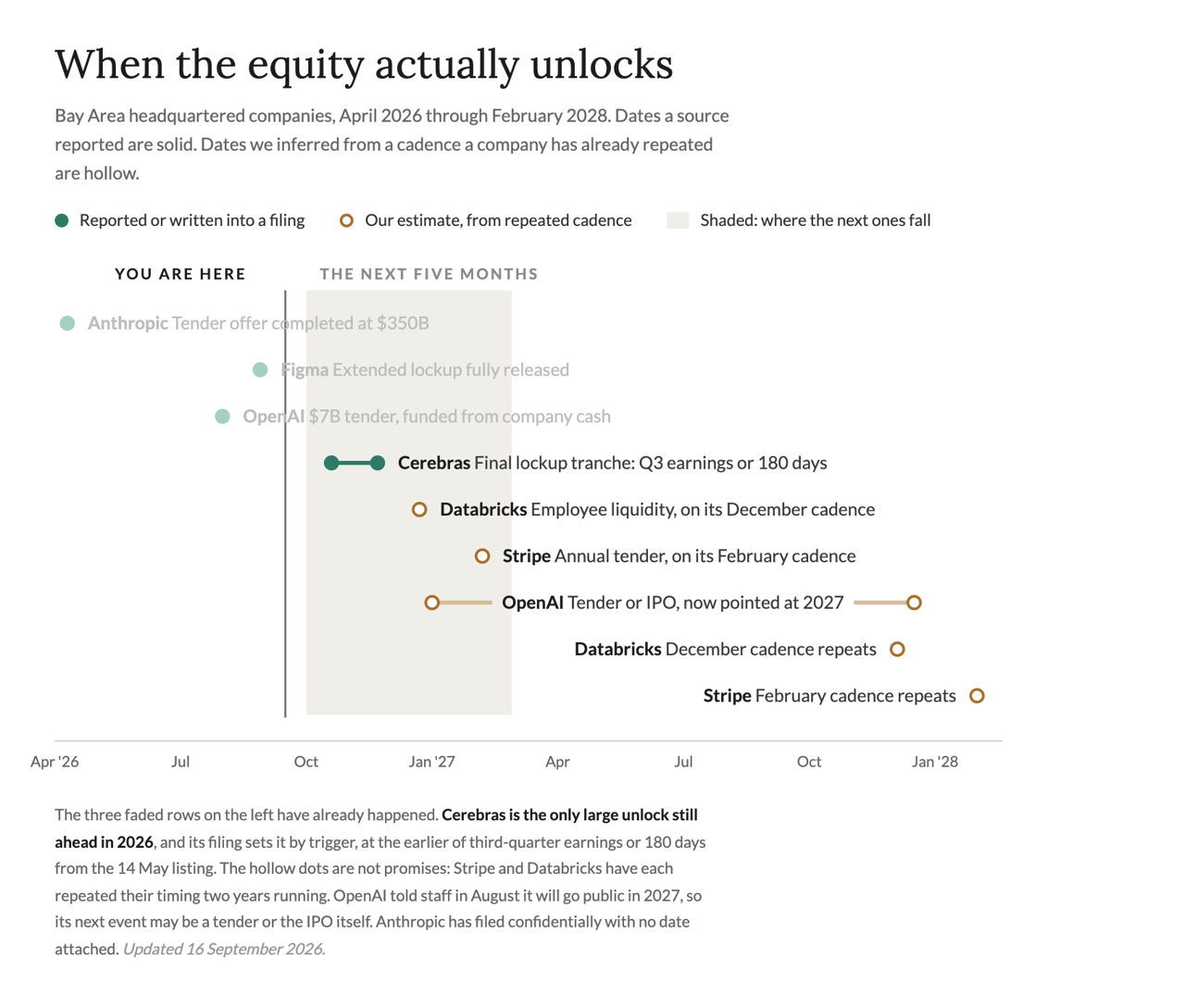
Short version: Everyone in this business talks about AI money hitting the housing market. Almost nobody checks the calendar it runs on. Equity does not become spendable when a company gets valuable. It becomes spendable on specific dates set by lockup agreements, tender offers and vesting schedules, most of which are published. We pulled those dates for the Bay Area companies that employ enough people here to matter. The next eighteen months hold one large IPO unlock, two private tender offers that happen on a reliable annual cycle, and two confidential IPO filings with no firm date attached. OpenAI had been expected to list this autumn; in August its chief financial officer pushed that to 2027. We are publishing the calendar. We are not going to tell you what it does to prices, because a year of sales data just taught us how easy that is to get wrong.

Why a calendar instead of a forecast
In August we argued that AI hiring in San Francisco would push housing demand out into the East Bay. We checked that against 100,076 closed sales and found the demand was real and the geography was wrong. It concentrated inside ten miles of downtown San Francisco instead of travelling out along BART.
That result changed how we work. The thing we can establish here is when equity converts to cash, because companies file it. The thing we cannot establish is where that cash goes, because nobody files that. So this piece does the first part properly and is honest about the second.
Three ways equity becomes money
They work differently and they matter on different dates.
A lockup follows an IPO. Employees and early investors agree not to sell for a set period, classically 180 days. That convention has been coming apart. Recent offerings use staged releases tied to earnings dates and share-price thresholds, so a single company now has four or five unlock dates. Cerebras let non-executive employees sell a slice on the first day of trading, and another slice on day two if the stock closed a third above the offer price (Evercore Wealth Management).
A tender offer is how private companies do it. The company, or an investor, buys shares back from employees at a set price. There is no public market involved and no lockup, and the terms are set by the company: who may sell, how much, and whether people who have left are included. OpenAI capped its October 2025 tender at $30 million per person, and about 75 employees hit that cap (Sherwood News). Rippling capped its 2024 offer at 25% of vested equity and barred former employees who had gone to eight named competitors (TechCrunch).
A double-trigger RSU is the instrument most private-company employees hold. It vests on two conditions: the normal four-year service schedule, and a liquidity event. Until both happen the employee owns nothing sellable and owes no tax. When both happen, several years of vesting land at once (Carta). That is the mechanism behind the idea of money arriving in a lump. It is real. It is also the reason the tax bill arrives in a lump. For OpenAI staff, that lump now waits on a 2027 listing and a lockup after it. A mid-2027 IPO with a conventional 180-day lockup puts most of that cash in late 2027 or early 2028.
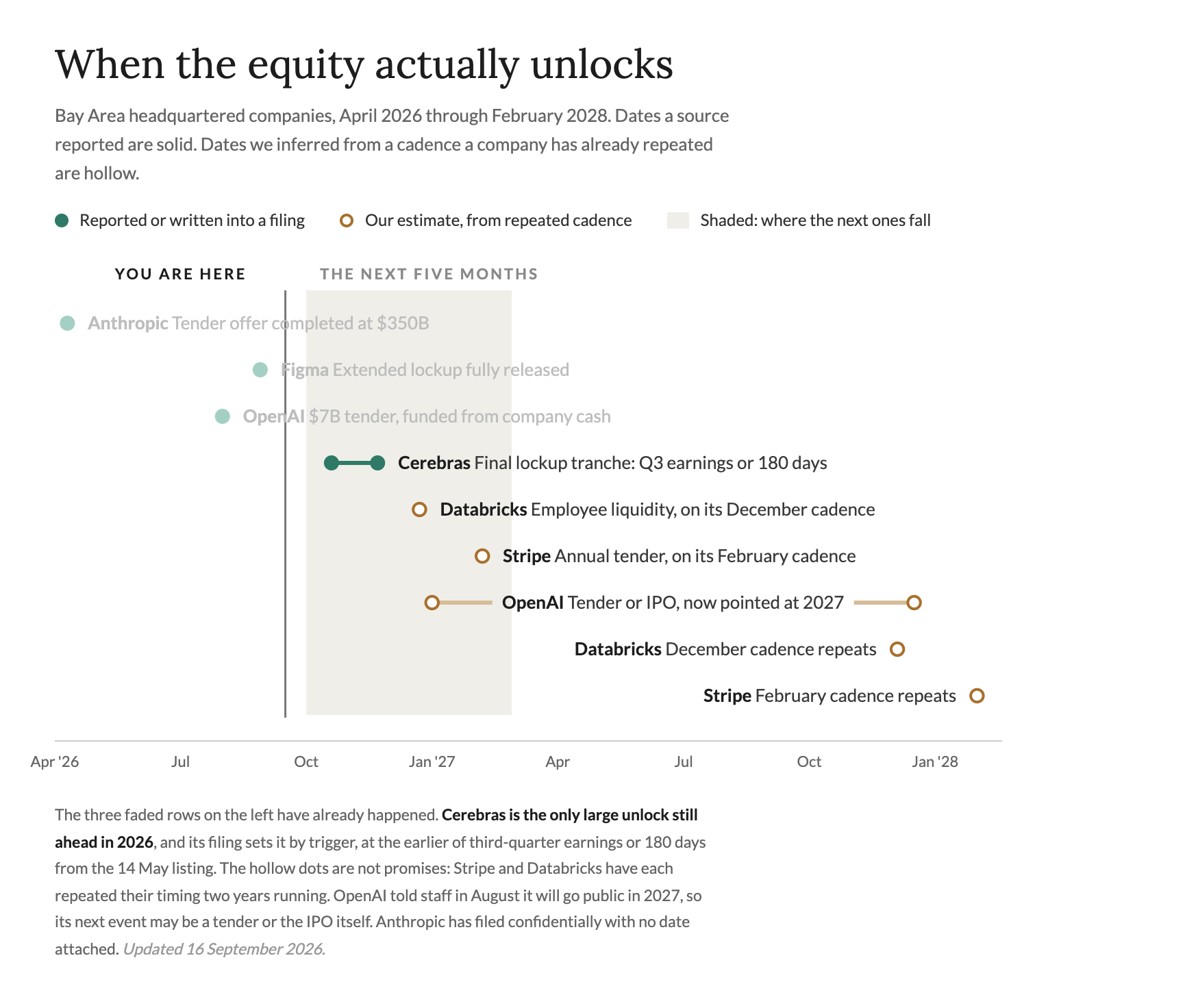
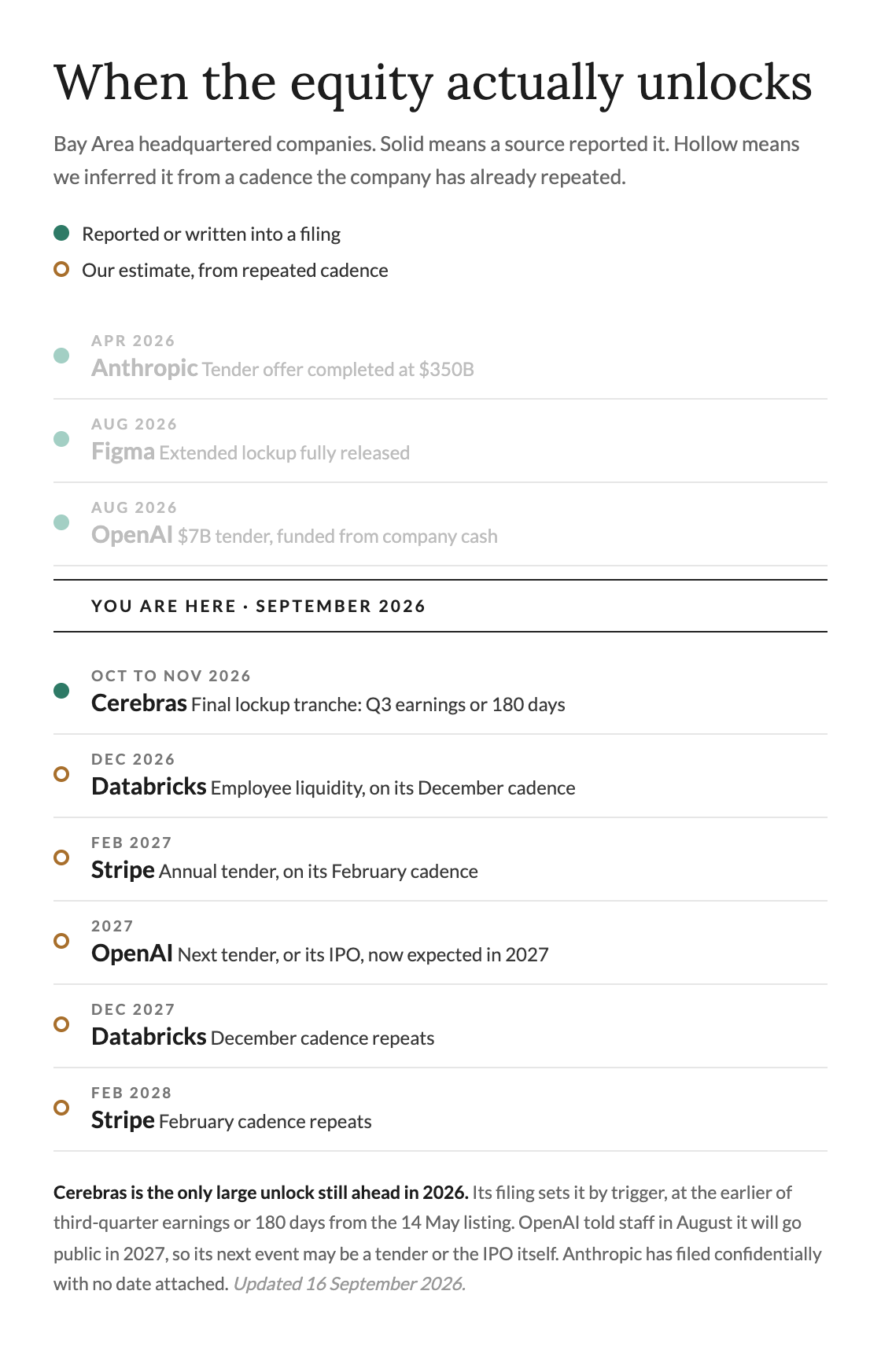
The calendar
Bay Area headquartered companies only. A company whose staff live in Los Angeles does not move a house in Rockridge, whatever its market capitalisation.
The two that actually matter
Cerebras is the single largest unlock in the window. It listed on 14 May 2026 at $185 a share, priced $25 above its range, at a fully diluted valuation of $56.4 billion, and raised $5.55 billion (TechCrunch). It closed at $210.05 on 4 September, above the offer price, which matters: an unlock only produces sellers if the stock is worth selling. It is headquartered in Sunnyvale, which points at the Peninsula and the South Bay.
The private tenders are the more reliable source. A lockup happens once. Stripe has run an employee tender in February two years running, at a $91.5 billion valuation in 2025 and $159 billion in 2026 (Stripe). Databricks has folded employee liquidity into a December funding round two years running (Databricks). Its chief executive has said publicly that he is using tender offers as a substitute for going public. OpenAI has now run four tenders in three years, the most recent in August 2026 at $7 billion, funded from its own cash, with no new investors involved.
OpenAI had been widely expected to go public this autumn after filing confidentially with the SEC in June. On 19 August its chief financial officer told staff it will be a public company in 2027, possibly sooner (CNBC). That moves its largest liquidity event out of this window, and it makes another tender less certain: companies close to listing often stop running them and let the IPO do the work.
For a listing agent that pattern is more useful than any IPO rumour. A recurring February and December cycle is something you can plan a spring launch around. An IPO with no date is not.
How much of it is spendable
Less than the headline, and the gap is bigger than most people expect.
Equity proceeds are supplemental wages. Employers withhold a flat 22% federally on the first million dollars in a calendar year and a mandatory 37% on everything above that (IRS Publication 15). California adds a flat 10.23% on bonuses and stock (EDD DE 231PS). For someone whose actual marginal rate lands above the blended withholding, and at these numbers it usually does, the shortfall shows up as a payment due the following April.
What that means in practice: a buyer who unlocked in October has a real number in November and a smaller one after they have set aside what they owe in April. We have watched more than one pre-approval get rebuilt in February when the tax picture came into focus. It is worth doing that arithmetic before writing an offer, not after.
What we do not know
Three things, and we would rather say so than write around them.
We do not know how many people are involved. Companies disclose global headcount, not how many employees live in Alameda County. Not one of the nine recent Bay Area IPOs breaks that out, and we are not going to substitute an estimate from a data vendor for a number that does not exist.
We do not know that unlocked equity gets sold. When Anthropic completed a tender offer in April 2026 at a $350 billion valuation, it came in short of roughly $6 billion of investor demand, because employees held their shares back rather than selling into it (Bloomberg). Employees at a company they think is going higher behave like investors. That single fact undercuts most of what gets written about tech wealth and housing, including some of what we wrote in August.
We do not know where it lands. We ran the correlation between a city's distance from downtown San Francisco and its price change across 102 cities. It came out at −0.10, which is close to nothing. The ring pattern is strong in aggregate and weak city by city. Knowing that money exists somewhere in San Francisco tells you very little about any particular house in Berkeley.
So what do we do with it
We treat it as a hypothesis with a test date attached. The unlock dates above are known. Our quarterly price map refreshes with every closed sale in nine counties. If the Cerebras unlock in late autumn moves anything, it will show up in Sunnyvale, Mountain View and the Peninsula cities in the January or April refresh, and we will report what we find whichever way it goes. That is the same standard we held our August forecast to.
If it does not show up, that is also worth publishing. A market story that survives contact with the sales record is worth something. One that does not survive should be retired.
What this means if you are selling
If you own on the Peninsula or in the South Bay, there is a plausible bid arriving in your market this autumn and winter, and it is concentrated among people who work at one company in Sunnyvale. That is a reason to be precise about who your buyer is, and to have your house ready in that window, which means booking the painter around it.
If you own in the East Bay, the honest answer is that the last twelve months gave the inner ring the gains and gave the outer ring nothing, and none of the dates above obviously changes that. Price to what your own city did. Look it up. The regional number will not tell you.
What this means if you are buying
There are two kinds of buyer in this market right now: the ones holding equity, and the ones bidding against them. We work with both, and the answer for each starts in the same place, which is a plan.
If you are competing against equity money
Know who you are bidding against, and when. On the Peninsula and in the South Bay, the Cerebras unlock puts newly liquid buyers into the market this autumn and winter, and many of them can write with a large down payment or no loan contingency at all. In the East Bay, nothing on this calendar obviously adds competition in the next six months, so price your offer to what your target city actually did, not to headlines about tech money. The February tenders are the ones to watch. Stripe’s has landed at the start of the spring market two years running. We cannot tell you where that money buys, but a buyer who is ready in January faces fewer freshly liquid competitors than one who waits for April.
You can compete with equity money without having it. A cash-rich buyer wins on certainty and speed as much as on price, and most of that can be matched with preparation: a fully underwritten loan approval instead of a pre-qualification letter, disclosures and inspection reports read before the offer goes in so contingencies can be short, or waived with your eyes open, a close date that suits the seller, and a price set from the comparable sales rather than the list price. The highest number does not always win. Sellers weigh how likely an offer is to close, and we have written about how we weigh them for our sellers.
The part most buyers skip is knowing their own ceiling. A buyer who has run their numbers with a planner knows exactly how far they can go without damaging the next thirty years, and writes that offer once, cleanly. A buyer who has not either stops short out of nerves or overreaches in the moment. Our buyers write about one and a half offers per purchase on average, and that is most of the reason.
If you are buying with RSUs
Selling equity to buy a house is a trade, not a windfall. The moment you sell shares for a down payment, you give something up: whatever that stock does next. If it doubles, the house cost more than the price on the contract. If it falls, you got out at the right time. Nobody knows which, so the useful question is not whether to sell, but how much, and what you are exchanging it for.
Look at it over thirty years, not thirty days. A down payment is a single decision with a thirty-year tail. The mortgage, property tax, insurance and upkeep run for decades. So does the compounding you give up on the shares you sold, and the retirement savings, college funding and cash reserves that have to coexist with the house payment. Run the plan with the house and without it, selling a little equity and selling a lot, and the right answer is usually obvious. Run it only on the week you write the offer, and it rarely is.
Be clear about what you are diversifying, and what you are not. If your salary, your bonus and most of your savings all depend on one employer’s share price, selling some of that stock to buy a home genuinely reduces your concentration in that one company. But a house is not a diversified asset either. It is one illiquid property, in one region, whose economy leans on the same industry that pays you. Buying can lower one risk while adding another, and it is worth knowing the size of each before you sign.
Plan the cash before you tour. A tender expected in February is a pattern, not a promise: Anthropic’s went ahead and employees still held, and OpenAI’s IPO slipped a year this summer. Double-trigger RSUs count for nothing toward a down payment until a liquidity event has a date. Proceeds arrive with tax withheld at rates that often fall short of what is owed in April. And lenders generally want the money in your account, or a documented history, before they count it.
How we help you make a grounded decision
A home purchase is usually the largest financial decision a household makes, and in this market it tends to get made under pressure: a deadline on offers, a bidding war, a tender date, a number someone heard at work. Our job is to take the pressure out of the decision before it reaches the offer table. That means knowing what you can comfortably afford, not just what a lender will approve; knowing what the purchase does to the rest of your financial life; and knowing, before you fall for a house, the price at which you would walk away. Clients who start there tend to buy faster, write fewer offers, and feel good about the decision years later, because it was made on their numbers rather than on the market’s mood.
These are the questions our financial planning is built to answer, and they are the questions we specialize in. Our team includes a Series 65 advisor who is also an Enrolled Agent with the IRS, so the tax side of the decision is part of the same conversation. With him, you can see what using your RSUs actually costs you, model your plan over thirty years with and without the purchase, see what the sale means at tax time, and understand how buying changes your concentration and diversification. If you are not holding equity, the same planning tells you exactly what you can afford to bid, so you can compete with confidence instead of guessing. We also offer mortgage banking as a separate service, which you are free to use or not.
It is complimentary for our clients, and we accept no referral fees from any partner. Whether you hold equity or are competing against people who do, call us at 510-774-4231 before you start touring.
Frequently asked questions
Does an IPO lockup expiring mean everyone sells? No. It means they may. Whether they do depends mostly on where the stock is trading against the price they expect, which is why a company trading below its offer price often produces a quiet unlock and a company trading above it produces a busy one.
Why do private companies run tender offers at all? To keep employees without going public. Staff with vested equity and no way to sell it eventually leave. A tender releases pressure and lets the company stay private, which is what Databricks has said it is doing deliberately.
Are these dates certain? The ones marked done are certain. The recurring tenders are patterns, not commitments, and no company has promised to repeat them. The Cerebras unlock is defined by a trigger in its filing, so it moves if its earnings date moves. IPO dates move too: OpenAI’s slipped from 2026 to 2027 this summer.
Is this financial advice? No. Nothing here is a recommendation to buy, sell or hold any security. Personal financial planning is provided one on one, by our Series 65 advisor, around your actual numbers. On the tax questions above, our Enrolled Agent can walk through your situation with you, or alongside your own accountant.
Sources
Cerebras IPO terms: company release, TechCrunch, 424B4. Lockup conventions: Evercore Wealth Management. Figma extended lockup: SEC 8-K. Ethos early release: company release. OpenAI tenders: Fortune, CNBC, TechCrunch. OpenAI IPO timing: CNBC. Anthropic tender and IPO filing: Bloomberg, TechCrunch. Stripe: company release. Databricks: company release. Rippling: TechCrunch. Withholding: IRS Publication 15, California EDD. RSU mechanics: Carta.
Analysis by The Lederer Team at Red Oak Realty. Housing figures from Bay Area MLS closed sales, August 2025 through July 2026 against the twelve months prior. Company dates from the sources listed above. Not an appraisal and not investment advice. For a read on a specific home, ask us or call 510-774-4231.