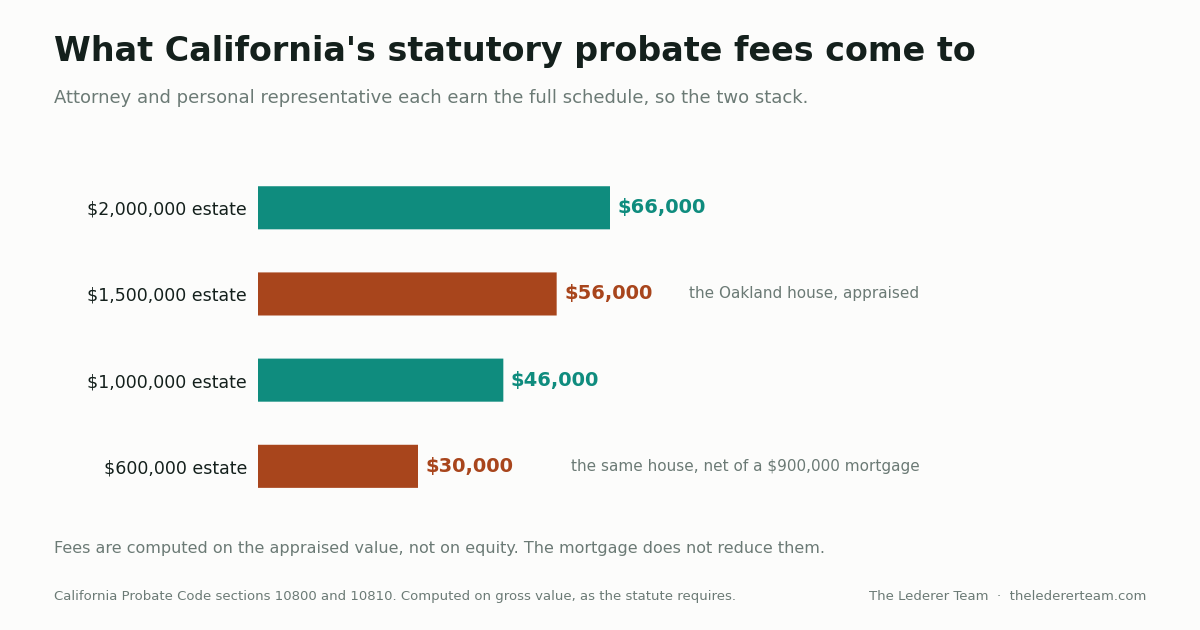
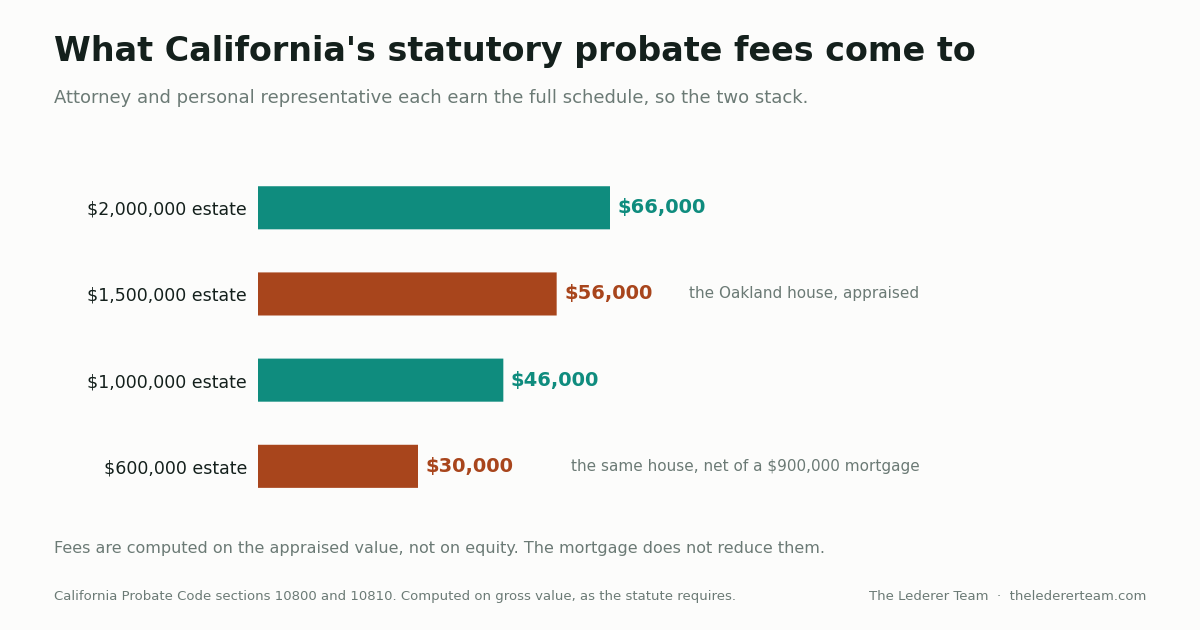
Short answer: California's statutory probate fees are calculated on the gross value of the estate, and mortgages are ignored. An Oakland house appraised at $1.5 million with a $900,000 loan generates fees on $1.5 million, not on the $600,000 of equity — $28,000 to the attorney and $28,000 to the executor, $56,000 combined, under Probate Code §§ 10800 and 10810.
I am a licensed real estate professional, not an attorney, and nothing here is legal advice. These are general rules that turn on facts I cannot see from a blog post, so take your situation to your own estate planning attorney.
How California calculates probate compensation
Two statutes matter. Probate Code § 10810 sets the attorney's compensation for ordinary services; § 10800 sets the personal representative's. The tiers are identical, and each party is entitled to the full schedule. They stack.
Portion of estate value | Rate | Fee on that portion |
|---|---|---|
First $100,000 | 4% | $4,000 |
Next $100,000 | 3% | $3,000 |
Next $800,000 | 2% | $16,000 |
Next $9,000,000 | 1% | up to $90,000 |
Next $15,000,000 | 0.5% | up to $75,000 |
Above $25,000,000 | Reasonable amount set by the court | — |
The schedule runs once for the attorney and once for the representative, and it covers ordinary services only. Extraordinary services — litigation, tax work, some property sales — are compensated on top, under §§ 10801 and 10811.
Worth knowing: statutory compensation is an entitlement, not a mandatory charge. A personal representative may waive it, and family serving as executor commonly do.
The part that catches East Bay families: the fee base is gross
Both sections define the value "without reference to encumbrances or other obligations on estate property." The mortgage is invisible to the calculation. You are charged on the appraised value of the house, not on what the family inherits.
Work the Oakland example through. A house appraised at $1.5 million with a $900,000 loan leaves $600,000 of equity:
Value the fee is computed on | Attorney | Executor | Combined |
|---|---|---|---|
$600,000 — the actual equity | $15,000 | $15,000 | $30,000 |
$1,000,000 | $23,000 | $23,000 | $46,000 |
$1,500,000 — the gross appraised value, which is what the statute uses | $28,000 | $28,000 | $56,000 |
$2,000,000 | $33,000 | $33,000 | $66,000 |
The gap is $26,000 on the same house — the row the family expects against the row the statute applies. And gross values are routinely large here: per Redfin, the median sale price for the three months ending June 2026 was $898,511 in Oakland and $1,509,179 in Berkeley. A long-held house with a late-life refinance against it can hold little equity and still sit in a high tier.
When an estate may avoid full probate
California has simplified procedures for smaller estates, and the thresholds changed materially in 2025. The critical mechanic: the limits key to the date of death, not the date you file. A March 2025 death and a May 2025 death are governed by different numbers.
Procedure | Death Apr 1, 2022 – Mar 31, 2025 | Death on/after Apr 1, 2025 |
|---|---|---|
§§ 13100–13101 small estate affidavit (personal property) | $184,500 | $208,850 |
§§ 13151–13154 court petition, primary residence | $184,500 | $750,000 |
§ 13200 affidavit, other real property of small value | $61,500 | $69,625 |
Two corrections to what you will read elsewhere. First, $184,500 is still widely quoted as the current affidavit limit; it is not — the figure is $208,850. Second, AB 2016 did not just raise the real property ceiling to $750,000, it narrowed the procedure: the § 13151 petition once covered real property generally and now reaches only the decedent's primary residence, on renamed form DE-310. A parent's Richmond rental no longer fits through that door at any value.
The $750,000 is fixed, not indexed. Amounts adjust every three years under Probate Code § 890; the last was April 1, 2025 and the next is April 1, 2028. There is no 2026 adjustment.
The trust that did not hold the house
Per the California Courts Self-Help materials, when you die, as long as you have put your assets into the trust, they should go to the beneficiaries without going to probate court. The operative clause is "as long as you have put your assets into the trust."
This is the most common failure I see. A couple signs a trust, the attorney prepares a deed, and between signing and recording the house never actually moves. Or it moves, a later refinance takes it back out, and nobody puts it back. If the property was never transferred in, it is not trust property at death, and the trust does not do the job the family assumed it did.
There is a remedy: a petition under Probate Code § 850, commonly called a Heggstad petition after Estate of Heggstad (1993) 16 Cal.App.4th 943. A § 850 petition is still a court proceeding — generally faster and cheaper than probate, but not "no court," and it turns on the specific facts. It is not a backstop for a deed you could go record correctly this month.
California also permits a revocable transfer on death deed, Probate Code § 5600 et seq., for transferors dying on or after January 1, 2016. SB 315 (2021) extended the sunset: § 5600(c) keeps the part in effect only until January 1, 2032. I am deliberately not explaining how to execute one — the formalities are exacting, and getting them wrong defeats the instrument.
How long, honestly
You will find confident duration estimates all over the internet. I will not repeat one: no California court or state source publishes a typical probate duration, and the Judicial Council's time-to-disposition standards do not cover probate. What can be stated are the floors:
- The creditor claim period runs the later of four months after letters issue or 60 days after notice to that creditor — Probate Code § 9100.
- The representative must petition for final distribution or report status within one year after letters issue, or 18 months if a federal estate tax return is required — Probate Code § 12200.
Those are floors, not an estimate of your case. They do tell you the shape of it: this does not conclude in weeks, and a house held inside it carries taxes, insurance and maintenance the whole time.
One piece of good news. Under IRC § 1014, current law as of 2026, the basis of property acquired from a decedent is its fair market value at the date of death. The One Big Beautiful Bill Act of July 2025 set a $15 million per-person federal gift, estate and generation-skipping exemption effective January 1, 2026, and did not change § 1014. Property tax is separate — see Prop 19 and inherited East Bay property. Confirm both with your CPA and attorney.
Where our team fits
The Lederer Team is nine people: three real estate advisors and six dedicated specialists in finance, mortgage, insurance, estate planning and renovation. Most families assemble that cast one referral at a time and the pieces never talk to each other. Our estate planning offering includes a complimentary half-hour consultation with the team's trust attorney — a service description, not legal advice, and no replacement for your own attorney.
If the house has to be sold, our renovation team works regularly on probate, conservatorship, trust and estate sales, where the property has not been updated in decades. What that costs is broken down in what it costs to sell a house in Oakland in 2026. To talk one through, get in touch.
Frequently asked questions
How much does probate cost in California?
Statutory compensation is 4% of the first $100,000, 3% of the next $100,000, 2% of the next $800,000, and 1% of the next $9,000,000, 0.5% of the next $15,000,000, and above $25,000,000 a reasonable amount set by the court. The attorney and the personal representative are each entitled to that schedule, so a $1,000,000 estate generates $23,000 each, $46,000 combined, plus any extraordinary services.
Does my mortgage reduce California probate fees?
No. Probate Code §§ 10800 and 10810 compute the fee base "without reference to encumbrances or other obligations on estate property." A $1.5 million Oakland house with a $900,000 loan produces fees on $1.5 million — $56,000 combined — not on the $600,000 of equity, which would produce $30,000.
What is the small estate limit in California right now?
For deaths on or after April 1, 2025, the §§ 13100–13101 affidavit limit is $208,850 and the § 13151 petition for the decedent's primary residence reaches $750,000. The widely quoted $184,500 applies to deaths between April 1, 2022 and March 31, 2025. The limits key to the date of death, not the filing date.
What happens if a house was never put into the trust?
It is not trust property at death, and the trust will not keep it out of court. The usual remedy is a Probate Code § 850 petition, called a Heggstad petition — still a court proceeding, generally faster and cheaper than probate but not "no court," and it turns on the specific facts. Ask your attorney.
Do heirs pay capital gains tax on an inherited East Bay home?
Under IRC § 1014, the basis of property acquired from a decedent is its fair market value at the date of death, so gain is measured from that rather than what the decedent paid. That is income tax basis only; Proposition 19 property tax reassessment is a separate question. Confirm both with your CPA and attorney.
Sources
- California Probate Code § 10800, statutory compensation — link
- Judicial Council of California, Probate Code § 890 adjusted amounts, April 1, 2025 — link
- California Courts Self-Help, simplified transfers and living trusts — link
- Redfin, East Bay city data, three months ending June 2026 — link
Mark Lederer leads The Lederer Team at Red Oak Realty — 25-plus years and 1,000-plus closed East Bay transactions, with a dedicated estate planning specialist among the team's six. If you are handling an inherited, trust-held or probate property, call 510-774-4231 or email [email protected]. I am not an attorney; take legal questions to your own.