Short answer: Proposition 19 does not fully protect an inherited East Bay home. The parent-to-child exclusion shields the factored base year value plus $1,044,586 for transfers February 16, 2025 through February 15, 2027; value above that limit is added to the assessment. It applies only to a parent's principal residence the child moves into within one year — a rental is reassessed in full.
I am a licensed real estate professional, not an attorney and not a CPA. This is how the rules are written, not advice about your family. Outcomes turn on deed language, dates, residency and assessor practice, so take your facts to your own estate planning attorney and CPA.
What changed, and when
Prop 19's parent-child rules took effect February 16, 2021, its base year value transfer rules on April 1, 2021. Much of what families believe about inheriting describes the system that ended.
Under Prop 58 (before Feb 16, 2021) | Under Prop 19 (now) | |
|---|---|---|
Parent's principal residence | Excluded, no value cap | Excluded only up to base year value + $1,044,586 |
Child must live there? | No | Yes — child's principal residence within one year |
Rentals, vacation homes, commercial | Up to $1,000,000 of assessed value excluded | No exclusion. Fully reassessed to market |
Does the exclusion last? | Indefinitely | No — reassessed when the child stops living there |
Prior-law column per the State Board of Equalization's comparison of Proposition 58 and Proposition 19.
The value limit, worked through on a real East Bay number
The exclusion amount is $1,044,586 for transfers February 16, 2025 through February 15, 2027. It adjusts every other year, next on February 16, 2027; the prior figure was $1,022,600.
One detail worth stating, because readers assume otherwise: the adjustment is indexed to the FHFA House Price Index for California, not CPI. It tracks house prices, which is why it moved more than a cost-of-living adjustment would.
The mechanic is not a cliff. The value limit is the factored base year value plus $1,044,586. At or below it, no reassessment. Above it, only the excess over the limit is added to the base year value — the property is not reassessed to full market.
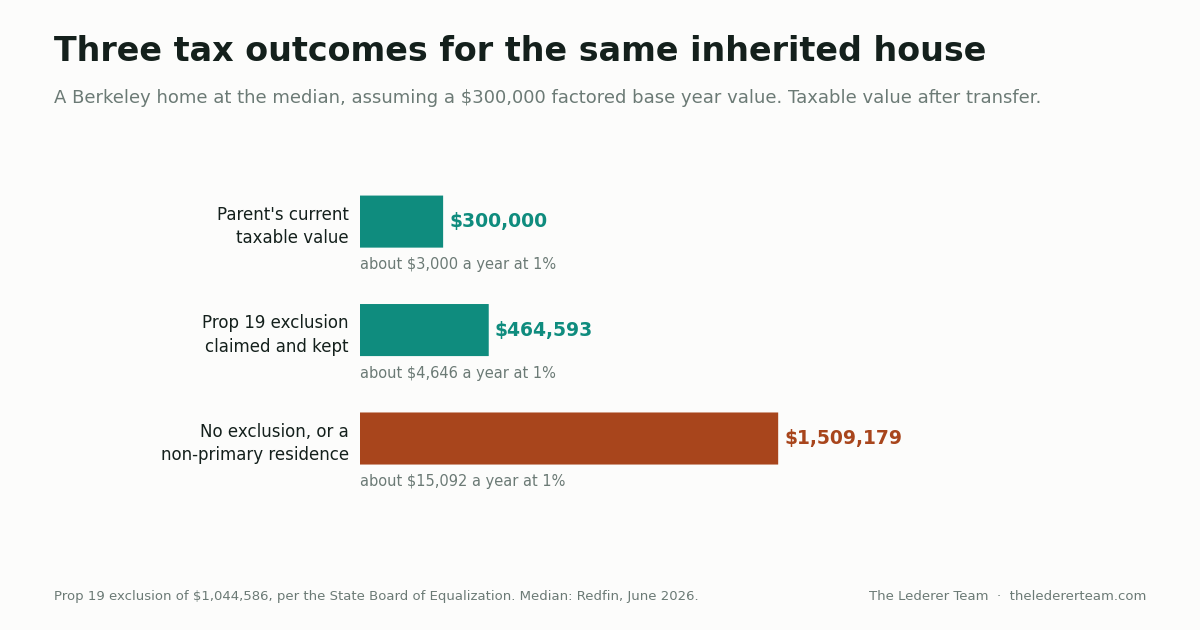
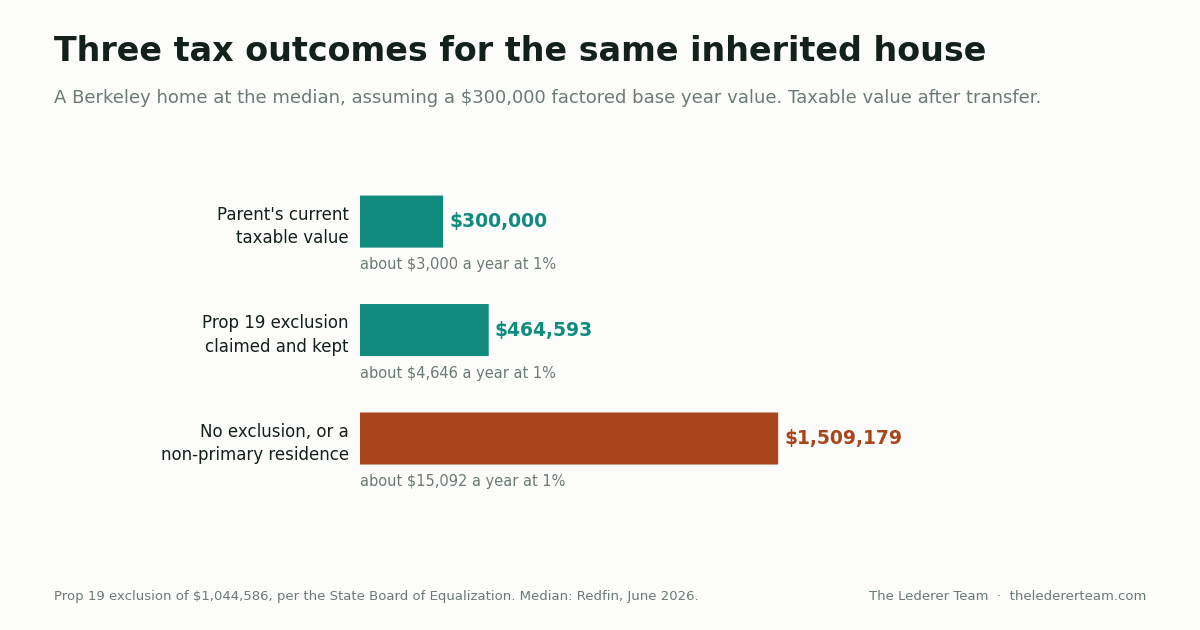
Take a Berkeley house. Per Redfin, Berkeley's median sale price was $1,509,179 for the three months ending June 2026, so call that the transfer value. Assume a factored base year value of $300,000 — illustrative; yours is on the assessment record.
Step | Amount |
|---|---|
Factored base year value | $300,000 |
Fair market value at transfer | $1,509,179 |
Value limit ($300,000 + $1,044,586) | $1,344,586 |
Excess over the limit | $164,593 |
New taxable value ($300,000 + $164,593) | $464,593 |
At Proposition 13's maximum ad valorem rate of 1% of full cash value, that is roughly $4,646 a year against roughly $15,092 on a full reassessment — a difference near $10,400 annually, before voter-approved bonded indebtedness and direct assessments, which commonly push East Bay bills above 1%.
Two things follow. The exclusion is valuable but partial — the child inherits a discounted version of the parent's bill, not the bill itself. And it is not permanent: when the child stops living there, the property is reassessed.
Two deadlines, and the short one is the trap
The exclusion claim is form BOE-19-P, filed with the county assessor within three years of the transfer or before the property goes to a third party, whichever is first. That is the deadline everybody cites.
But Revenue and Taxation Code § 63.2 requires three things, not one:
- The property was the eligible transferor's principal residence and qualified for the homeowners' or disabled veterans' exemption.
- It becomes the transferee's principal residence within one year of the transfer.
- The transferee files for the homeowners' or disabled veterans' exemption within one year of the transfer.
The third item gets missed, and it is why most coverage is only half right. The one-year exemption filing is a condition of the exclusion itself, not separate housekeeping. A family that reads only about the three-year deadline and files the BOE-19-P at month thirty can still have a problem. Put the one-year date on the calendar first.
The rental duplex: the change East Bay families do not see coming
Under Proposition 58, a parent could transfer up to $1,000,000 of assessed value in rentals, vacation homes or commercial property to children without reassessment. Prop 19 eliminated that exclusion entirely.
There is no cap and no partial shelter: a parent's Oakland duplex or Richmond rental transferred to a child is fully reassessed to market value, regardless of amount. Redfin put Oakland's median sale price at $898,511 and Richmond's at $649,646 for the three months ending June 2026. A long-held rental can go from a very low assessment to full market in one transfer, and the new bill arrives against rent underwritten on the old one.
This is the least understood part of Prop 19 for East Bay families, and it is why "we will just leave the units to the kids" deserves a conversation with an attorney and a CPA. If the property might be sold instead, the trade-offs are in sell, rent out, or borrow against it.
Moving your own base year value, and the wildfire exception
Prop 19's other half runs the opposite direction: it lets certain homeowners take a low assessment with them. Under Cal. Const. art. XIII A § 2.1 and R&TC § 69.6, base year value transfers are open to homeowners 55 or older, severely and permanently disabled, or victims of wildfire or a Governor-declared natural disaster, and the replacement can be anywhere in California, replacing the old same-county limit.
The replacement must be bought or newly built within two years of the original's sale, in either order. The equal-or-lesser-value thresholds are 100% of the original's fair market value if you buy before the sale, 105% in the first year after, 110% in the second. Buying above the threshold does not forfeit the transfer — the excess is added to the transferred base year value. BOE's example: original value $400,000, base year value $100,000, replacement bought in year one for $600,000, threshold $420,000, excess $180,000, taxable value $280,000.
Now the part to be careful about. BOE's comparison chart says the transfer may be used "three times" without qualification, and the statute does not read that way. R&TC § 69.6 applies the three-transfer cap to claimants over 55 or severely and permanently disabled, and provides that "This limitation shall not apply to claimants who are victims of wildfire or natural disaster." The statute controls. Given the fire-hazard geography through the Berkeley Hills, Oakland Hills, Kensington and Lamorinda — see the Zone 0 rules — that is not academic. Verify your count with the assessor.
Where our team fits
The Lederer Team is nine people — three real estate advisors and six dedicated specialists in finance, mortgage, insurance, estate planning and renovation. Most families assemble that cast one referral at a time and the pieces never talk to each other; here they are already in the room. Our estate planning offering includes a complimentary half-hour consultation with the team's trust attorney — a service description, not legal advice, and no substitute for your own.
The companion piece on what probate costs, and why the fee schedule ignores your mortgage, is here. To weigh what to do with an inherited property, get in touch.
Frequently asked questions
How much can I inherit under Prop 19 without reassessment?
The limit is the factored base year value plus $1,044,586, for transfers February 16, 2025 through February 15, 2027. Below that, no reassessment. Above it, only the excess over the limit is added to the base year value — the home is not reassessed to full market. The figure adjusts again on February 16, 2027.
Do I have to live in an inherited house to keep the low property taxes?
Yes. The exclusion requires the property to have been the parent's principal residence and to become the child's within one year of transfer. It is not permanent either: at least one eligible transferee must continually live there, and when the child moves out it is reassessed to market.
What is the deadline to file for the Prop 19 parent-child exclusion?
There are two. Form BOE-19-P goes to the county assessor within three years of the transfer or before the property goes to a third party, whichever is first. Separately, the homeowners' or disabled veterans' exemption must be filed within one year, and that filing is a condition of the exclusion itself.
Can I inherit my parents' rental property without reassessment?
No. Prop 19 eliminated the exclusion for property other than a principal residence. Under Prop 58 a parent could pass up to $1,000,000 of assessed value in rentals or commercial property; that is gone. An Oakland duplex or Richmond rental is now fully reassessed to market value regardless of amount.
How many times can I transfer my base year value under Prop 19?
R&TC § 69.6 caps it at three for claimants over 55 or severely and permanently disabled, and states that limitation does not apply to victims of wildfire or natural disaster. BOE's chart says "three times" without that qualification; the statute controls. Confirm your count with your county assessor.
Sources
- California State Board of Equalization, Proposition 19 exclusion amount, February 16, 2025 – February 15, 2027 — link
- California State Board of Equalization, Proposition 19 comparison of prior law and current law — link
- Redfin, East Bay city data, three months ending June 2026 — link
Mark Lederer leads The Lederer Team at Red Oak Realty — 25-plus years and 1,000-plus closed East Bay transactions, with a dedicated estate planning specialist among the team's six. If you have inherited East Bay property or are planning how to pass one on, call 510-774-4231 or email [email protected]. I am not an attorney or a CPA; confirm treatment with your own.