Short answer: On a $1.2 million sale, city and county transfer tax runs about $19,320 in Berkeley, Albany, Oakland and Emeryville, $16,320 in Richmond, $14,520 in San Leandro, and $1,320 in Lafayette, Orinda, Moraga, Walnut Creek and Kensington, which charge no city transfer tax at all. Same house, same price, an $18,000 spread.
How East Bay transfer taxes stack
Every sale in Alameda or Contra Costa County pays a county documentary transfer tax. In both counties the county rate is $0.55 per $500 of value, which works out to $1.10 per $1,000. In Contra Costa the taxable value is rounded up to the nearest $500 before the rate is applied.
On top of that, cities may impose their own, charged in addition to the county's. The Alameda County cities that charge one are listed below. In Contra Costa County only two do: El Cerrito and Richmond. Everywhere else in Contra Costa, the county's $1.10 per $1,000 is the entire transfer tax bill.
That structural difference is why a Lafayette seller and a Berkeley seller at the same price can face figures that differ by a factor of fifteen. On a seven-figure sale it is real money, and it belongs in your net-proceeds conversation before the sign goes in the yard, not at signing.
City-by-city rates
Alameda County
County documentary transfer tax: $0.55 per $500, or $1.10 per $1,000, on every sale. City rates below are in addition.
City | City rate per $1,000 of sale price |
|---|---|
Berkeley | $15.00 up to $1.7M; $25.00 above $1.7M |
Albany | $15.00 |
Piedmont | $13.00 |
Alameda | $12.00 |
Emeryville | $12.00 under $1M; $15.00 from $1M to $2M; $25.00 over $2M |
San Leandro | $11.00 |
Oakland | $10.00 up to $300K; $15.00 from $300K to $2M; $17.50 from $2M to $5M; $25.00 over $5M |
Hayward | $8.50 |
Contra Costa County
County documentary transfer tax: $0.55 per $500, rounded up to the nearest $500, on every sale. Only two cities add their own.
City | City rate per $1,000 of sale price |
|---|---|
El Cerrito | $12.00, rounded up to the nearest $1,000 of value |
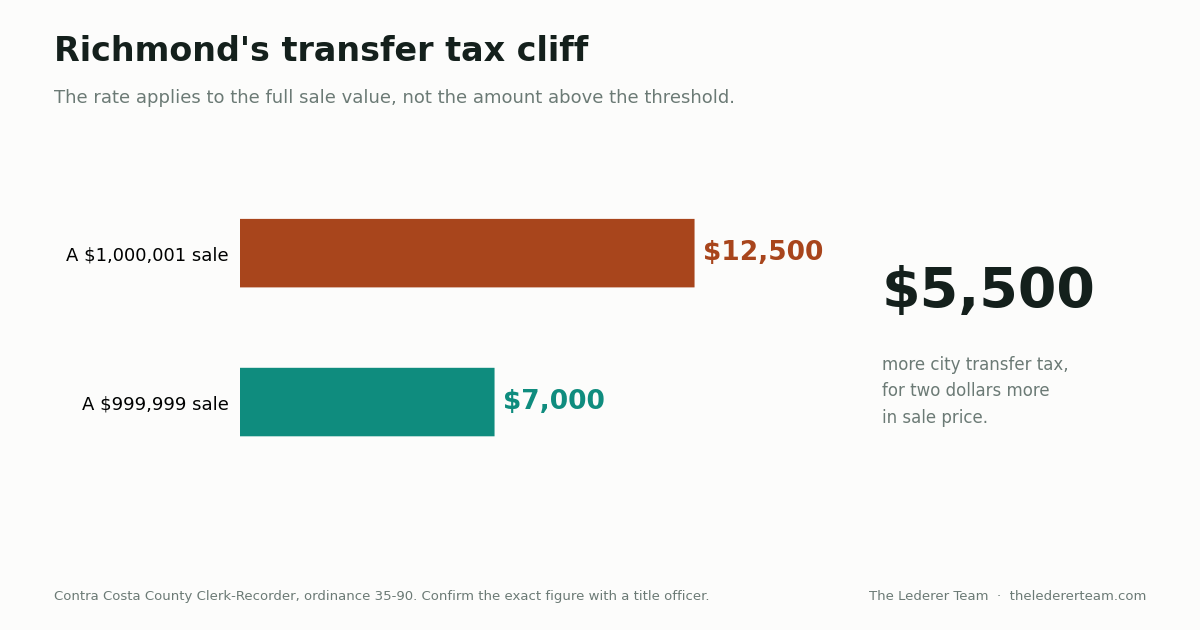
Richmond | $7.00 under $1M; $12.50 from $1M to $3M; $25.00 from $3M to $10M; $30.00 over $10M, applied to the full value |
Lafayette, Orinda, Moraga, Walnut Creek, Danville, Alamo, Kensington | None |
The cities that charge nothing
Lafayette, Orinda and Moraga have no city transfer tax. Neither do Walnut Creek, Danville, Alamo or Kensington. A Lamorinda seller pays the county's $1.10 per $1,000 and stops there. Against Berkeley's $15 to $25 per $1,000, that is a genuine structural difference, and one of the quieter reasons Lamorinda net proceeds surprise sellers used to the inner East Bay. More on those three cities in Lamorinda for Buyers Leaving San Francisco.
What it costs on a $1.2 million sale
Rates per $1,000 are hard to feel. Here is the same $1,200,000 sale run through each schedule. These figures are arithmetic on the published rates, an illustration only, covering county plus city transfer tax and nothing else.
City | County transfer tax | City transfer tax | Total |
|---|---|---|---|
Berkeley | $1,320 | $18,000 | $19,320 |
Albany | $1,320 | $18,000 | $19,320 |
Emeryville | $1,320 | $18,000 | $19,320 |
Oakland | $1,320 | $18,000 | $19,320 |
Piedmont | $1,320 | $15,600 | $16,920 |
Richmond | $1,320 | $15,000 | $16,320 |
Alameda | $1,320 | $14,400 | $15,720 |
El Cerrito | $1,320 | $14,400 | $15,720 |
San Leandro | $1,320 | $13,200 | $14,520 |
Hayward | $1,320 | $10,200 | $11,520 |
Lafayette, Orinda, Moraga, Walnut Creek, Danville, Alamo, Kensington | $1,320 | None | $1,320 |
Confirm any of these with a title officer and the relevant city or county before relying on them. Rates change, rounding conventions differ, and exemptions exist that a title company will catch and a blog post will not.
The Richmond cliff at $1 million
Richmond's schedule deserves its own section, because it does not work the way people assume tax brackets work.
Federal income tax is marginal: cross a bracket and only the dollars above the line are taxed at the higher rate. Richmond's transfer tax is not. The sale price determines the rate, and that rate then applies to the entire value. Crossing a threshold reprices the whole transaction.
Sale price | City rate applied | Richmond city transfer tax |
|---|---|---|
$999,999 | $7.00 per $1,000 | About $7,000 |
$1,000,001 | $12.50 per $1,000 | $12,500 |
Two dollars of additional price creates about $5,500 of additional tax. A seller who accepts $1,000,001 nets roughly $5,500 less than one who accepts $999,999.
Run the arithmetic forward and the implication is uncomfortable. Ignoring every other cost of sale, a Richmond seller has to reach a price of roughly $1,005,600 before they net more than they would have netted at $999,999. Anything between about $1,000,000 and $1,005,600 leaves the seller worse off than stopping just under the line.
That is not a reason to underprice a house. Plenty of Richmond homes belong well above $1 million, and a strong property clears the dead zone easily. It is a reason to know where the line sits before you set an asking price, and to think about how you handle an offer at $1,001,000. That conversation usually turns on who pays the transfer tax, which is negotiable and varies by city custom.
The same logic applies at Richmond's $3 million and $10 million thresholds. Whenever a rate applies to full value rather than marginally, the dollars just above a threshold are the most expensive in the deal. Other cities publish tiered rates too, so ask your title officer how your city applies them before you set an asking price near a threshold.

Berkeley's rate changes on January 1, 2027
If you own in Berkeley, this is the most consequential item on the page. Berkeley voters approved Measure W in November 2024. It takes effect January 1, 2027 and replaces the current structure, 1.5% up to $1.7 million and 2.5% above it, with three tiers:
- 2.5% at $1.6 million and above
- 3.0% at $1.9 million and above
- 3.5% at $3.0 million and above
The thresholds are adjusted annually for value and will be recalculated before the effective date, so the exact dollar figures that apply in 2027 are not final today. Confirm them with the City of Berkeley and a title officer before you make a decision based on them.
An illustration of the magnitude, using the published rates: a $2,000,000 Berkeley sale today falls above the $1.7 million line and owes 2.5%, or $50,000, in city transfer tax. The same sale closing on or after January 1, 2027 falls in the 3.0% band and owes $60,000. The difference is $10,000. Berkeley transfer tax is customarily negotiable between buyer and seller, so who absorbs that $10,000 is itself a bargaining point.
I have written a full breakdown of the change, including how it interacts with 2026 listing timelines, in Berkeley's Transfer Tax Jumps January 1, 2027.
What transfer tax is not
Transfer tax is one line on a seller's closing statement, and it should not stand in for the whole picture. You will see articles quoting total seller closing costs as a single percentage of sale price. I do not publish one, because I have found no authoritative East Bay source that holds up. What I can tell you is which components are knowable in advance and which are not.
- Transfer tax is knowable. The rates above are published by the counties and cities, and a title officer will quote your exact figure.
- County recording fees are set by each county recorder on a published schedule. Ask your title officer for the current one, since it changes.
- Commission is negotiated. Our team charges a 2.5% seller-paid listing commission, and what a buyer's agent is paid is a separate negotiation on every deal.
- Title and escrow fees vary by provider and transaction, and are negotiable.
- Repairs, credits and concessions depend on the property and the offer.
The way to get a real number is a seller net sheet built for your address, price and city, not a percentage from the internet. For an example worked through on a single city, see What It Costs to Sell a House in Oakland in 2026.
One more thing worth saying plainly: transfer tax is customarily negotiable between buyer and seller in much of the East Bay, and custom differs city to city. Where a large share of homes sell above list, who pays it is a live term, and one we push on. None of this is tax or legal advice. Confirm your situation with your CPA or attorney and a title officer.
Frequently asked questions
Who pays the transfer tax in the East Bay, the buyer or the seller?
It is negotiable, and local custom varies by city. In much of the East Bay, including Berkeley, transfer tax is customarily split or negotiated between buyer and seller rather than assigned by law. In a competitive market where most homes sell above list, who absorbs it is a real bargaining term. Confirm the custom for your city with your agent and title officer.
Which East Bay city has the highest transfer tax?
Richmond has the single highest published rate, at $30.00 per $1,000 on sales above $10 million. Below that, Berkeley above $1.7 million, Oakland above $5 million and Emeryville above $2 million all reach $25.00 per $1,000. On a $1.2 million sale, Berkeley, Albany, Oakland and Emeryville all land at about $19,320 including the county's $1.10 per $1,000. Berkeley's rates rise again on January 1, 2027 under Measure W.
Do Lafayette, Orinda and Moraga have a transfer tax?
They have no city transfer tax. Lamorinda sellers pay only Contra Costa County's documentary transfer tax of $0.55 per $500, which is $1.10 per $1,000. Walnut Creek, Danville, Alamo and Kensington also charge no city transfer tax. On a $1.2 million sale that is $1,320 total, against roughly $19,320 in Berkeley.
Why does a $1,000,001 sale in Richmond cost so much more than $999,999?
Richmond applies its rate to the full sale value rather than marginally. Under $1 million the rate is $7.00 per $1,000, so a $999,999 sale owes about $7,000. At $1 million and above the rate becomes $12.50 per $1,000, so a $1,000,001 sale owes $12,500. Two dollars of price triggers about $5,500 of tax.
How much will Berkeley's transfer tax increase in 2027?
Measure W, approved in November 2024 and effective January 1, 2027, sets 2.5% at $1.6 million, 3.0% at $1.9 million and 3.5% at $3.0 million. As an illustration, a $2,000,000 sale that owes $50,000 today would fall in the 3.0% band and owe $60,000. Thresholds are adjusted annually and recalculated before the effective date, so confirm final figures with the City of Berkeley.
What are total seller closing costs in the East Bay as a percentage?
We do not publish one, because no authoritative source for this region held up to verification. Transfer tax and county recording fees are knowable in advance from published schedules. Commission, title, escrow, repairs and credits are negotiated deal by deal. Ask for a seller net sheet built for your address and price rather than relying on a percentage.
Sources
- Alameda County Clerk-Recorder, documentary transfer tax and city rates, 2026 — link
- Contra Costa County Clerk-Recorder, documentary transfer tax and city rates, 2026 — link
- City of Berkeley, property transfer tax and Measure W — link
Mark Lederer leads The Lederer Team at Red Oak Realty, with 25 years and more than 1,000 East Bay transactions behind him. He builds a city-specific net sheet before a listing is priced, not after an offer is accepted, and he accepts no referral fees from any partner. For a net-proceeds estimate on your address, start with a home valuation. 510-774-4231 · [email protected]