Short answer: The federal primary residence exclusion is $250,000 for a single filer and $500,000 for a married couple filing jointly, and it has not changed while East Bay single-family medians reached $1,235,000 in May 2026, up 7.4% year over year. Long-tenured owners routinely have gains larger than the exclusion. California adds its own problem: per the Franchise Tax Board, all capital gains are taxed as ordinary income. This is general information, not tax advice. Talk to your CPA.
How the federal exclusion works
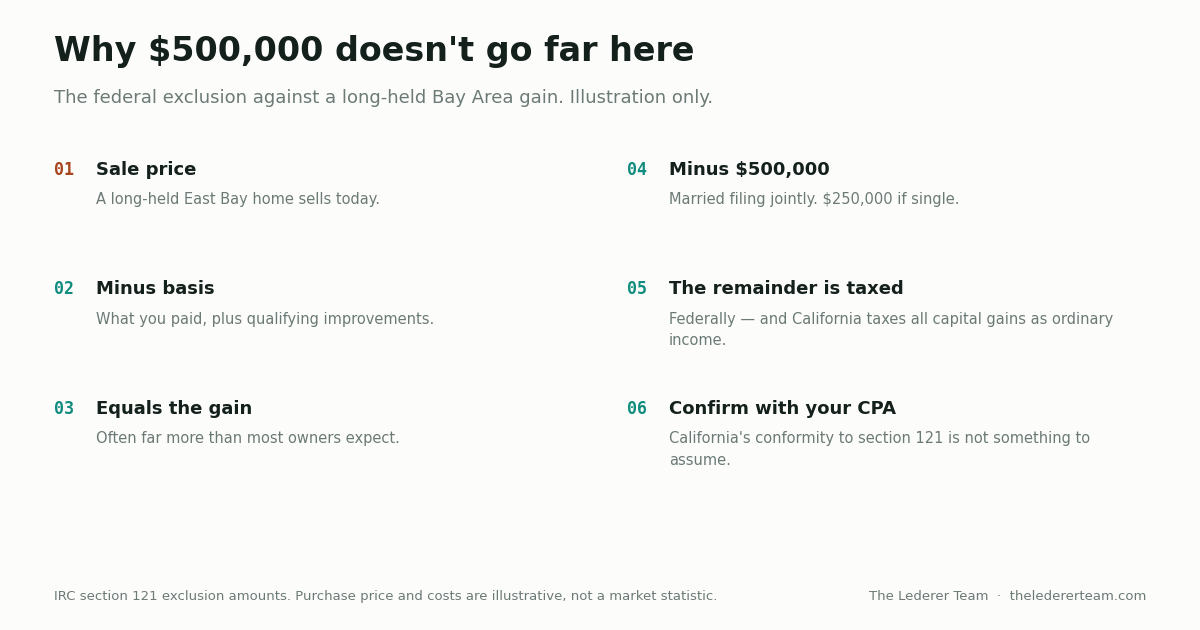
Under Internal Revenue Code Section 121, a homeowner can exclude gain on the sale of a principal residence up to $250,000 if single or $500,000 if married filing jointly. To qualify you must have owned the home for at least 24 of the last 60 months, and used it as a residence for at least 24 of the last 60 months. The two tests are separate, and the 24 months of use do not have to be consecutive.
Two things people get wrong about this consistently.
The exclusion applies to gain, not to sale price. Gain is roughly what you sold for, minus your adjusted basis, minus the costs of selling. Basis starts at what you paid and increases with capital improvements you can document. It is not the same as what your property tax bill says, and it is not what a Zestimate says.
The exclusion has not been indexed to Bay Area prices. The $250,000 and $500,000 figures are fixed dollar amounts. Bay Area home values are not. That gap is the entire subject of this post.
Why $500,000 stopped being enough here
Look at what a long-held East Bay house has done relative to a fixed exclusion.
Figure | Amount | Period and source |
|---|---|---|
Federal exclusion, single filer | $250,000 | IRC Section 121, IRS |
Federal exclusion, married filing jointly | $500,000 | IRC Section 121, IRS |
East Bay single-family median | $1,235,000, up 7.4% year over year | May 2026, RE/MAX Accord |
SF metro median home price | $1,700,000, up 14.4% year over year | March 2026, Redfin |
Berkeley median sale | $1,509,179 | 3 months ending June 2026, Redfin |
Piedmont median sale | $3,198,260 | 3 months ending June 2026, Redfin |
Bay Area homes priced $3.1M to $7.6M | Up 13.4% | Nov 2022 to May 2026, Redfin via Fortune |
A married couple who bought decades ago and is selling into a $1.2 million to $1.5 million market can easily hold a gain larger than $500,000. Once the exclusion is used up, every additional dollar is taxable.
An illustration, not a data point
The following numbers are invented to show the mechanics. They are not a market statistic, and your figures will differ.
Suppose a married couple bought a Berkeley house long ago for $400,000, put $150,000 of documented capital improvements into it over the years, and sells at $1,509,179, which was Berkeley's median sale price in the three months ending June 2026 per Redfin. Suppose selling costs, including transfer tax, commission, title and escrow, come to $110,000.
- Amount realized: $1,509,179 minus $110,000 in selling costs, or $1,399,179
- Adjusted basis: $400,000 purchase plus $150,000 improvements, or $550,000
- Gain: $849,179
- Less the $500,000 married-filing-jointly exclusion: $349,179 of gain remains
That remaining $349,179 is what gets taxed, federally and again by California. A single filer in the same position would have a $250,000 exclusion and $599,179 of remaining gain. The mechanics matter more than the specific numbers.
California's part of the bill
This is the piece most sellers do not see coming.
Per the Franchise Tax Board, California taxes all capital gains as ordinary income. There is no preferential long-term rate at the state level. Whatever marginal rate applies to your California taxable income applies to the gain, and a large one-time gain can push you into a higher bracket in the year of sale.
I am deliberately not telling you how California treats the federal Section 121 exclusion. The FTB page does not state a conformity position, and asserting one would be guessing with your money. Ask your CPA how the exclusion is handled on your California return, in your specific situation, before you plan around it.
A few other things worth raising with a CPA rather than resolving from a blog post:
- Whether any portion of the property was used as a rental or a home office, which changes the analysis
- Whether you have taken depreciation on any part of the property
- How to document improvements, and which improvements count toward basis versus which are repairs
- Timing, and whether closing in one tax year rather than the next changes your bracket
- Estimated payments and withholding on the sale, which are handled through escrow

Documentation is the part you control
The piece a homeowner can actually influence is basis. It reduces taxable gain dollar for dollar, and undocumented improvements are worth nothing at tax time.
If you have owned a home for twenty or thirty years and put a new roof, a foundation retrofit, a kitchen, seismic work, a sewer lateral or an addition into it, those may increase basis. What you need is records: contracts, invoices, permits and canceled checks. This is the most common preventable loss in a long-tenured Bay Area sale. The work was done, and the paperwork is gone.
Two practical habits. Keep a running folder, digital is fine, from the day you buy. And when you are within a couple of years of selling, ask your CPA what they will want to see, then go find it while contractors and permit records are still traceable. Ask them too about the difference between a capital improvement and a repair, because the distinction is not intuitive.
How this interacts with the rest of your decision
Capital gains rarely sit alone. Three other threads come up in the same conversation.
Property tax and Proposition 19
If you are 55 or older, severely disabled, or a disaster victim, Proposition 19 allows you to transfer your property tax base year value to a replacement home anywhere in California, up to three times, provided you buy or build within two years of the sale. If the replacement home costs more, the difference is added to the transferred base. Claims are filed within three years.
That is a property tax benefit, not a capital gains benefit. It does not reduce the gain on the sale, but it changes the arithmetic of moving, and for many owners it is what makes selling a long-held home viable. Prop 19 also reshaped parent-to-child transfers, which now apply only to a principal residence or family farm, with an exclusion of current taxable value plus $1,000,000 indexed, currently $1,044,586 for transfers between February 16, 2025 and February 15, 2027. I cover that in Prop 19 and Your East Bay Home.
Selling costs reduce your gain
Costs of sale come off the amount realized, which reduces gain. That includes transfer tax, and transfer tax in the East Bay varies enormously by city: on a $1.2 million sale it runs about $19,320 in Berkeley or Oakland and $1,320 in Lafayette or Orinda, which charge no city transfer tax at all. The city-by-city breakdown is in Seller Transfer Taxes Across the East Bay, and a full line-by-line for one city is in What It Costs to Sell a House in Oakland in 2026.
Timing the sale
Because California taxes gain as ordinary income, the year you close can matter. So can what else happens in that year: a retirement, an exercise of options, a business sale. This is exactly the kind of question a CPA answers well and an agent answers badly. What I can do is control the closing date, which is often more flexible than sellers assume, and coordinate with your CPA so the two decisions are made together rather than in sequence.
That coordination is the idea behind how our team works. We keep licensed specialists in financing, insurance, design, staging, financial planning and estate planning in the loop on a sale, and we take no referral fees from any of them.
Frequently asked questions
How much capital gain can I exclude when I sell my home?
Under IRC Section 121, $250,000 if you file single and $500,000 if you are married filing jointly. You must have owned the home at least 24 of the last 60 months and used it as a residence at least 24 of the last 60 months. The exclusion applies to gain, not to sale price, and it has not been adjusted for Bay Area values. Confirm your eligibility with your CPA.
Does California tax capital gains on a home sale?
Per the Franchise Tax Board, California taxes all capital gains as ordinary income, with no preferential long-term rate at the state level. Your California marginal rate on ordinary income is what applies. Whether and how California treats the federal Section 121 exclusion is not something we state here, because the FTB page does not address it. Ask your CPA about the California treatment of your sale.
Why isn't the $500,000 exclusion enough in the Bay Area?
Because it is a fixed dollar amount and local prices are not. East Bay single-family medians reached $1,235,000 in May 2026, up 7.4% year over year per RE/MAX Accord, and the San Francisco metro median hit $1.7 million in March 2026 per Redfin. An owner of twenty or thirty years can hold gain well above $500,000, and every dollar over the exclusion is taxable.
What reduces my taxable gain on a home sale?
Two things: your adjusted basis and your costs of sale. Basis is what you paid plus documented capital improvements. Costs of sale include transfer tax, commission, title and escrow. Keeping contracts, invoices, permits and canceled checks for improvements is the part you control, and missing paperwork is the most common preventable loss in a long-tenured sale.
Does Proposition 19 help with capital gains tax?
No. Prop 19 is a property tax rule, not an income tax rule. For homeowners 55 or older, severely disabled, or disaster victims, it allows transferring a property tax base year value to a replacement home anywhere in California, up to three times, if you buy or build within two years. It does not reduce the gain on the sale. Confirm details with your CPA or the county assessor.
Should I time my home sale for tax reasons?
Possibly, and that is a question for your CPA rather than your agent. Because California taxes gain as ordinary income, a large one-time gain can push you into a higher bracket, and other events that year, a retirement or an option exercise, interact with it. Closing dates are more flexible than sellers assume, so raise it early.
Sources
- IRS, Topic No. 701, Sale of Your Home — link
- California Franchise Tax Board, capital gains treatment — link
- California Board of Equalization, Proposition 19 — link
- RE/MAX Accord, East Bay single-family median, May 2026 — link
- Redfin, market data, March and June 2026 — link
Mark Lederer leads The Lederer Team at Red Oak Realty, with 25 years and more than 1,000 East Bay transactions behind him. Nothing here is tax or legal advice, and every situation turns on facts a CPA needs to see, so bring yours in early. When you are ready to understand what a sale would actually net, start with a home valuation. 510-774-4231 · [email protected]