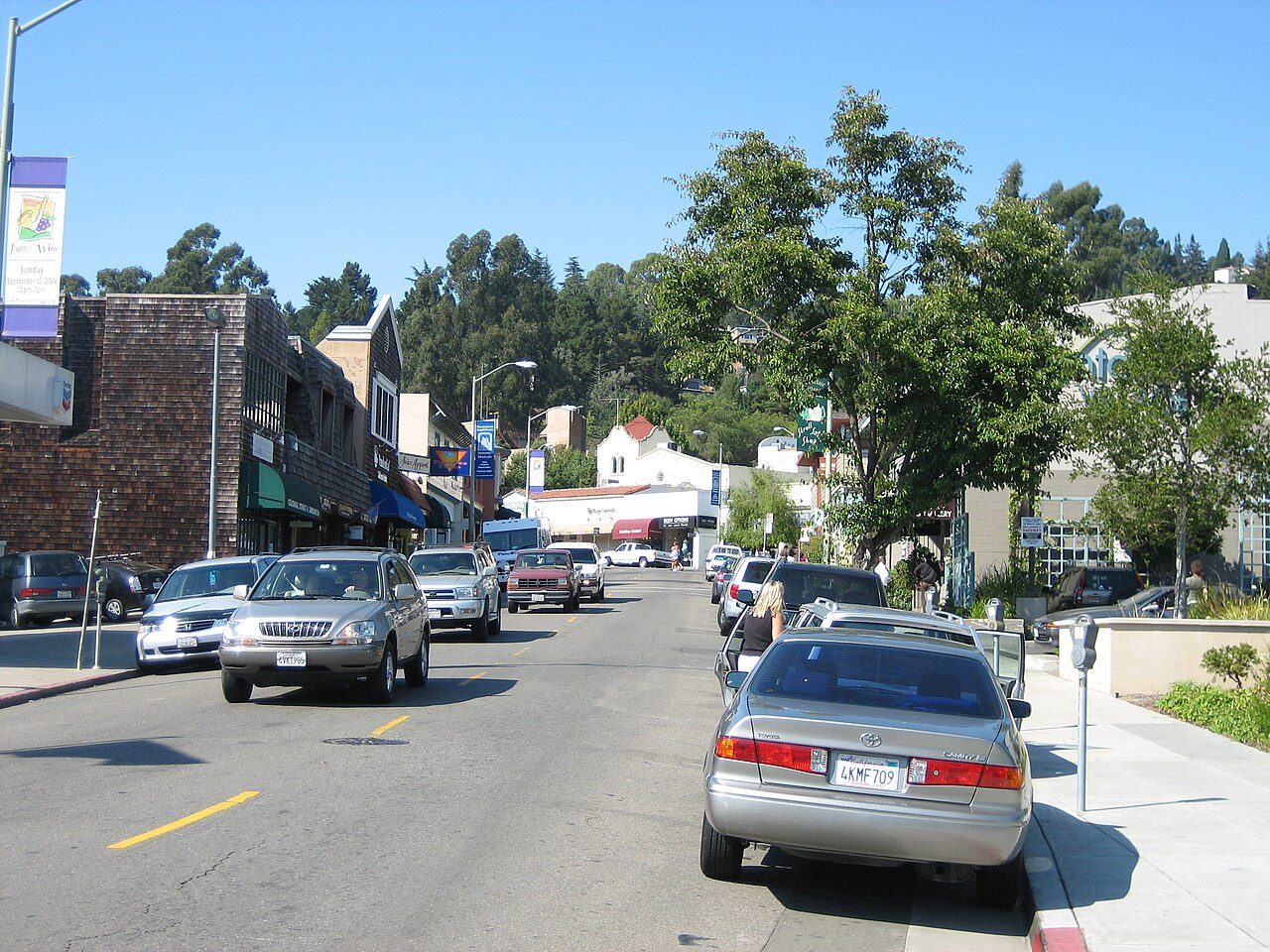
Short answer: In the three months ending June 2026, per Redfin, 90.4% of El Cerrito homes, 83.1% of Berkeley homes and 68.5% of Oakland homes sold above list. Multiple offers are still normal here, so the seller's real decision is not price. It is which offer will actually close, at the number on the page, on the date promised.
Where multiple offers are still the norm
This post assumes more than one offer, so start with whether that is true where you live. Redfin figures, three months ending June 2026, same methodology.
Market | Median sale price | Median days on market | % sold above list | Homes sold |
|---|---|---|---|---|
El Cerrito | $1,179,358 | 14 | 90.4% | 52 |
Piedmont | $3,198,260 | 13 | 91.3% | 46 |
Berkeley | $1,509,179 | 15 | 83.1% | 228 |
Alameda | $1,184,855 | 17 | 70.3% | 158 |
Oakland | $898,511 | 20 | 68.5% | 805 |
Richmond | $649,646 | 17 | 64.0% | 207 |
Notice what that column is. I am quoting the share of homes that sold above list, not a sale-to-list ratio: Redfin's East Bay sale-to-list figures run high enough to be an artifact of the region's underpricing convention, so I do not publish them. In most of these cities, two thirds to nine tenths of sellers received more than they asked. The mechanics are in why East Bay homes sell 30% over asking.
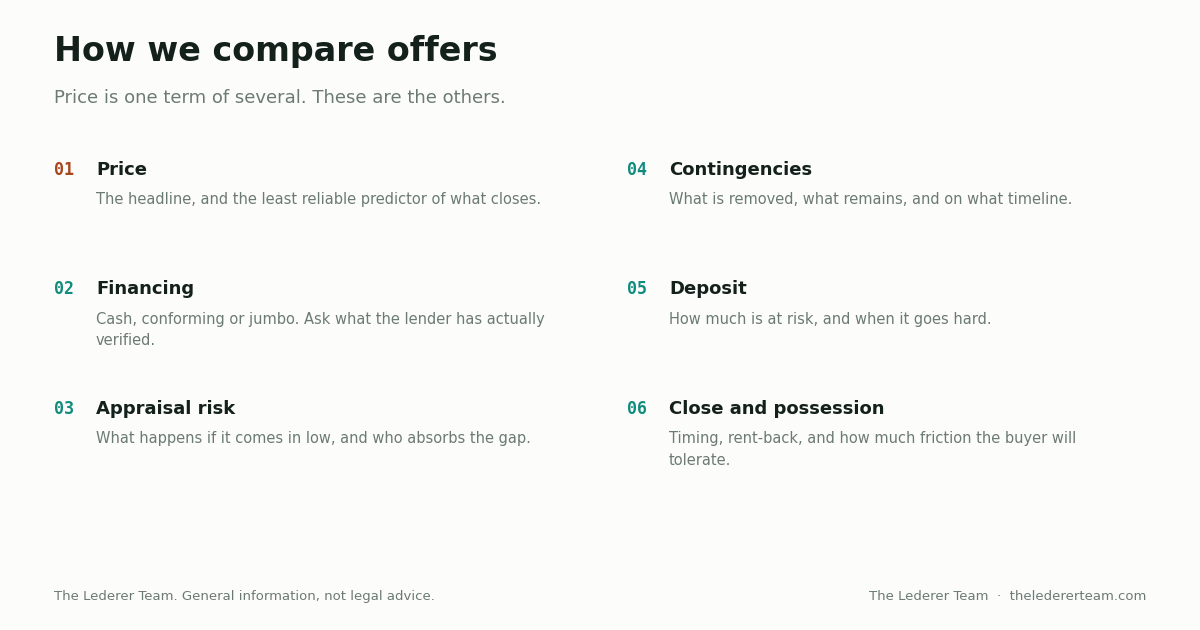
Price is one of six variables
When five offers land on a Tuesday, the spreadsheet a good listing agent builds has six columns, and price is only the first.
- Price. The number, and whether anything supports it.
- Form of funds. Cash with proof, a conventional loan with a real underwriting file, or a pre-qualification letter generated in ten minutes.
- Down payment percentage. This matters more than most sellers realize.
- Contingencies. Loan, appraisal and inspection, and the days on each.
- Deposit. The buyer's stake in following through.
- Timeline and possession. Close date, and whether you need to stay afterward.
An offer is a set of promises. The job is to price the odds each one is kept.

Three offers on the same house
An illustration, not a case study. Assume an Oakland listing at $1,200,000 draws three offers.
Term | Offer A | Offer B | Offer C |
|---|---|---|---|
Price | $1,325,000 | $1,300,000 | $1,250,000 |
Financing | 20% down conventional | 35% down conventional | All cash, funds verified |
Loan contingency | 17 days | None | None |
Appraisal contingency | 14 days | None | Not applicable |
Initial deposit | $25,000 | $65,000 | $50,000 |
Close of escrow | 30 days | 21 days | 10 days |
Possession | At close | 30-day rent-back at no cost | At close |
Offer A is the highest by $25,000. Run the appraisal scenario before taking it. At $1,325,000 with 20% down, the buyer plans on a $1,060,000 loan and $265,000 in cash. If the appraisal lands at $1,250,000, the lender funds 80% of that, or $1,000,000, and the buyer needs $325,000 in cash, $60,000 more than planned. With a live appraisal contingency that buyer can renegotiate or leave, three weeks after the house left the market.
Offer B, at $25,000 less, survives that same appraisal. A 35% down payment on $1,300,000 is an $845,000 loan, and even at a $1,250,000 appraised value the lender's 80% is $1,000,000, above what was requested. The appraisal essentially cannot break this deal, the deposit is larger, the close is shorter, and the rent-back solves where to live before your next purchase.
Offer C is fastest and most certain, at $75,000 below Offer A. Whether that certainty is worth $75,000 depends on your circumstances. There is no universally correct answer among the three, only a correct answer for you, and finding it means knowing what you need before offers arrive.
What actually protects a seller
- Verified funds, not stated funds. A cash offer without documentation is a wish. Ask for account statements, and have your agent call the lender to confirm a financed file is underwritten, not merely pre-qualified.
- A deposit sized to matter. It is the practical consequence of a buyer walking away. How a deposit dispute resolves is a legal question for an attorney.
- Escalation clauses read carefully. They can produce a strong number and also a ceiling you did not intend. Read the cap and the proof requirement, not the headline.

A clean disclosure package is why buyers waive contingencies
Sellers who want offers without inspection contingencies earn them by giving buyers enough information before offer date to price the condition themselves.
The Transfer Disclosure Statement is statutory under Civil Code section 1102 and following, required on most residential sales of one to four units. The Seller Property Questionnaire is a California Association of Realtors form most Bay Area sellers also complete; it is not a statute. The Natural Hazard Disclosure under section 1103.2 covers six zones: FEMA Special Flood Hazard Area, dam-failure inundation, High or Very High Fire Hazard Severity Zone, State Responsibility Area wildland, Earthquake Fault Zone, and Seismic Hazard Zone. Several trigger routinely in the hills.
Complete disclosures plus current reports let a buyer waive an inspection contingency with open eyes and cut the odds of a mid-escrow renegotiation. Incomplete disclosure buys a higher number on Tuesday and costs more in the third week. Timing matters too: fall or spring.
One cost worth pricing before you choose
Transfer tax is one of the few closing figures you can calculate exactly in advance. Oakland charges $15.00 per $1,000 between $300,000 and $2 million, and $17.50 per $1,000 from $2 million to $5 million, on top of Alameda County's $1.10 per $1,000. On the $1,300,000 Offer B above, that is $19,500 to the city and $1,430 to the county, or $20,930 total.
Title, escrow and commission are separate and negotiable, so I will not publish a blanket percentage for seller closing costs. Who pays which component can itself be a term of the offer. Ask your title officer for a written estimate before comparing offers on net proceeds.
Frequently asked questions
Should I always accept the highest offer on my house?
No. The highest price frequently carries the most risk of falling apart or being renegotiated. Compare price, funds, down payment, contingencies, deposit and timeline together. An offer $25,000 lower with 35% down and no appraisal contingency can be worth more than a higher one with 20% down.
Why does the buyer's down payment matter to me as the seller?
Because it decides whether a low appraisal can break your deal. A buyer paying $1,325,000 with 20% down must find $60,000 more in cash if the appraisal lands at $1,250,000. A buyer paying $1,300,000 with 35% down needs only an $845,000 loan, which that same appraisal still supports comfortably.
How much should the earnest money deposit be?
There is no fixed rule; the right amount depends on price point and local practice. What matters is that it is large enough to be a real consequence if the buyer walks. Deposit disputes are a legal matter, so ask your attorney how the remedy works.
Is a cash offer always better than a financed offer?
Usually faster and more certain, but not automatically better. Cash removes loan and appraisal risk and can close in days, which is worth real money to a seller who has already bought their next home and less to one with time. Verify funds with account statements, because unverified cash is just a claim.
Do complete disclosures really get me a better offer?
In this market, yes. Most East Bay buyers compete without contingencies, which they can only do responsibly after reading full disclosures and reports before offer date. The Transfer Disclosure Statement is statutory; the Seller Property Questionnaire is a C.A.R. form most sellers also complete. Information up front reduces mid-escrow renegotiation.
Sources
- Redfin, medians, days on market and share sold above list, three months ending June 2026 — link
- California Civil Code sections 1102 and 1103.2, seller disclosures
- Alameda County Clerk-Recorder, transfer tax and City of Oakland rates — link
Mark Lederer leads The Lederer Team at Red Oak Realty. In 25 years and more than 1,000 closed transactions he has sat at many kitchen tables with five offers spread across them, and the conversation that decides the outcome usually happened weeks earlier. His team charges a 2.5% seller-paid listing commission and takes no referral fee from any partner, which is how the model works. Call 510-774-4231, email [email protected], or start with a home valuation. Before you hire anyone, read how to choose a listing agent.