Short answer: Proposition 19 still lets a parent pass a principal residence to a child without a full property tax reassessment, but only up to the home's current taxable value plus $1,044,586 for transfers between February 16, 2025 and February 15, 2027. Value above that line gets added to the base. Rental and vacation property no longer qualifies at all.
This post explains the rules and the deadlines. It is not tax or legal advice. Confirm every number below with your CPA or estate attorney before you file anything.
What Prop 19 changed, and what it left alone
Start with what did not change. Proposition 13 still governs the annual bill: a 1% base rate plus voter-approved bonded indebtedness, applied to a base year value set at market value on the last change of ownership or new construction, with annual increases capped at the lower of California CPI or 2%. That is why two houses on identical lots can pay wildly different property taxes.
What Prop 19 changed, effective February 16, 2021, is who gets to inherit that low base year value and how much of it.
- Property type. The exclusion now applies only to a principal residence or a family farm. A rental duplex, a vacation cabin, a commercial building: none of it qualifies. Before 2021, a great deal of it did.
- Occupancy. The child has to actually live there, and must claim the homeowners' or disabled veterans' exemption within one year of the transfer.
- A dollar cap. The exclusion covers the current taxable value plus $1,000,000, indexed. For transfers between February 16, 2025 and February 15, 2027 that figure is $1,044,586, so every 2026 transfer falls inside that window.
Value above the cap is not forgiven. It is added to the base year value that passes to the child.
The arithmetic, at real East Bay price points
The mechanic is simpler than most explanations make it sound. Compare the home's market value on the date of transfer against the parent's current taxable value plus $1,044,586. If market value is at or below that number, nothing changes. If it is above, the new taxable value is the market value minus $1,044,586.
The table runs that against Redfin median sale prices for the three months ending June 2026. The taxable values in column two are assumptions illustrating a long-held home, not data. Your parcel's actual figure is on your assessor's records.
City (Redfin median, 3 mo. ending June 2026) | Assumed current taxable value | Exclusion covers up to | New taxable value after transfer |
|---|---|---|---|
Oakland, $898,511 | $180,000 | $1,224,586 | $180,000 (fully excluded) |
Alameda, $1,184,855 | $200,000 | $1,244,586 | $200,000 (fully excluded) |
Berkeley, $1,509,179 | $250,000 | $1,294,586 | $464,593 |
Piedmont, $3,198,260 | $300,000 | $1,344,586 | $2,153,674 |
Read the Oakland and Alameda rows first. At those medians a long-held family home passes to an occupying child with the tax base intact, which covers a large share of the East Bay.
Now read Berkeley. A $1,509,179 market value against a $250,000 taxable value produces $214,593 of excess over the cap, which lands on the base: $250,000 becomes $464,593. At the 1% base rate alone, that moves roughly $2,500 a year to roughly $4,646 a year, before any voter-approved bonded indebtedness. The bill goes up. The house does not become unaffordable.
Piedmont is where it gets serious. A $3,198,260 market value produces a new taxable value of $2,153,674, about $21,537 a year at the base rate alone. And in Piedmont that sits on top of a school parcel tax: Measure H passed June 2, 2026 with roughly 80% of the vote, at $3,174 per parcel annually, inflation-adjusted, raising about $12 million a year. Earlier Piedmont measures remain in force as well.
Two caveats. Actual bills exceed the 1% base rate because of voter-approved bonds and local assessments, and I am not publishing an Alameda County effective rate because I do not have a verified one. And the assessor uses market value on the transfer date, which is not necessarily what a median or an online estimate says. If your family is near the cap, that valuation question is the whole ballgame; see how much is my Berkeley home worth.

The deadlines that quietly disqualify families
In my experience the exclusion is lost more often to a missed filing than to the dollar cap. The cap is arithmetic you can see coming. The deadlines run in the background during the year a family is least equipped to track paperwork.
Requirement | Deadline |
|---|---|
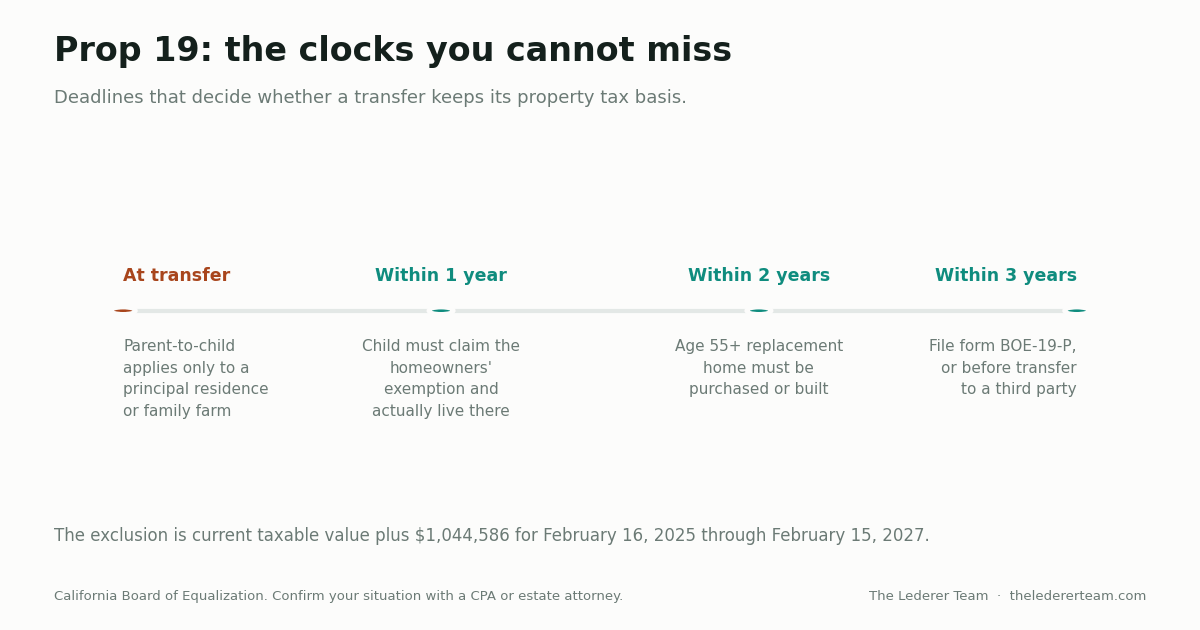
Child claims the homeowners' or disabled veterans' exemption and occupies the home | Within 1 year of transfer |
File Form BOE-19-P (parent-child exclusion claim) | Within 3 years of transfer, or before transfer to a third party, whichever is earlier |
Base year value transfer (55+, severely disabled, disaster victim): buy or build the replacement | Within 2 years of the sale |
Base year value transfer: file the claim | Within 3 years |
Property tax, 1st installment | Due November 1, delinquent after December 10 (10% penalty) |
Property tax, 2nd installment | Due February 1, delinquent after April 10 (10% penalty plus $10 cost) |
Note the clause that catches people on Form BOE-19-P: three years, or before transfer to a third party, whichever is earlier. Siblings who inherit a house, hold it while deciding, then sell it can find they never perfected a claim they assumed was automatic.

The other half of Prop 19: taking your base with you after 55
Most coverage treats Prop 19 as the measure that took something away. For homeowners 55 and older, severely disabled homeowners and disaster victims, it gave something back, effective April 1, 2021.
- Up to three base year value transfers, where the old rule allowed one.
- A replacement home anywhere in California, not just within the same county or a list of participating counties.
- Purchase or build the replacement within two years of the sale.
- If the replacement costs more than the sale price, the difference is added to the transferred base year value. It is not all-or-nothing.
- File within three years.
For an East Bay family this is often the more useful half. A couple in their seventies in a Berkeley hills house they can no longer manage can sell, buy a single-level home in Contra Costa County, and carry their base year value along, adjusted upward only by the price difference. Three transfers means one decision no longer has to be permanent.
Transfer tax is the moving cost that varies most by address. Berkeley charges $15.00 per $1,000 up to $1.7M and $25.00 above it, on top of the county's $1.10 per $1,000, while Lafayette, Orinda and Moraga have no city transfer tax at all. Berkeley's Measure W raises those rates effective January 1, 2027. The city-by-city detail is in seller transfer taxes across the East Bay.
Property tax is not the only tax in the room
Families often solve the Prop 19 question and forget there are two tax systems involved. Property tax governs what you pay every year for owning. Capital gains governs what you pay once, for selling.
If a parent sells during their lifetime, the federal primary residence exclusion under IRC section 121 is $250,000 for a single filer and $500,000 for a married couple filing jointly, with ownership and use as a residence for 24 of the last 60 months. Against East Bay basis from the 1980s and 1990s, that exclusion frequently does not cover the gain. And per the Franchise Tax Board, California taxes all capital gains as ordinary income, with no preferential long-term rate. I go through that math in capital gains on a Bay Area home sale. Ask your CPA specifically about the California treatment.
So "keep it or sell it" is rarely answered by property tax alone. A house that produces a manageable Prop 19 outcome can still produce a difficult capital gains outcome later. That is a conversation for your CPA and your estate attorney, ideally before anyone is under a deadline.
Frequently asked questions
What is the Prop 19 parent to child exclusion amount in 2026?
For transfers occurring between February 16, 2025 and February 15, 2027, the exclusion equals the property's current taxable value plus $1,044,586. That indexed figure applies to every transfer in 2026. If the home's market value on the transfer date exceeds that combined amount, the excess is added to the base year value, and the new taxable value is market value minus $1,044,586. Confirm your figures with your CPA.
Does Prop 19 apply to a rental property I inherit?
No. Since February 16, 2021, the parent-child exclusion applies only to a principal residence or a family farm. Rental homes, vacation property and commercial buildings no longer qualify, and they are reassessed to market value at the transfer. This is the single largest change Prop 19 made, and it caught many East Bay families who had planned around the prior rules. Talk to your estate attorney about alternatives.
Does my child have to live in the house to keep the low property tax?
Yes. The child must occupy the property as a principal residence and claim either the homeowners' exemption or the disabled veterans' exemption within one year of the transfer. Claiming the exclusion and then renting the house out does not work. If more than one child inherits and only one will live there, that fact pattern needs a professional review before the transfer, not after.
How long do I have to file Form BOE-19-P?
Within three years of the transfer, or before the property is transferred to a third party, whichever comes first. That second condition is the one that surprises families. Heirs who inherit a home, hold it while deciding what to do, and then sell it to a buyer can lose the exclusion if they never filed. File early rather than at the deadline, and confirm the process with your county assessor.
Can I take my Proposition 13 base year value with me if I sell after 55?
Yes, within limits. Homeowners 55 and older, severely disabled homeowners and disaster victims may transfer a base year value up to three times, to a replacement home anywhere in California, if they buy or build within two years of the sale. If the replacement costs more, the difference is added to the transferred base. The claim must be filed within three years. Confirm eligibility with your CPA.
Sources
- California State Board of Equalization, Proposition 19 guidance, accessed August 2026 — link
- California State Board of Equalization, Proposition 13 and property tax basics — link
- IRS Topic No. 701, Sale of Your Home — link
- California Franchise Tax Board, capital gains treatment — link
- Redfin, median sale prices, three months ending June 2026 — link
- City of Piedmont, Measure H, passed June 2, 2026 — link
- City of Berkeley, real property transfer tax and Measure W — link
Mark Lederer leads The Lederer Team at Red Oak Realty, where 25 years and more than 1,000 closed transactions have included many houses that passed between generations. He coordinates with your CPA and estate attorney rather than replacing them, and takes no referral fee from any professional he introduces you to. The team's estate planning advisors can model the keep-or-sell decision with you at no charge. If your family is weighing whether to keep or sell an East Bay home, call 510-774-4231, email [email protected], and start with a home valuation.