On Wednesday the Federal Reserve raised its benchmark rate by a quarter point, to a target range of 3.75% to 4%. The vote was unanimous, 12–0. It is the first increase in three years, and the Fed was explicit about why: inflation is still running above target, and the Committee wants a faster return to 2%.
Every agent in the Bay Area is writing about this today, and most of those posts will tell you rates went up and that's bad for buyers. Not wrong, exactly. Just not very useful — and it misses the more interesting thing happening here.
The part every lender is emailing you about
If you have a loan officer, you have already received the note: mortgage rates did not go up a quarter point. That's true, and it's worth understanding, so here it is briefly.
Mortgage rates track the 10-year Treasury and mortgage-backed securities, not the fed funds rate directly. Futures markets had priced this hike above 90% going in, so the bond market moved weeks ago. And in the day since, long yields have actually fallen. The 10-year touched 5% on the announcement and has drifted back toward the mid-4.90s. Mortgage rates ticked down slightly with it.
Where they sit depends on whose index you read: Freddie Mac's weekly survey put the 30-year at 6.95%, daily trackers are running 7.0% to 7.2%. We use 7.05% for the math below. None of the arithmetic that follows changes if your lender quotes you a number fifteen basis points either side of that.
So the quarter point is not the news. The signal is: after three years of a market that assumed the next move was down, the Fed moved up, unanimously, and sixteen of eighteen officials projected at least one more increase before year-end. If you have been sitting out waiting for a cut, that thesis just broke.
That is where the lender emails stop. It is also where the part that actually affects what you pay for a house begins.
What a quarter point actually costs a buyer here
Let's put a number on it. Take a $1.2 million purchase in El Cerrito or Oakland with 20% down — a $960,000 loan, which is a very ordinary East Bay transaction.
- At 6.80%, principal and interest run about $6,258 per month.
- At 7.05%, the same loan costs about $6,419 per month.
That is $161 a month, or roughly $1,930 a year. Flip it around and hold the payment constant instead: a buyer who could carry $960,000 at 6.80% can carry about $936,000 at 7.05%. At 20% down, that is roughly $30,000 of purchasing price gone.
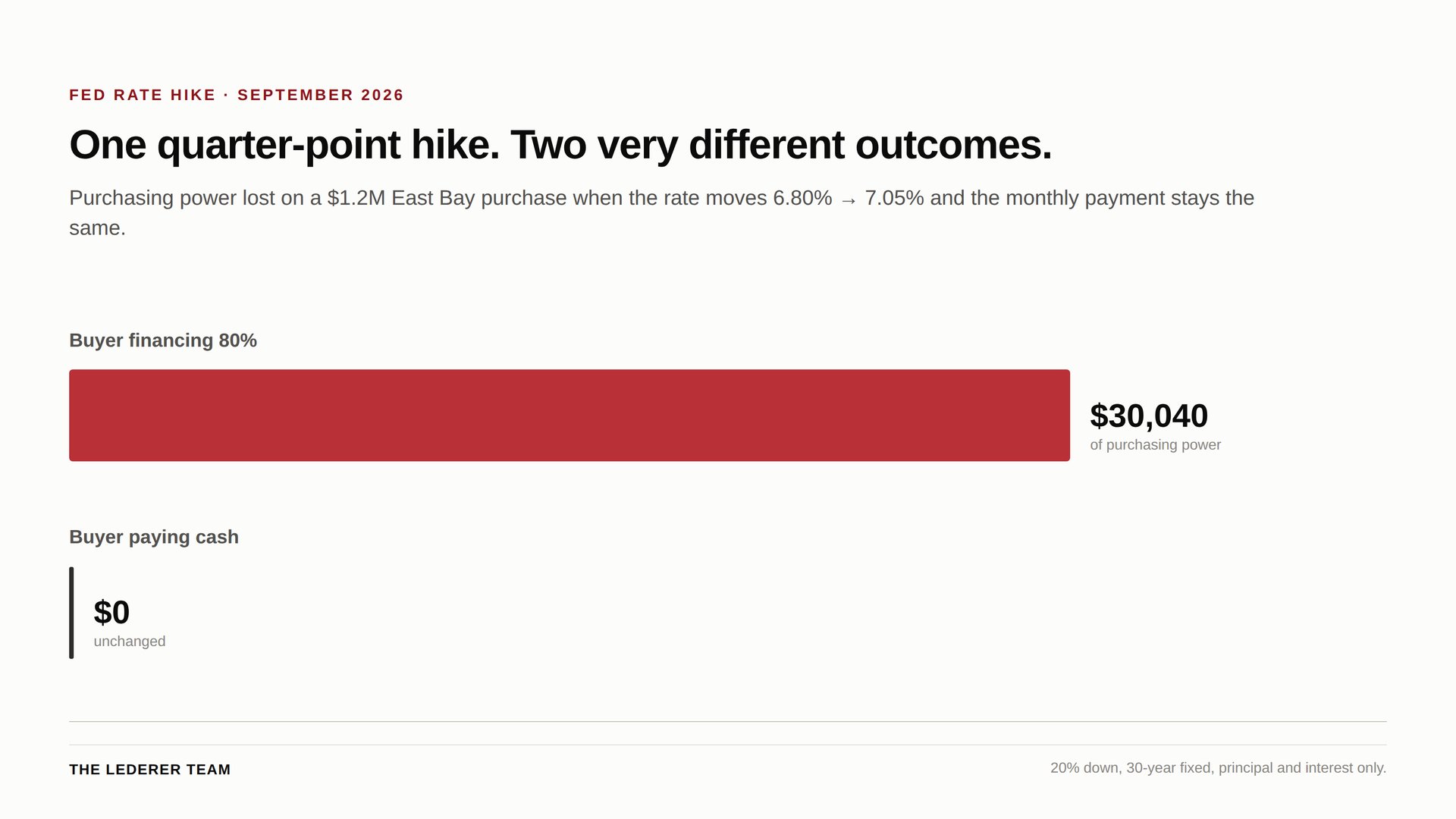
Thirty thousand dollars matters. It is the difference between winning and losing a house here. But it is also not a market-breaking number, and anyone telling you this single hike changes everything is selling urgency.
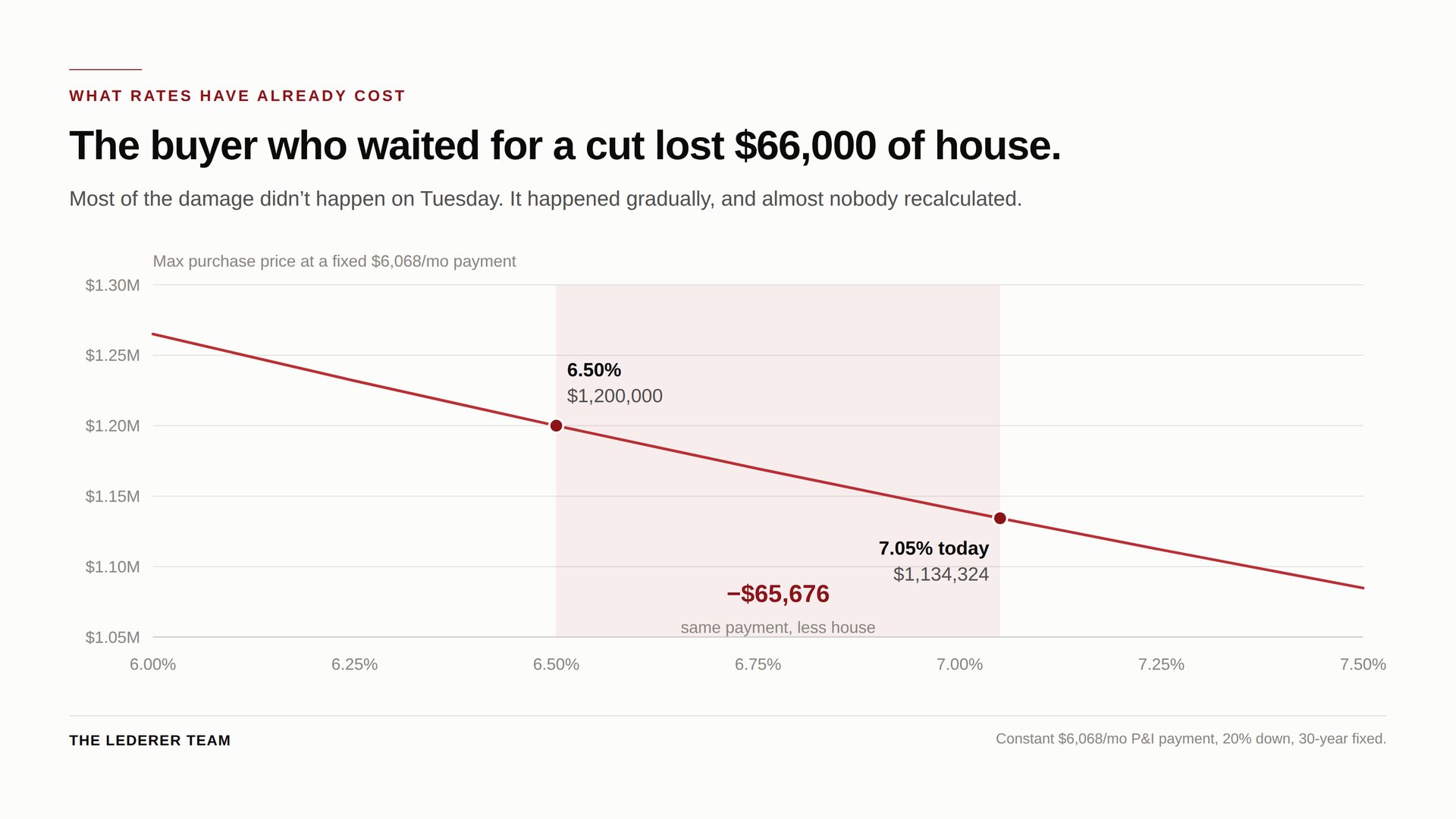
The move that actually matters is the cumulative one. A buyer who was shopping at 6.50% and is now shopping at 7.05% has lost about $66,000 of purchasing power at the same monthly payment. That is the real erosion, and it happened gradually enough that most buyers never recalculated.
Here is the part specific to us
The Fed has exactly one lever: the cost of borrowed money. It works by making financing more expensive, which cools demand.
But a meaningful share of the demand driving Bay Area prices right now is not borrowed. It is equity. The AI boom has produced a class of buyer writing very large checks against appreciated stock. These are buyers who are financing lightly, or not at all, or who are financing but are entirely indifferent to a $161 monthly difference.
A quarter-point hike does nothing to that buyer. It lands, in full, on the buyer financing 75 to 80 percent of a house.
That means the Fed did not cool this market. It cooled half of this market, and in doing so, handed the other half a slightly larger relative advantage in every competitive situation where the two meet.
Nationally, a rate hike compresses prices. In the Bay Area, it widens the gap between two buyers standing in the same open house.
Where that gap shows up, and where it doesn't
This does not apply uniformly, and the distinction matters before you draw conclusions about your own situation.
At entry and mid price points (much of San Leandro, large parts of Oakland, most of El Cerrito) buyers are overwhelmingly financed and genuinely rate-sensitive. This is where a quarter point moves behavior, where you should expect slightly thinner offer counts, and where a well-prepared buyer has more room than they did a year ago.
Higher up the price ladder, and in the specific pockets of Berkeley and Oakland that draw equity-heavy buyers, financing is a convenience rather than a constraint. Rate moves do not reliably change what those houses sell for.
Most of the confusion in local market commentary comes from averaging those two together and reporting the blend as though it describes anybody's actual transaction.
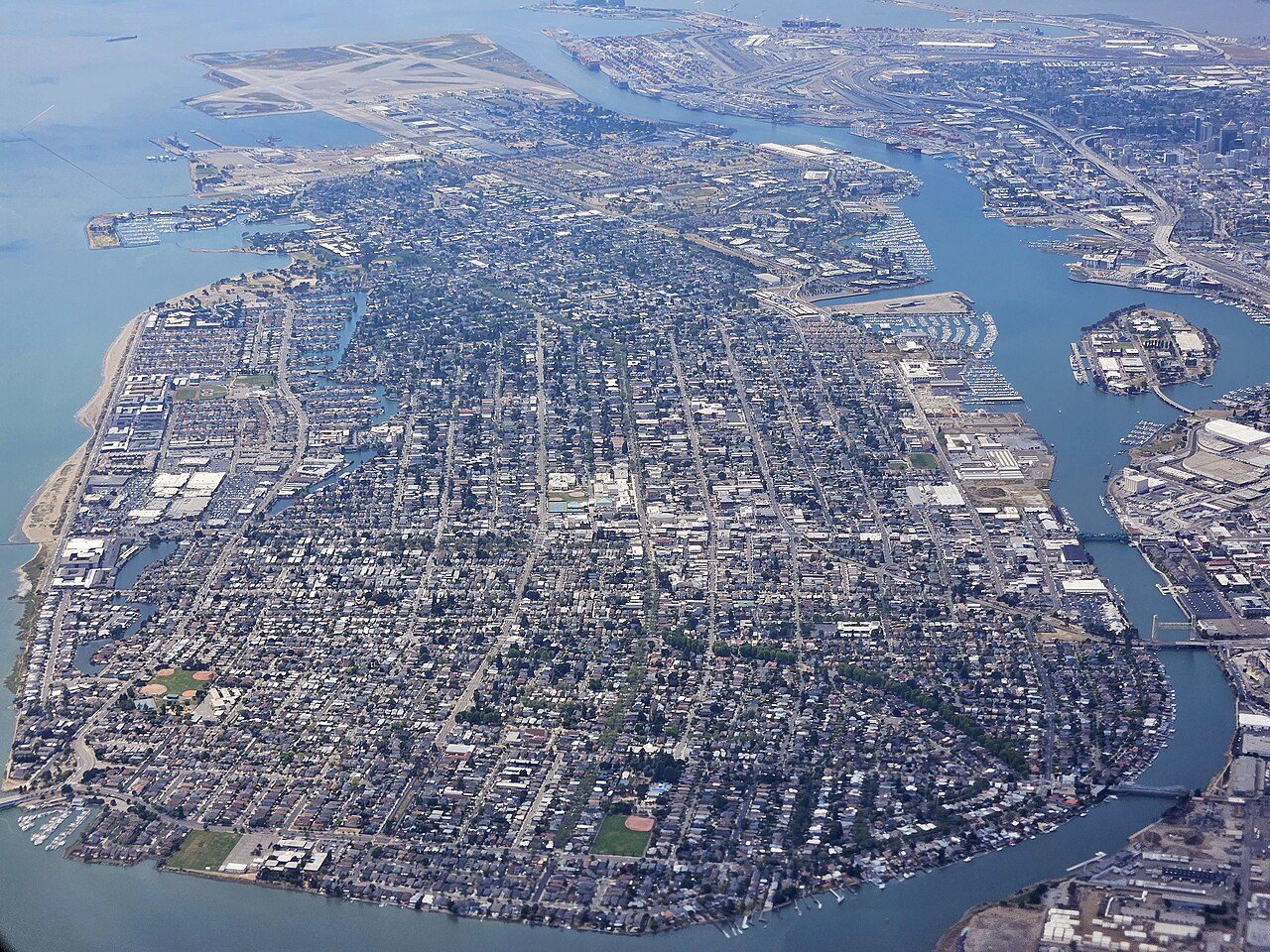
If you want to see which of those two describes your own street rather than the county average, our Quarterly Market Data map breaks out 106 Bay Area cities individually — median price per square foot, days on market, and percent over asking, with houses and condos separated.
What we'd tell you to do about it
If you're buying and financing: the right response is not to wait. Waiting has been the losing strategy for three years, and the Fed just told you the thing you were waiting for isn't coming soon. The right response is to know your actual number. This is not your pre-approval ceiling, but the payment you are willing to live with for a decade and to understand how your offer competes against a buyer whose constraint isn't the rate. We spend real time on this before a client writes anything, because buyers who are clear on their own math move faster and write fewer losing offers.
If you're selling: your buyer pool just shifted composition, and the shift is different at $900,000 than at $2 million. That changes which preparation dollars earn a return and how you price in the first week. We'll cover that in detail in a follow-up post.
And the honest caveat: we could be wrong about the path, and the first day of evidence cuts against us. The Fed controls short rates; mortgage rates follow long ones. Long yields fell in the twenty-four hours after the hike, which is what happens when the bond market decides a central bank is serious about inflation. If that reading holds, mortgage rates could drift down even while the Fed keeps raising.
Two things could break that. Sixteen of eighteen Fed officials still project another increase this year. And energy remains unresolved. Brent crude oil is near $105 with Saudi pipeline capacity still under repair, and oil is the fastest route from a geopolitical headline back into an inflation print. We are watching both. What we would not do is build a purchase timeline around a forecast, ours or anyone's.
If you'd like to talk through what a 7% rate environment means for your own plans, whether you're buying or selling, reach us at 510-774-4231 or [email protected]. You can read more about how we work on our approach page.
Rate figures as of September 17, 2026. Payment examples are principal and interest only and exclude taxes, insurance, and any mortgage insurance. Individual rates depend on credit, loan program, and property.