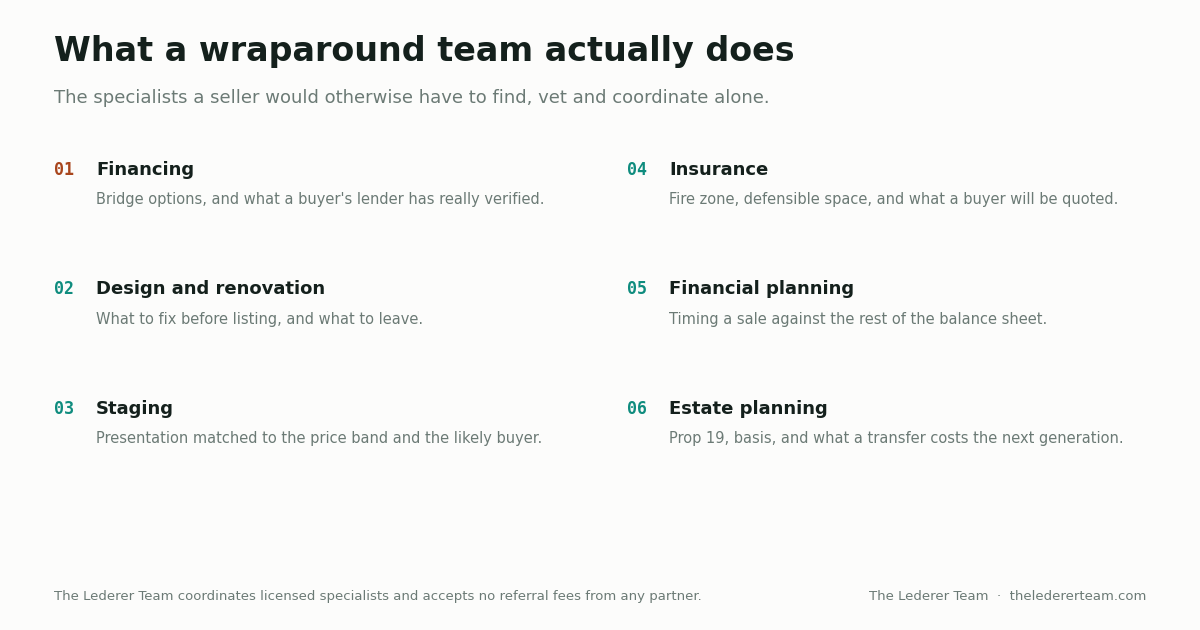
Short answer: Six categories of licensed specialist get coordinated around your sale at defined points: financing, insurance, design and renovation, staging, financial planning and estate planning. You do not hire, schedule or referee any of them. We accept no referral fees from any of them, so the recommendation carries no hidden incentive.
The problem this solves
Most sellers discover, about ten days in, that they have accidentally become the general contractor of their own transaction. They are getting three bids on a bathroom, chasing an insurance broker who will not return calls, asking a lender whether they can buy before they sell, and wondering whether the house being in a trust changes who signs. None of those are real estate questions. All of them decide the outcome of a real estate sale.
The alternative is not "we handle everything." It is narrower: someone whose job is to know which specialist a question belongs to, engage that person at the point where their answer still changes something, and hold the sequence together. Getting the right answer in week nine, when it needed to be week two, is the same as not getting it.
The six specialists, and when each one comes in
Specialist | When engaged | What they actually decide | What you would otherwise do yourself |
|---|---|---|---|
Mortgage advisor | 6 to 8 weeks before listing | Whether you can buy before you sell; bridge financing versus a line of credit | Call three lenders with no basis for comparison |
Insurance broker | At prep, before photography | Whether a buyer can insure the property, and what a carrier wants to see on fire zone work | Find out during the buyer's contingency period |
Design and renovation | 4 to 10 weeks before listing | Which repairs return money and which do not; what needs a permit | Referee three bids without a scope |
Stager | After repairs, before photography | Furniture plan, what stays, what gets stored | Schedule movers, storage and the photographer around each other |
Financial planner | Before you accept an offer | What the proceeds need to do; whether closing timing matters across tax years | Guess, then reverse-engineer it in April |
Estate or trust attorney | Before listing, if title sits in a trust | How title is held, who has authority to sign | Find a signature problem three days before closing |
The column that matters is the second one. Any agent can hand you a list of names; the value is in timing, because five of those six answers stop being useful once the house is listed.

What the sequence looks like on a real timeline
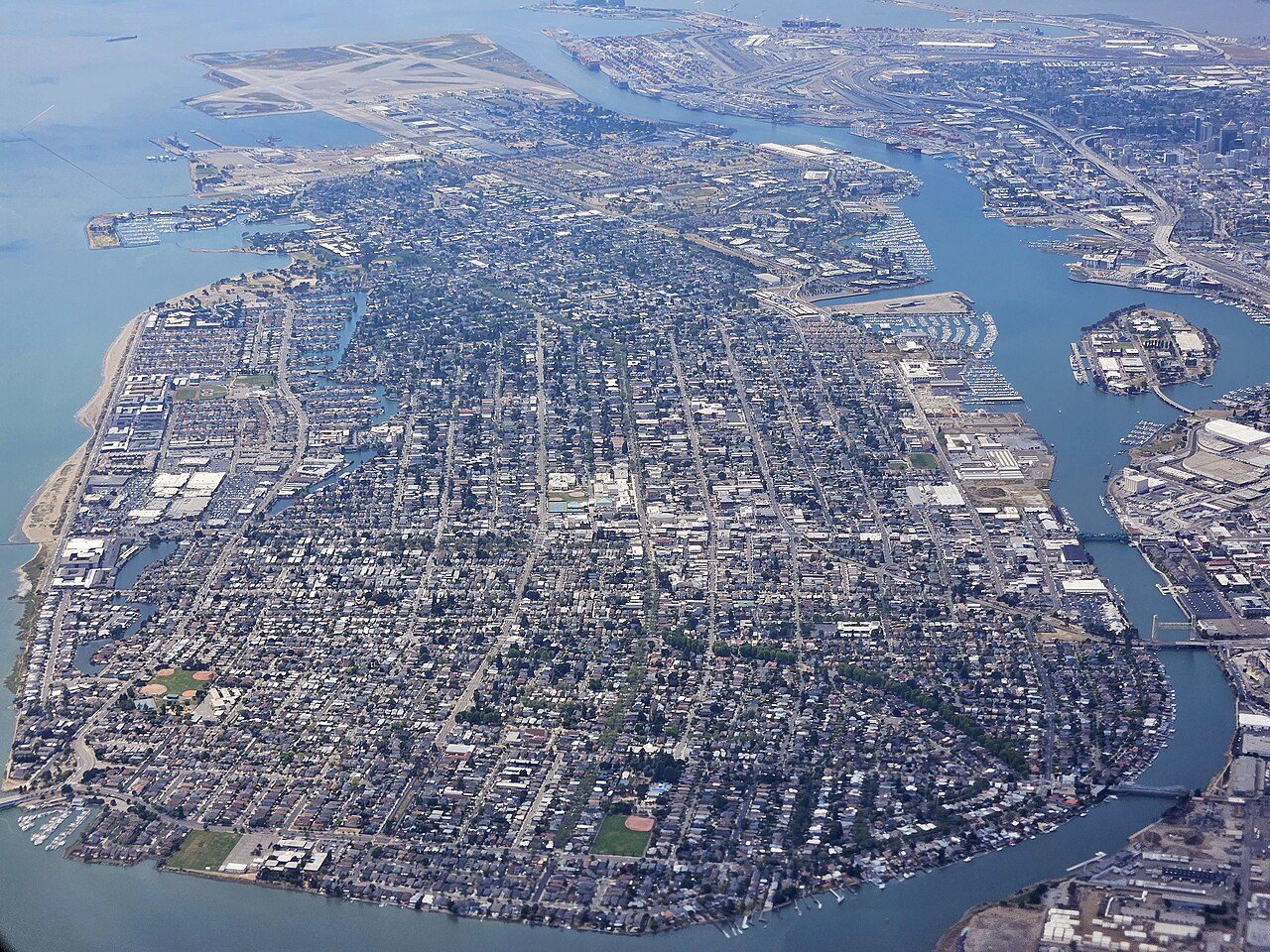
East Bay homes move fast once listed. Per Redfin, for the three months ending June 2026, median days on market was 15 in Berkeley, 17 in Alameda, 20 in Oakland and 13 in Piedmont. That is the window everyone pictures when they think about selling, and it is the least consequential part of the process, because by then every decision that mattered has been made.
The work sits in the eight to ten weeks before. Financing and title first, because they can change whether you sell this year at all. Insurance and inspections next, because what they turn up determines the repair scope. Repairs, then staging, then photography, in that order and no other. Pricing last, once you know what you are selling.
The seller's job in that stretch is to make decisions and sign things, not to manage a vendor calendar. If you are brokering a scheduling conflict between your painter and your stager, the model has broken down.

What this is not
It is not free, and it is not a promise about price. No one can guarantee a sale price or a rate of appreciation, and an agent who does is telling you something they cannot know.
The specialists are paid by you, directly, at their own rates. We charge a 2.5% seller-paid listing commission for our part. Those are separate. What we do not do is take a referral fee, kickback or marketing payment from any vendor we send you to, which is the whole reason the recommendation is worth anything. If a stager is on our list, it is because of how their last twelve jobs performed. That policy has its own explanation in why we do not accept referral fees.
It is also not a full cost accounting. Transfer tax and county recording fees are verifiable in advance; title, escrow and commission vary and are negotiable, which is why I break them out line by line rather than quoting one percentage in what it costs to sell a house in Oakland.
Where the coordination earns its keep right now
Fire and insurance. On August 19, 2026 the California Board of Forestry and Fire Protection voted 8–0 to approve the final draft of its Zone 0 defensible space regulations, creating an ember-resistant band in the first five feet around a structure in high-hazard areas. The rule is not yet in effect — it now goes to the Office of Administrative Law for review, and no effective date has been set. Once it does take effect, new construction complies immediately and existing homes phase in over roughly three and five years, while AB 1455 gives rentals no phase-in and requires property being sold to comply on sale or within three years, whichever is sooner; confirm the current status at bof.fire.ca.gov. For a hills seller, that is an insurance broker conversation in week one, not a repair request in week seven.
Transfer tax timing. Berkeley's Measure W takes effect January 1, 2027, moving the city transfer tax to 2.5% at $1.6 million, 3.0% at $1.9 million and 3.5% at $3.0 million, with thresholds adjusted annually and recalculated before the effective date. Whether that changes your listing date is a planning question with a deadline.
Title and taxes. The federal primary residence exclusion under IRC section 121 is $250,000 single and $500,000 married filing jointly, with ownership and use tests of 24 of the last 60 months. California taxes capital gains as ordinary income, per the Franchise Tax Board. If the property sits in a trust, or a Proposition 19 parent-to-child transfer is contemplated, those are attorney and CPA questions that belong before listing. Confirm all of it with your own CPA and attorney.
How we run this is on our approach; the questions to ask any agent are in how to choose a listing agent.
Frequently asked questions
What does a wraparound advisory team actually do?
It coordinates six categories of licensed specialist around your sale: financing, insurance, design and renovation, staging, financial planning and estate planning. Each is brought in at a specific point, mostly in the eight to ten weeks before listing. The seller makes decisions rather than managing vendors. The agent's job is sequencing.
Do I pay extra for the specialists?
Yes, separately and directly. Each specialist sets and collects their own fee. Our listing commission is 2.5%, seller-paid, and covers our work only. We accept no referral fee, kickback or marketing payment from any specialist we recommend, so who we suggest is not influenced by what we would be paid.
When should I start the process before listing?
Eight to ten weeks is typical for a house needing real prep. Financing and title come first, because they can change whether you sell this year at all. Insurance and inspections follow, then repairs, staging and photography in that order. Pricing comes last. Homes needing little work compress this considerably.
How fast do East Bay homes sell once listed?
Quickly. Per Redfin, for the three months ending June 2026, median days on market was 15 in Berkeley, 17 in Alameda, 20 in Oakland and 13 in Piedmont. That speed is why the preparation window matters more than the marketing window. Once a home is live, the decisions that determine the result are already made.
Does this guarantee a higher sale price?
No, and be skeptical of anyone who says otherwise. No agent can guarantee a price or a rate of appreciation. What coordination removes is the failures actually within reach: an insurance problem surfacing during contingencies, a signature authority issue found in escrow, repairs scoped before inspections.
Sources
- Redfin, three months ending June 2026 — link
- Board of Forestry, Zone 0 final draft approved Aug 19, 2026, pending Office of Administrative Law review — link
- City of Berkeley, Measure W — link
- IRS Topic 701 — link
- California Franchise Tax Board — link
Mark Lederer leads The Lederer Team at Red Oak Realty, with 25 years and more than 1,000 closed East Bay transactions. If you are selling in the next year and want the sequence mapped before you spend money, call 510-774-4231, email [email protected], or start with a valuation of your home.