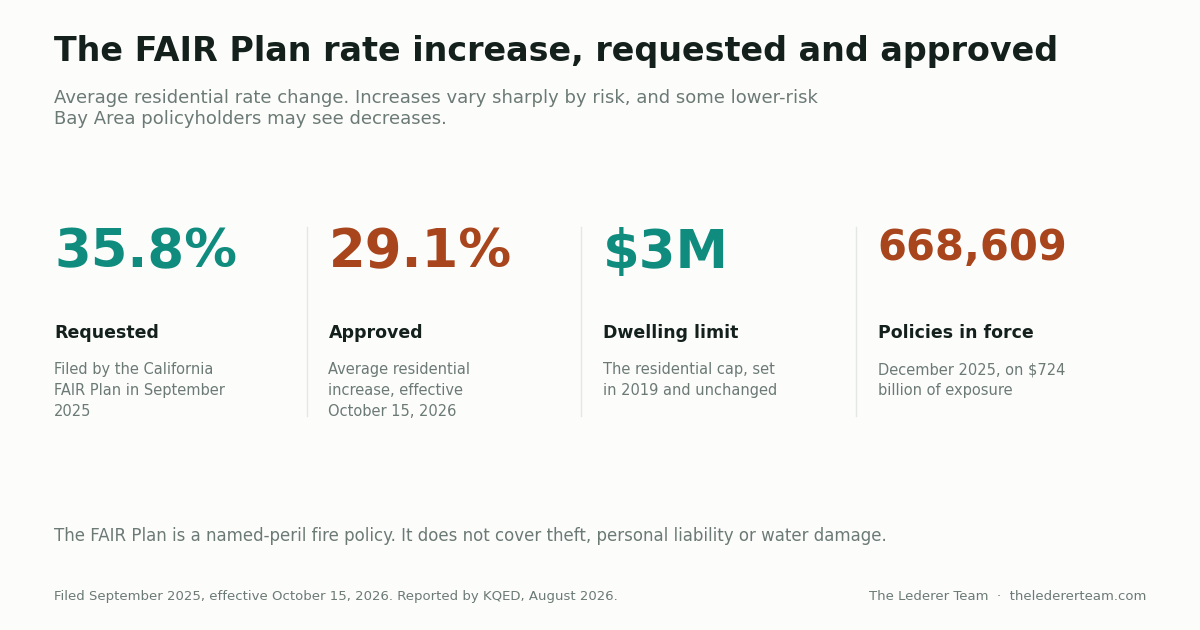
Short answer: Order insurance quotes in the first days of your contingency period, not the last. In the East Bay hills that often means two policies — a FAIR Plan dwelling policy capped at a $3 million residential limit plus a Difference in Conditions wrap — and the FAIR Plan's 29.1% average rate increase takes effect October 15, 2026.
I am a licensed real estate professional, not an insurance broker. This is mechanics; confirm specifics with a licensed insurance broker.
Why this belongs in the contingency period
Insurance is the item most buyers treat as paperwork and discover is a gate. Per the CFPB, lenders "generally require proof that you have homeowner's insurance." In practice that proof is a condition of funding. If a property is hard to place, the fix takes weeks — and you want to know while you still hold a contingency.
Two mechanics first. A quote is not a bound policy: a quote is an estimate subject to underwriting, binding is the carrier agreeing to cover the property from a date certain. Your lender needs the second. And most buyers pay premiums through an impound account — California's term for what the CFPB calls an escrow account, which the lender uses to pay property taxes and insurance from part of the monthly payment. A premium surprise arrives as a payment increase, not a bill.
The consequence is specific. Per the CFPB, if coverage lapses the lender may buy force-placed insurance and charge you; that coverage "may only cover the lender, and not you" and "may be more expensive than what you could buy on your own."
What to request, from whom, by when
California contingency periods are negotiated, not statutory. Anchor each row to your timeline.
What to request | From whom | By when |
|---|---|---|
Declarations page: carrier, perils, limits, deductibles | Listing agent | First 48 hours |
Annual premium and renewal notices | Listing agent | First 48 hours |
FAIR Plan, admitted, or surplus lines | Declarations page | First 48 hours |
Any non-renewal or cancellation notice | Seller disclosures | With disclosures |
Quotes on the address, admitted market first | Your insurance broker | Days 1-5 |
Wildfire risk score and how to lower it | The carrier, at application | Before choosing one |
Roof age and class, vents, eaves, decks | Inspection report | Before quotes are final |
Written confirmation it can bind by close | Your insurance broker | Before releasing contingencies |
Insurance figure for the impound account | Your lender | Before loan docs |
How to read the seller's declarations page
It shows what a carrier was willing to do on this house. Three things to check.
Which market it came from. A FAIR Plan policy covers named perils only: fire and lightning, internal explosion, and smoke, with optional coverages at extra cost. It is not comprehensive homeowners insurance — commonly missing are theft, personal liability and water damage, and in December 2025 a California Court of Appeal held it is not required to offer expanded liability coverage. If the seller is on the FAIR Plan, plan on two policies: the fire policy plus a Difference in Conditions wrap, which the FAIR Plan's own site calls the route to the equivalent of comprehensive coverage. That structure is in how to get homeowners insurance in the East Bay hills.
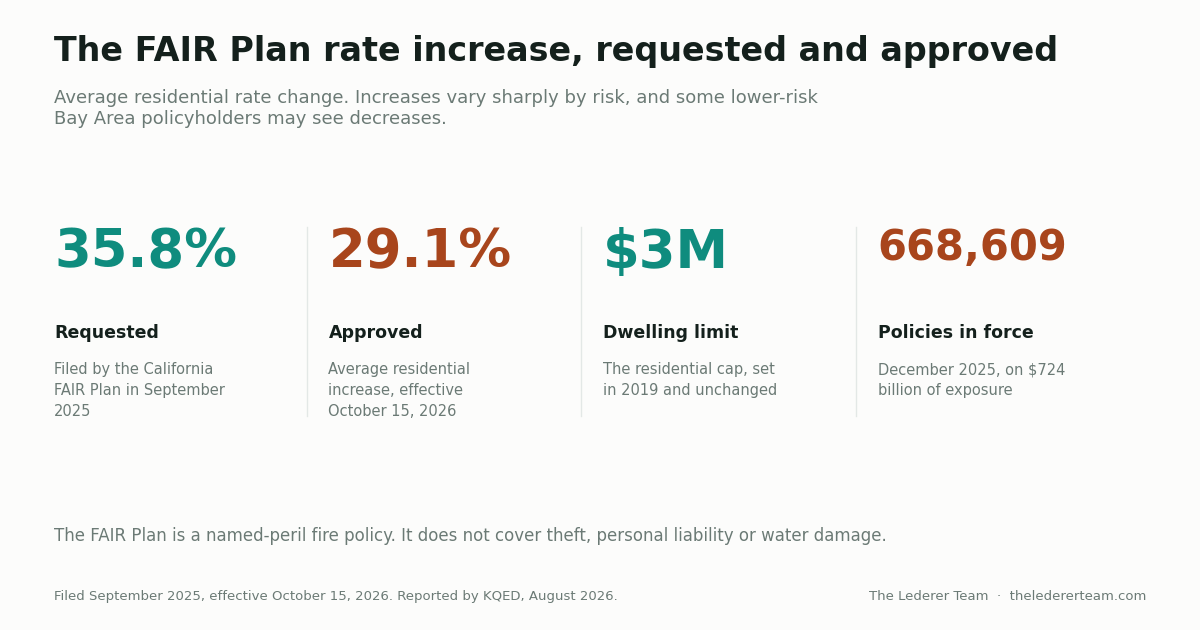
Whether the limit works. The FAIR Plan's residential dwelling limit is $3 million, set in 2019 — a cap on the fire policy, not a valuation of the house. Above it you need excess or surplus-lines coverage.
That the seller's premium is not yours. New business is underwritten fresh at current rates. FAIR Plan pricing changes October 15, 2026, when a 29.1% average increase takes effect against the 35.8% requested in a September 2025 filing, per KQED, August 11, 2026. Increases vary sharply by risk and some lower-risk Bay Area policyholders may see decreases, so ask which side of that date you bind on.
The questions that change the number
Safer from Wildfires, at 10 CCR section 2644.9 effective October 14, 2022, is leverage most buyers never use. Insurers that rate by wildfire risk must recognize twelve specified mitigation measures, disclose the property's risk score and how to lower it — at application, at renewal, and on request after mitigation work — and provide an appeals process. The FAIR Plan must offer them too. Ask in writing at application: what is the score, what moves it, how do I appeal. No verifiable percentage range for the mandated discount exists.
The voluntary route is the IBHS Wildfire Prepared Home designation, from the Insurance Institute for Business and Home Safety, an insurer-funded nonprofit. Third-party verified, in two tiers: Base for wind-blown embers, Plus adding flame and radiant-heat protection plus defensible space within 30 feet. Not part of the mandate, so recognition is carrier by carrier. Mercury Insurance's own California page lists 22.5% to 37.5% for Wildfire Prepared Home and 30% to 50% for Plus, applying only to the wildfire-peril portion and subject to underwriting approval — Mercury's figures for Mercury's product.
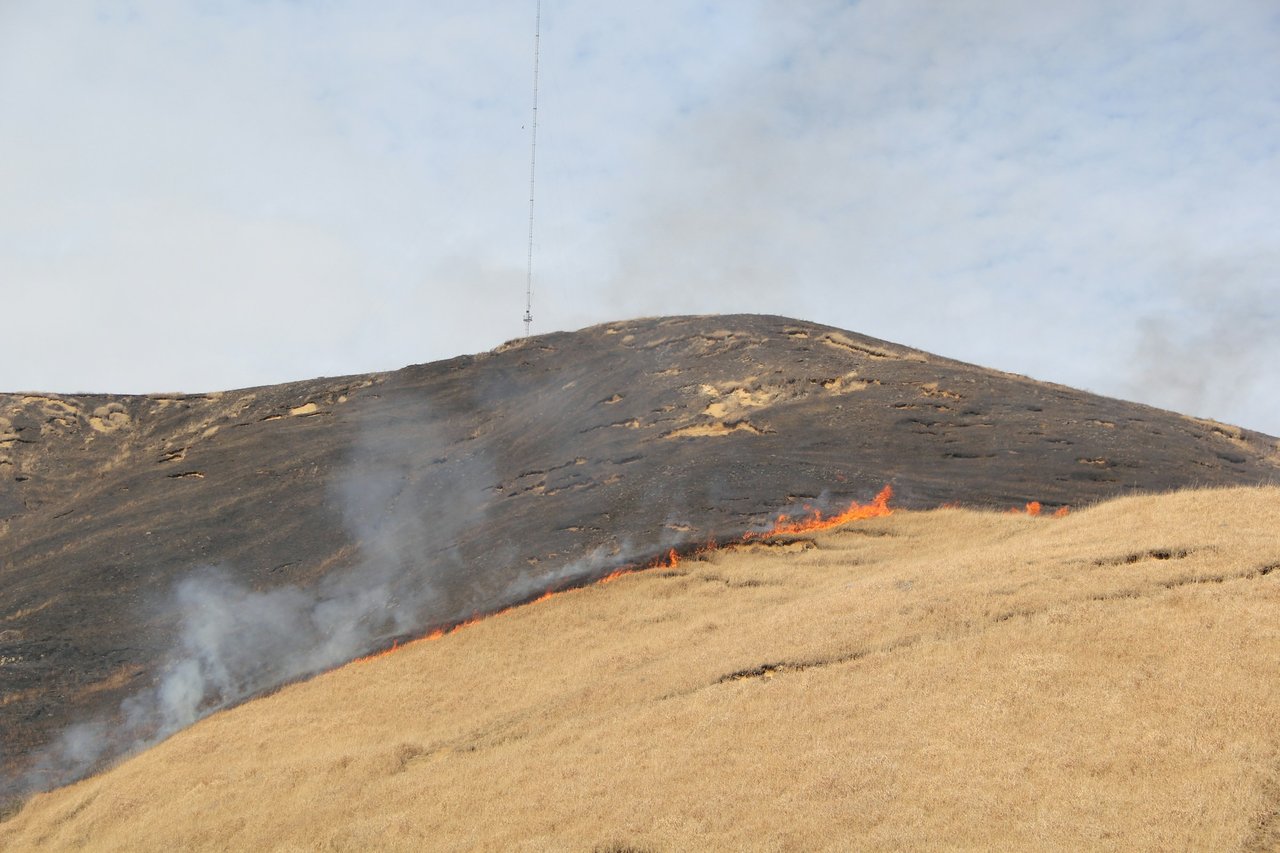
One more item is widely reported wrong. On August 19, 2026 the California Board of Forestry and Fire Protection voted 8 to 0 to approve the final draft of its Zone 0 regulations, which now go to the Office of Administrative Law for review. The rule is not in effect: no OAL file number, no Secretary of State filing, no effective date, and CAL FIRE's own site still says that while not legally required yet, Zone 0 is key for wildfire defense. Once the rule takes effect, new construction complies immediately and existing structures get roughly three years for Phase 1 and five for Phase 2 — clocks running from an effective date that does not yet exist. But AB 1455 sets earlier deadlines most coverage omits, and one points at this transaction: rental properties immediately, and properties for sale on sale or three years, whichever is sooner. Detail is in our Zone 0 post.
Consolidate, then calendar it
Multi-line consolidation is the least glamorous lever and often the largest: moving auto, property, multi-unit holdings and life to one broker often moves the total more than shopping the dwelling policy alone. And two policies mean two renewal dates and two chances to lapse — calendar both the day you close, because a lapse triggers force-placed coverage.
One backstop: Insurance Code section 675.1 bars cancellation or non-renewal for one year after a gubernatorial wildfire emergency declaration, in ZIP codes within or adjacent to the perimeter, for policyholders with less than a total loss, including no loss at all.
How we run it: our nine-person team includes six dedicated specialists in finance, mortgage, insurance, estate planning and renovation, so insurance work starts when the contract is accepted, not when the lender asks. The assessment is complimentary across auto, property, multi-unit and life; we often increase clients' coverage while decreasing their cost. In 2025, the team's sales stats placed it in the top 1.5% of agents nationwide. For that review on a specific address, see insurance planning or get in touch.
Frequently asked questions
When should I get insurance quotes when buying a house?
In the first days of your contingency period. The CFPB says lenders "generally require proof that you have homeowner's insurance," and in practice that proof is a condition of funding. A hard-to-place property can take weeks to resolve. Ordering early means a problem surfaces while you still hold a contingency.
Can I ask the seller for their insurance policy and premium?
Yes. Ask the listing agent for the current declarations page, the annual premium, and any non-renewal or cancellation notices. It shows what a carrier was willing to write on this house. It does not fix your pricing: new business is underwritten fresh at current rates.
What is an impound account and how does insurance affect it?
An impound account is California's term for what the CFPB calls an escrow account: the lender collects part of your monthly payment and pays property taxes and homeowners insurance from it. A higher premium raises your payment rather than arriving as a bill, at the next escrow analysis.
What is force-placed insurance?
It is coverage your lender buys if your policy lapses, and charges to you, with advance notice. The CFPB's warning is the point: it "may only cover the lender, and not you," and "may be more expensive than what you could buy on your own." Tracking renewal dates prevents it.
Do I have to do Zone 0 work when I buy an East Bay hills home?
Not yet. On August 19, 2026 the Board of Forestry approved the final draft of its Zone 0 regulations, which now go to the Office of Administrative Law for review. There is no effective date, and CAL FIRE's own site still says it is not legally required yet. Once the rule takes effect, AB 1455 sets earlier deadlines: rentals immediately, and properties for sale on sale or three years, whichever is sooner.
Sources
- CFPB, homeowners insurance requirements — link
- California FAIR Plan Association — link
- CDI, FAIR Plan limits, March 28, 2025 — link
- KQED, FAIR Plan rate increase, August 11, 2026 — link
- CDI, Safer from Wildfires FAQ — link
- CDI, non-renewal moratorium — link
- Mercury Insurance, wildfire mitigation — link
- Board of Forestry, Zone 0 — link
- CAL FIRE, defensible space — link
Mark Lederer leads The Lederer Team at Red Oak Realty — 25-plus years and 1,000-plus closed East Bay transactions, with a dedicated insurance expert among the team's six specialists. To close the insurance question before contingencies come off, call 510-774-4231 or email [email protected]. Confirm coverage with a licensed insurance broker.