Short answer: Ask seven questions, and pay closest attention to the first. If an agent leads with a sale-to-list ratio, that number is an artifact of how this region prices homes, not a measure of their work. The metric that holds up is the share of their listings that sold above list, against your city's benchmark.
Why the usual agent interview fails
The standard listing appointment is structured to prevent the seller from learning anything. Three agents come through, each presents a market analysis and a price, and the seller picks whoever named the highest number or seemed most likeable. Neither predicts what happens.
The suggested price is the weakest signal, because it costs nothing to say. An agent who wants the listing can name a number 8% high, take it, and spend six weeks walking you back down to where the market was. By then you have lost the two weeks of attention that mattered.
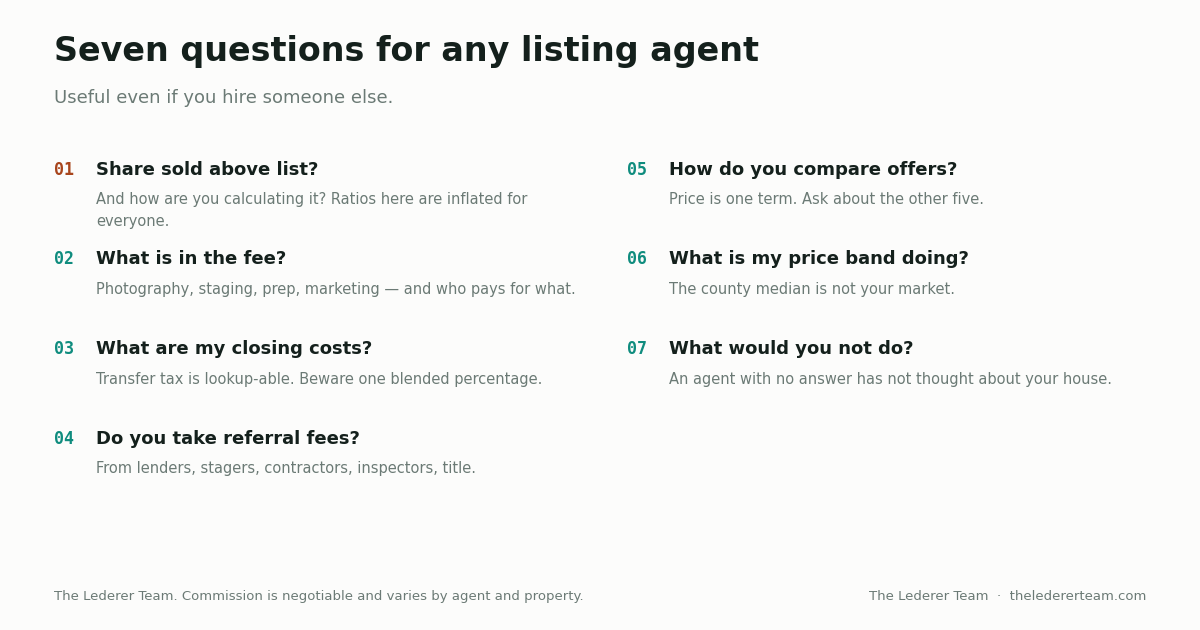
These seven are hard to answer with charm, and most have a right answer you can verify afterward. Ask them of every agent you interview, including me. This is useful even if you hire someone else.

The seven questions
1. What share of your listings sold above asking, and how are you calculating it?
This one separates people fast. The East Bay lists below expected value to generate multiple offers, so sale-to-list ratios here run high enough to be an artifact of the convention rather than a measure of anyone's work. That is not negotiating skill. It measures how far below value the list price was set, and looks similar for almost any agent here.
The sound metric is the share of homes that sold above list: binary, and hard to game. Benchmarks, all Redfin, three months ending June 2026, same methodology across every row:
Market | Median sale | Median DOM | % sold above list | Homes sold |
|---|---|---|---|---|
El Cerrito | $1,179,358 | 14 | 90.4% | 52 |
Piedmont | $3,198,260 | 13 | 91.3% | 46 |
Berkeley | $1,509,179 | 15 | 83.1% | 228 |
Alameda | $1,184,855 | 17 | 70.3% | 158 |
San Leandro | $888,017 | 15 | 69.5% | 127 |
Oakland | $898,511 | 20 | 68.5% | 805 |
Richmond | $649,646 | 17 | 64.0% | 207 |
Contra Costa County | $842,623 | 18 | 49.9% | 992 |
With that context: if an agent's Oakland listings cleared list 70% of the time, that is the market, not outperformance. Ask over how many listings, and in which cities. Ten is a track record. Two is a coincidence.
2. How did you arrive at this price, and what happens if week two comes and goes?
Every agent has a pricing answer. Fewer have a failure plan, and that is the real information: it tells you whether the price was set to sell or to win the listing.
Speed is the thing to understand. Median days on market for the three months ending June 2026 ran from 13 in Piedmont to 20 in Oakland, with Berkeley and San Leandro at 15. In a market that moves in two to three weeks, a home sitting past day 21 sends a signal every buyer's agent reads.
For how rarely repricing happens when the number is right: in the Berkeley Hills in the second quarter of 2026, across 72 sales, there were only six price reductions, per The Berkeley Report. Ask what triggers a change, on what day, and what the change is. "We will reevaluate" is not a plan.
3. What is your fee, and precisely what does it cover?
Commission is negotiable and always has been. We charge a 2.5% seller-paid listing commission. What matters more than the number is whether the agent can tell you what is inside it: photography, staging, prep, marketing, and who pays for what.
Be suspicious of any agent who answers the closing-cost question with one blended percentage. Transfer tax and county recording fees can be looked up exactly; title, escrow and commission vary and are negotiable. An agent quoting a single blended percentage is estimating and calling it a fact.
4. Do you accept referral fees from anyone you send me to?
Ask it directly, and watch how fast the answer comes. Agents recommend lenders, stagers, contractors, inspectors, insurance brokers and title companies. Whether money flows back changes what the recommendation is worth.
We accept no referral fees from any partner, so a recommendation from us is only about performance. Other arrangements exist and are not necessarily improper, but you are entitled to know which one you are in. The reasoning is in why we do not accept referral fees.
5. Who on your team does what, and who will be at my house?
Plenty of sellers hire the person who came to the listing appointment and never see them again. That is fine if the team is real and the handoff explicit, not fine when nobody told you.
Ask who writes the strategy, who runs the prep, who is present for inspections, and who is on the phone when offers come in. Our team is three people, Mark Lederer, Derrick Tyler and Mio Sullivan, coordinating six categories of specialist: financing, insurance, design and renovation, staging, financial planning and estate planning. What that looks like week by week is in what a wraparound advisory team does, and the model is on our approach.
6. What do the disclosures, hazard zones and transfer taxes on my specific address look like?
This is the fastest way to find out whether an agent knows the local rules.
On disclosure: the Transfer Disclosure Statement is statutory under Civil Code section 1102 and following, required on most residential sales of one to four units. The Seller Property Questionnaire is a California Association of Realtors form most Bay Area sellers also complete. It is not a statute, and an agent who says the SPQ is required by law has not checked. The Natural Hazard Disclosure under Civil Code section 1103.2 covers six zones, four of which commonly trigger in the Berkeley and Oakland hills and across Lamorinda.
On fire: on August 19, 2026 the Board of Forestry voted 8–0 to approve the final draft of its Zone 0 defensible space regulations, creating an ember-resistant band in the first five feet around a structure. The rule is not yet in effect — it now goes to the Office of Administrative Law for review, and no effective date has been set. Confirm the current status at bof.fire.ca.gov.
On transfer tax, city rules differ enough to change your net by five figures:
- Berkeley: $15.00 per $1,000 up to $1.7 million, $25.00 above. Measure W takes effect January 1, 2027: 2.5% at $1.6 million, 3.0% at $1.9 million, 3.5% at $3.0 million.
- Richmond: $7.00 per $1,000 under $1 million, $12.50 from $1 million to $3 million, applied to the full value rather than marginally. A $999,999 sale owes $7,000; a $1,000,001 sale owes $12,500.
- Oakland: $15.00 per $1,000 from $300,000 to $2 million; $17.50 from $2 million to $5 million.
- El Cerrito: $12.00 per $1,000. Lafayette, Orinda, Moraga, Walnut Creek, Danville, Kensington: none.
An agent who cannot tell you which applies to your address has not done the work. Confirm with the city and your title officer.
7. How will you present offers, and how will you compare them?
The highest number is not always the best offer, and that conversation should happen before offers arrive, not in the twenty minutes you have to respond. Ask how contingencies, financing type, deposit, close timeline and rent-back are weighted against price, in writing.
Ask also how they handle an offer that arrives before the scheduled offer date. That decision alone can cost or make a seller real money, and it comes up constantly. My method is in how we compare offers.

What no agent can promise
No one can guarantee your sale price, appreciation, a carrier's decision, a buyer's loan approval or an appraisal.
An agent can promise a process, a schedule, a fee and honest reporting. Guaranteeing an outcome describes something they do not control. Timing is the same: the honest version is a set of tradeoffs, which is how I handle it in fall versus spring.
Tax and legal questions belong to your CPA and attorney, and any agent should say so. The federal primary residence exclusion under IRC section 121 is $250,000 single and $500,000 married filing jointly, with ownership and use tests of 24 of the last 60 months. California taxes capital gains as ordinary income, per the Franchise Tax Board. Proposition 19's parent-to-child exclusion applies only to a principal residence or family farm, at current taxable value plus $1,044,586 through February 15, 2027. Those are verifiable facts, not advice.
Frequently asked questions
What should I ask a listing agent before hiring them?
Ask what share of their listings sold above asking and how they calculate it, how they set price and what triggers a change, what the fee covers, whether they take referral fees, who on the team does the work, what the transfer tax rules are for your address, and how they compare offers.
Why is a sale-to-list ratio a bad way to judge an East Bay agent?
Because the East Bay lists below expected value on purpose, so ratios run inflated for nearly everyone. Published East Bay sale-to-list figures measure how far under value the list price was set, not negotiating skill. The share of listings that sold above list is binary and harder to game.
What is a normal listing commission in the East Bay?
Commission is negotiable and varies by agent and property. Our listing commission is 2.5%, seller-paid. What matters as much as the rate is what it includes, so ask about photography, staging, prep and marketing. Be wary of any agent who quotes total closing costs as one blended percentage.
Should I hire the agent who suggests the highest price?
Not on that basis. Suggesting a high price costs an agent nothing and is the easiest way to win a listing. With median days on market running 13 to 20 across East Bay cities for the three months ending June 2026, an overpriced home burns its best two weeks. Ask what the plan is if week two passes.
Is the SPQ required by law in California?
No. The Transfer Disclosure Statement is statutory under Civil Code section 1102 and following, required on most residential sales of one to four units. The Seller Property Questionnaire is a California Association of Realtors form most Bay Area sellers also complete, but it is not a statute. Confirm your obligations with your attorney.
Does the city I live in change what I net at closing?
Substantially. Berkeley charges $15.00 per $1,000 up to $1.7 million and $25.00 above, and Measure W raises that on January 1, 2027. Richmond applies $12.50 per $1,000 to the full value from $1 million, so a $1,000,001 sale owes $12,500 while a $999,999 sale owes $7,000. Lafayette, Orinda and Moraga charge none.
Sources
- Redfin, three months ending June 2026 — link
- The Berkeley Report, Berkeley Hills, Q2 2026
- Board of Forestry, Zone 0 final draft approved Aug 19, 2026, pending Office of Administrative Law review — link
- City of Berkeley, Measure W — link
- Alameda and Contra Costa Clerk-Recorder schedules — link
- IRS Topic 701 — link
- Board of Equalization, Prop 19 — link
Mark Lederer leads The Lederer Team at Red Oak Realty, with 25 years and more than 1,000 closed transactions across the East Bay. Ask us these seven the same way you would ask anyone else. Call 510-774-4231, email [email protected], or start with a valuation of your home.