Short answer: California requires a written buyer representation agreement signed as soon as practicable and no later than your offer — Civil Code § 1670.50, effective January 1, 2025. It must state compensation, the services rendered, when compensation is due, and how the contract terminates. The term is capped at three months, which the DRE defines as 90 calendar days.
What changed, and when
Two things happened months apart and get blended together constantly. The first was the NAR settlement practice change, effective August 17, 2024. MLS Participants must now have a written agreement with a buyer before touring a home, and it must specify and conspicuously disclose the compensation amount or rate, state that the participant may not receive more than that amount, and disclose that broker commissions are not set by law. Separately, offers of compensation are no longer permitted on the MLS, though seller concessions can still appear there and compensation can still be negotiated off-MLS. The settlement received final approval November 26, 2024 in the Western District of Missouri, NAR's share $418 million over four years, and the Eighth Circuit affirmed it August 19, 2026 in Burnett v. Spring Way Center, LLC, No. 24-3444. This is settled law.
The second was California's own statute. AB 2992 (Chapter 516, Statutes of 2024) took effect January 1, 2025 and added Civil Code § 1670.50. Cite it correctly — § 1670.50, not § 2079.14, which is the section it gets confused with in a lot of published summaries.
The four terms § 1670.50 requires
A California buyer-broker representation agreement must contain four things. Where one reads vaguely, that vagueness is the negotiation.
Required term | What to actually look for |
|---|---|
Compensation | A number or a rate, stated plainly. Not "as customary." Under the NAR disclosure requirement your broker may not receive more than this figure. |
Services to be rendered | What the broker is obligated to do. A one-line description obligates almost nothing. Ask for the list you were promised verbally. |
When compensation is due | Usually close of escrow — read whether anything triggers it earlier, or after the term ends. |
Contract termination | How you get out, and in what form. The term buyers skip and later wish they had read. |
This is general information, not legal advice — have a real estate attorney review anything ambiguous before you sign.
Three months means 90 calendar days, and violating it voids the agreement
This is the part of California law with teeth. The maximum term is three months, except where the buyer is a corporation, LLC or partnership. There is no automatic renewal — renewals must be written, dated and signed, and are also capped at three months. The consequence is blunt: a violation of the duration or renewal rules makes the agreement void and unenforceable. Not voidable at a judge's discretion. Void.
The Department of Real Estate's implementing regulations, 10 CCR §§ 2906.1–2906.3, define the term. "Three months" means 90 calendar days, beginning the day after the last party signs. A document handed to you with a twelve-month term is not a tough negotiating posture — it is a defective document.
Before touring, or before the offer? The rules are not identical
Three different rules point at three different moments.
- The NAR practice change says an MLS Participant must have a written agreement with you prior to touring a home. It binds your agent through MLS participation.
- Civil Code § 1670.50 says the agreement must be executed as soon as practicable, but no later than the execution of your offer to purchase. It governs the contract.
- The DRE regulations add a rebuttable presumption that it is practicable to sign before showing a property — pushing "as soon as practicable" back toward the showing.
The practical answer for a California buyer is: expect to sign before you tour. But an agent saying "the law says you must sign before I can open this door" is describing the MLS rule and the DRE presumption, not the statutory deadline, which is the offer. That is not a reason to refuse — it is the difference between signing something you understand and signing because you were told to.
Who pays your agent now: BRBC and SPBB
Because compensation no longer appears on the MLS, it is asked for deal by deal, through two C.A.R. forms. The BRBC (Buyer Representation and Broker Compensation Agreement) establishes your obligation to pay your broker. The SPBB (Seller Payment to Buyer's Broker), used with RPA paragraph 3G(3), asks the seller to pay all or part of it.
Read them together and the structure is clear: the obligation is yours, and the SPBB is an attempt to move it. Anything the seller declines to cover stays with you, in cash, at close. Ask your lender how a seller payment to your broker is treated before you write the offer.
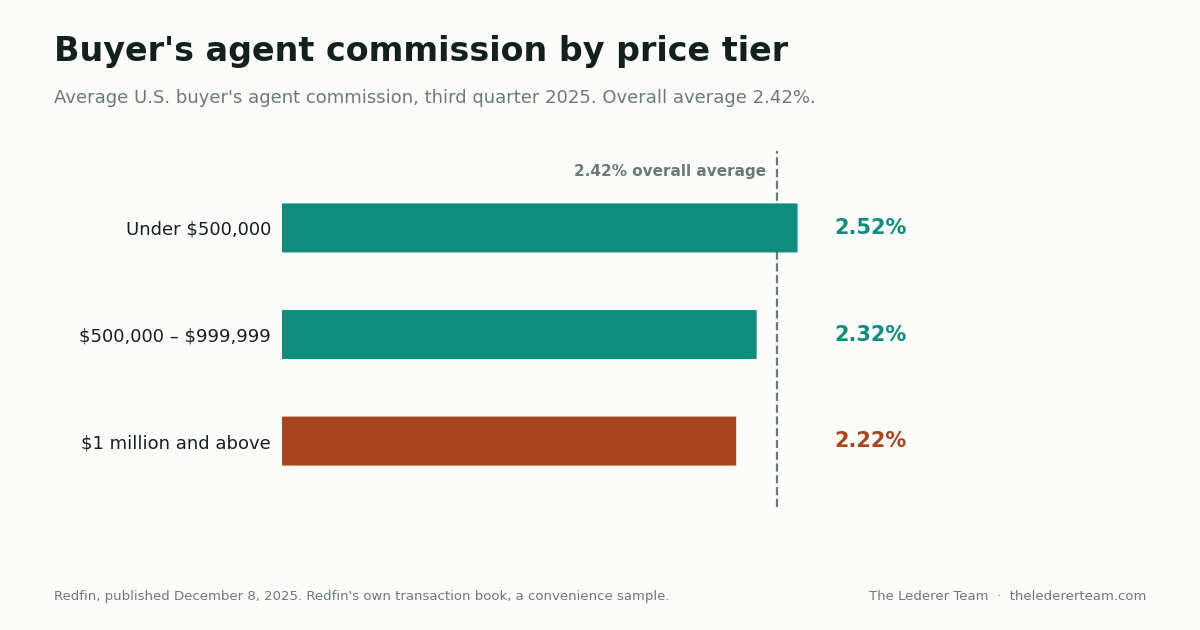
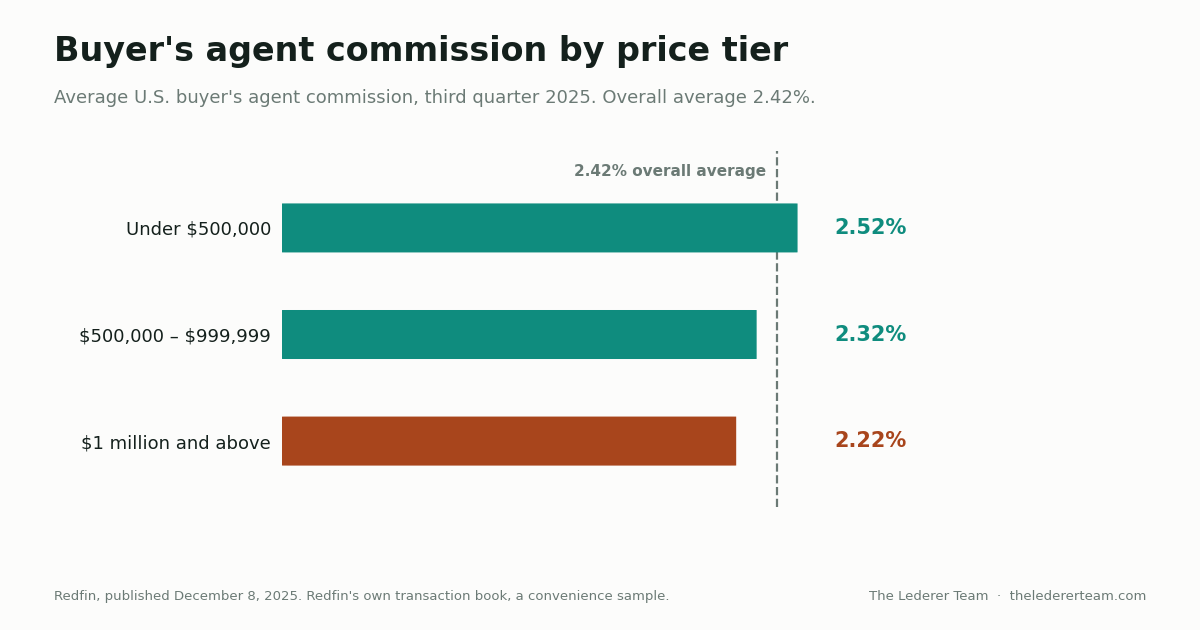
On the number itself, be careful. The only citable measurement is Redfin's: the average U.S. buyer's agent commission was 2.42% in Q3 2025, up from 2.36% a year earlier, published December 8, 2025, and 2.22% on sales of $1 million and above. Methodology matters: that is Redfin's own transaction book, a convenience sample rather than a market-wide census. And there is no verified California or East Bay average commission figure — anything quoted as one is not sourced. Locally it matters that medians vary widely — $1,509,179 in Berkeley against $898,511 in Oakland over the three months ending June 2026, per Redfin — so which Redfin price tier your purchase falls into depends heavily on the city.
What to negotiate before you sign
You can ask for changes. Commissions are not set by law, and neither is the rest of the document.
- Term length. Ninety days is the ceiling, not a requirement. Ask for 30 to test the relationship first.
- Termination. Ask how you cancel and what notice is required, and get it in the document.
- Scope. Ask whether it covers every property everywhere, or a defined area and property type.
- The compensation gap. Ask directly: if the seller pays less than the agreed rate, what do I owe.
- Services. Ask for the specific work, listed. An agent who cannot put it in writing may not be doing much of it.
How we handle it
We walk through the BRBC line by line before anyone signs, and we answer the compensation-gap question in writing rather than at the negotiating table. Our buyer representation process was built over 20 years, and what holds it up is the bench: three real estate advisors and six dedicated specialists in finance, mortgage, insurance, estate planning and renovation. Most buyers assemble that cast one referral at a time, and the pieces never talk to each other. Here they are already in the room, and the consultations are complimentary. In 2025 the team ranked in the top 1.5% of agents nationwide.
If you want the agreement explained before you are standing in a living room deciding whether to sign, reach out. Related reading: how to write fewer offers, jumbo versus conforming in the East Bay, and why the highest offer is not always the best one.
Frequently asked questions
Do I have to sign a buyer representation agreement in California?
Yes, if you want an agent to represent you. Civil Code § 1670.50 requires a written agreement as soon as practicable and no later than the execution of your offer, and the NAR practice change effective August 17, 2024 requires MLS Participants to have one before touring. You can buy unrepresented, but not be represented without it.
How long can a California buyer representation agreement last?
Three months maximum, except for corporate, LLC or partnership buyers. DRE regulations 10 CCR §§ 2906.1–2906.3 define three months as 90 calendar days starting the day after the last party signs. There is no automatic renewal — renewals must be written, dated and signed, and are capped at three months as well. Violating those rules voids the agreement.
Is a 12-month buyer agreement legal in California?
No, not for an individual buyer. Civil Code § 1670.50 caps the term at three months, and violating the duration rule renders the agreement void and unenforceable. If the document in front of you shows a six- or twelve-month term, do not sign it, and ask why it was written that way.
Who pays the buyer's agent in California now?
The C.A.R. BRBC form establishes the buyer's obligation to pay their own broker, and the SPBB form, used with RPA paragraph 3G(3), asks the seller to pay all or part of it. Since offers of compensation left the MLS on August 17, 2024, this is negotiated deal by deal. Confirm with your lender how a seller payment affects your cash to close.
Can I cancel a buyer representation agreement?
Termination is one of the four terms California law requires the agreement to contain, so the answer is in your document — read it before you sign. Ask how notice must be given and whether anything survives cancellation. Because the term is capped at 90 calendar days with no automatic renewal, your exposure is short either way.
Sources
- NAR, Written Buyer Agreements 101, effective August 17, 2024 — link
- NAR, Eighth Circuit affirms settlement, August 19, 2026 — link
- California DRE, 10 CCR §§ 2906.1–2906.3 implementing AB 2992 — link
- Redfin, buyer's agent commissions, Q3 2025, published December 8, 2025 — link
Mark Lederer leads The Lederer Team at Red Oak Realty, with 25+ years and 1,000+ closed transactions across El Cerrito, Berkeley, Albany, Kensington, Oakland, Piedmont and Alameda. To have an agreement read with you line by line before you sign, call 510-774-4231 or email [email protected].