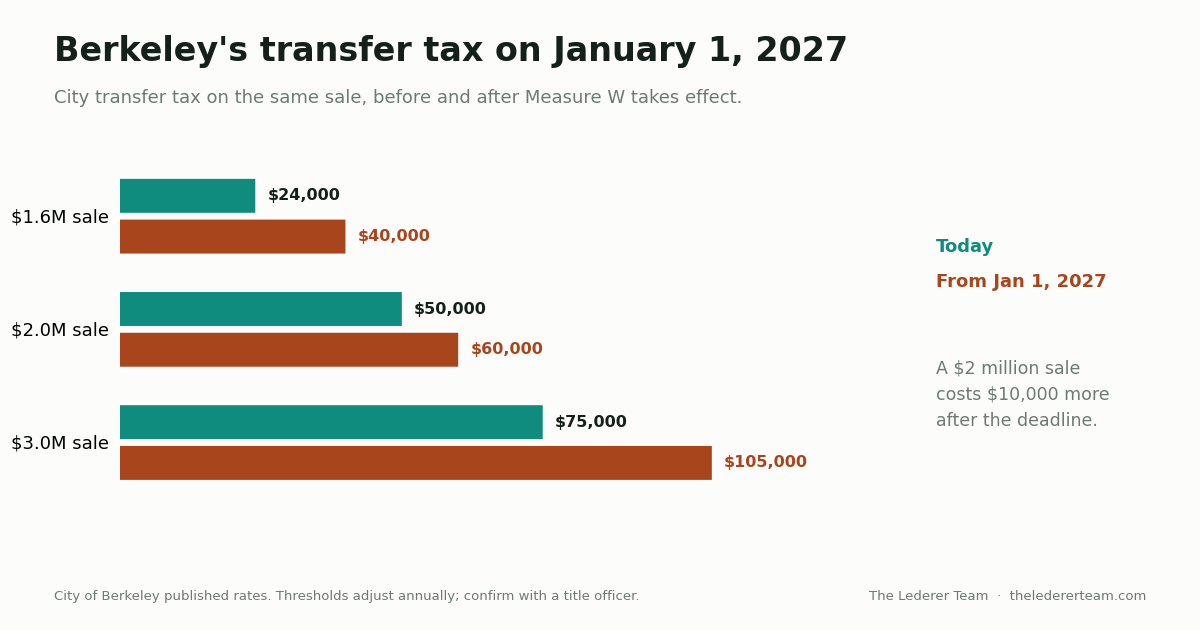
Short answer: Berkeley voters approved Measure W in November 2024. Effective January 1, 2027, the city transfer tax becomes 2.5% at $1.6 million, 3.0% at $1.9 million and 3.5% at $3 million, replacing today's 1.5% / 2.5% structure. On a $2,000,000 sale, the city's cut goes from $50,000 to $60,000 — a $10,000 difference.
What Measure W actually changes
Berkeley's city transfer tax today runs $15.00 per $1,000 of sale price up to $1.7 million, and $25.00 per $1,000 above that — 1.5% and 2.5%, expressed the way a title officer writes it. Measure W, approved by Berkeley voters in November 2024 and effective January 1, 2027, replaces that two-step structure with three published bands.
Sale price | City rate today (through Dec 31, 2026) | City rate under Measure W (Jan 1, 2027) |
|---|---|---|
Up to $1.6M | 1.5% ($15.00 per $1,000) | Below the first published band — confirm with the City |
$1.6M to $1.7M | 1.5% ($15.00 per $1,000) | 2.5% |
Above $1.7M to $1.9M | 2.5% ($25.00 per $1,000) | 2.5% |
$1.9M to $3.0M | 2.5% | 3.0% |
$3.0M and above | 2.5% | 3.5% |
Two things about that table deserve to be said plainly.
First, the published Measure W tiers start at $1.6 million, and the measure describes what happens at and above that line. A meaningful share of Berkeley sales fall below it: the city's median sale price was $1,509,179 in the three months ending June 2026, per Redfin. If that is your range, confirm the base rate with the City of Berkeley rather than assume it from this article.
Second, the thresholds are adjusted annually for value and recalculated before the effective date. The $1.6 million, $1.9 million and $3.0 million lines are the numbers as approved, not necessarily the numbers in force on January 2, 2027. Confirm the final figures with the City and your title officer before making a decision that turns on them.
The Alameda County documentary transfer tax is separate and is not changing. It runs $0.55 per $500, which is $1.10 per $1,000, and it applies on top of whatever the city charges.
What the change costs on a real sale
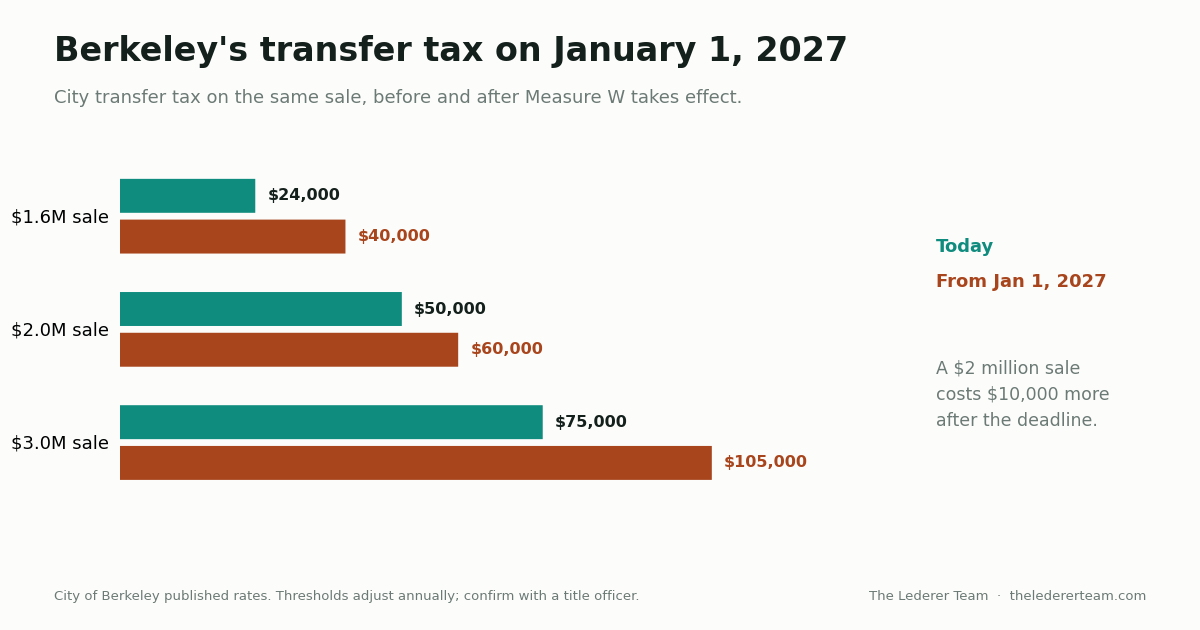
Here is the worked example, as an illustration rather than a quote. A $2,000,000 Berkeley sale closing today falls in the 2.5% band and owes $50,000 in city transfer tax. The same $2,000,000 sale closing on or after January 1, 2027 falls in the 3.0% band and owes $60,000. The difference is $10,000.
Run that across the range where most Berkeley houses trade and the picture gets more textured. City transfer tax only, county tax excluded, at the rates as approved:
Sale price | City transfer tax today | City transfer tax from Jan 1, 2027 | Difference |
|---|---|---|---|
$1,600,000 | $24,000 | $40,000 | $16,000 |
$1,750,000 | $43,750 | $43,750 | $0 |
$1,900,000 | $47,500 | $57,000 | $9,500 |
$2,000,000 | $50,000 | $60,000 | $10,000 |
$2,500,000 | $62,500 | $75,000 | $12,500 |
$3,000,000 | $75,000 | $105,000 | $30,000 |
The largest jump is not at the top. It is at $1.6 million, where a sale taxed at 1.5% today pays 2.5% in 2027 — a $16,000 swing on a house that is, by Berkeley standards, ordinary. A seller at $1,750,000 sees no change, because that price already sits in the 2.5% band. A seller at $3 million sees $30,000, because the top band moves a full point.
These bands apply to the full sale price rather than only to the amount above each threshold, which is why each step is abrupt. Ask your title officer to run your number. Banded taxes are unforgiving at the margins, and a few thousand dollars of price can move you across a line.
Who actually pays it
In Berkeley, transfer tax is customarily negotiable between buyer and seller. No rule assigns it to one side. The split is a deal term, like the closing date or the contingency period, negotiated with everything else.
That matters more than the rate itself. Split evenly on a $2,000,000 sale, the 2027 increase costs you $5,000, not $10,000. If the buyer takes all of it, it costs you nothing directly, though a buyer absorbing $60,000 instead of $50,000 will price that into the offer. Same money, different door.
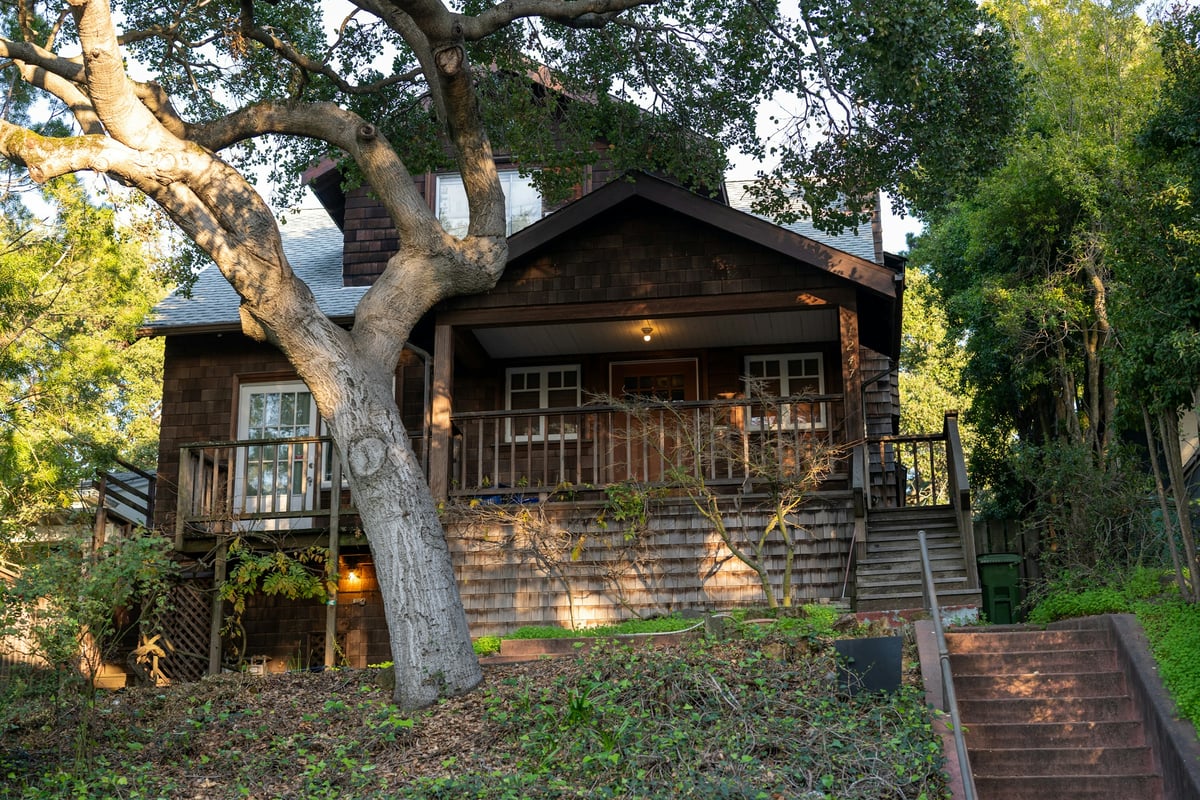
Berkeley has been a seller's market by most measures. In the three months ending June 2026, Redfin recorded 228 Berkeley sales at a median of $1,509,179, up 2.6% year over year, with a median of 15 days on market, 83.1% of homes selling above list and a Compete Score of 92. That demand generally gives a seller room to negotiate who carries a closing cost, though nothing guarantees it on any one deal.
Transfer tax is also one line on a closing statement, not the whole bill. We broke every East Bay city's rate out side by side in our city-by-city transfer tax comparison, and walked through the rest of a seller's costs in our line-by-line Oakland breakdown.
Should you move your sale into 2026?
Sometimes. Not automatically.
Start with the size of the number. On a $2,000,000 sale, $10,000 is half a percent of the price. That is real money, and smaller than the swing you get from listing in the wrong month or mispricing the house by one round number. A transfer tax deadline is a reason to plan. It is not a reason to sell a house you were not otherwise going to sell.
The case for acting in 2026 is strongest if all of the following are true:
- Your home is likely to sell between $1.6 million and $1.7 million, or above $1.9 million, where the bands actually move.
- You were already planning to sell within roughly the next year.
- You expect to carry all or most of the transfer tax in the negotiation.
- Your house can realistically be prepared, listed and closed before December 31, 2026, which means starting preparation well before the end of October.
The case for ignoring it is equally simple. If your home will sell below the first published band, or between $1.7 million and $1.9 million where the rate does not change, Measure W does not move your number. And if selling in 2026 means listing a house that is not ready, the tax saving is the smallest thing in that decision.
What the rest of the market is doing while you decide
Two conditions are worth weighing alongside the tax. East Bay inventory has run 20% to 25% below last year, per RE/MAX Accord's June 2026 reporting, which is the supply side of why homes keep selling quickly. And the 30-year fixed mortgage averaged 6.65% for the week ending August 20, 2026, per Freddie Mac's PMMS, with the 15-year at 5.95%. Those rates move independently of anything Berkeley does with its transfer tax.

Inside Berkeley, the picture is not uniform. The Berkeley Report's Q2 2026 MLS-derived data put North Berkeley at 36 sales with a median of $1,800,000, up 22% year over year, with 89% selling over list; Redfin's June 2026 figure for the same area is $1,599,444, so the honest way to state it is a range of roughly $1.60 million to $1.80 million. Berkeley Hills recorded 72 sales at a median of $1,726,000, up 7%, with 86% over list, 21 average days on market, 99 active listings and only 6 price reductions. Both medians sit in or near the bands Measure W changes, so if you own in either area this deadline is worth a real conversation. Our post on what actually moves a Berkeley home's value covers how we reach a number before the tax question comes up.
One note applying to all of the above: this is not tax or legal advice. Confirm your numbers with your CPA or attorney, and the rates with the City of Berkeley and your title officer.
Frequently asked questions
When does the Berkeley transfer tax increase take effect?
January 1, 2027. Berkeley voters approved Measure W in November 2024 with that effective date. Sales closing on or before December 31, 2026 fall under the current 1.5% and 2.5% structure; sales closing on or after January 1, 2027 fall under the new bands. The trigger is the closing date, so a deal signed in December that closes in January is taxed at the new rate.
How much is Berkeley's transfer tax right now?
The city charges $15.00 per $1,000 of sale price up to $1.7 million, and $25.00 per $1,000 above that, which is 1.5% and 2.5%. Alameda County adds its own documentary transfer tax of $0.55 per $500, or $1.10 per $1,000, on top. The county portion is not changing under Measure W. Confirm your exact figure with a title officer.
Who pays the transfer tax in Berkeley, the buyer or the seller?
It is customarily negotiable between buyer and seller in Berkeley. No rule assigns it to one side. In practice it is a deal term settled along with price, contingencies and closing date, and how it lands depends on leverage. A buyer absorbing more of the tax will usually reflect that in what they offer, so the money shows up somewhere either way.
Does Measure W apply if my Berkeley home sells for under $1.6 million?
The published Measure W tiers begin at $1.6 million, so the measure describes rates at and above that line. Berkeley's median sale price was $1,509,179 in the three months ending June 2026, per Redfin, so a substantial share of sales sit below the first band. If that is your range, confirm the base rate directly with the City of Berkeley rather than assuming it.
Should I sell my Berkeley home before January 1, 2027 to avoid the increase?
Only if you were already planning to sell and your price lands where the bands actually move. At $2,000,000 the difference is $10,000, or half a percent of the sale price. That is worth planning around, but it is smaller than the cost of listing an unprepared house or mispricing it. If you need to close by December 31, start preparation well before the end of October.
Will the $1.6 million and $1.9 million thresholds stay where they are?
Not necessarily. The thresholds are adjusted annually for value and recalculated before the effective date, so the figures in force on January 1, 2027 may differ from the numbers approved in November 2024. Treat the bands here as the approved structure rather than a final quote, and confirm current figures with the City of Berkeley and your title officer.
Sources
- City of Berkeley, Property Transfer Tax and Measure W (approved November 2024, effective January 1, 2027) — berkeleyca.gov
- Alameda County Clerk-Recorder, documentary transfer tax, 2026 — acgov.org
- Freddie Mac Primary Mortgage Market Survey, week ending August 20, 2026 — freddiemac.com
- The Berkeley Report, Q2 2026, MLS-derived neighborhood data (North Berkeley; Berkeley Hills)
Mark Lederer leads The Lederer Team at Red Oak Realty, with 25+ years and more than 1,000 closed transactions across Berkeley and the greater East Bay. If you own a Berkeley home in the $1.6 million to $3 million range, this deadline is worth an hour of planning in the fall rather than a scramble in November. Start with a real number for your house at theledererteam.com/home-valuation, or call 510-774-4231 or email [email protected].