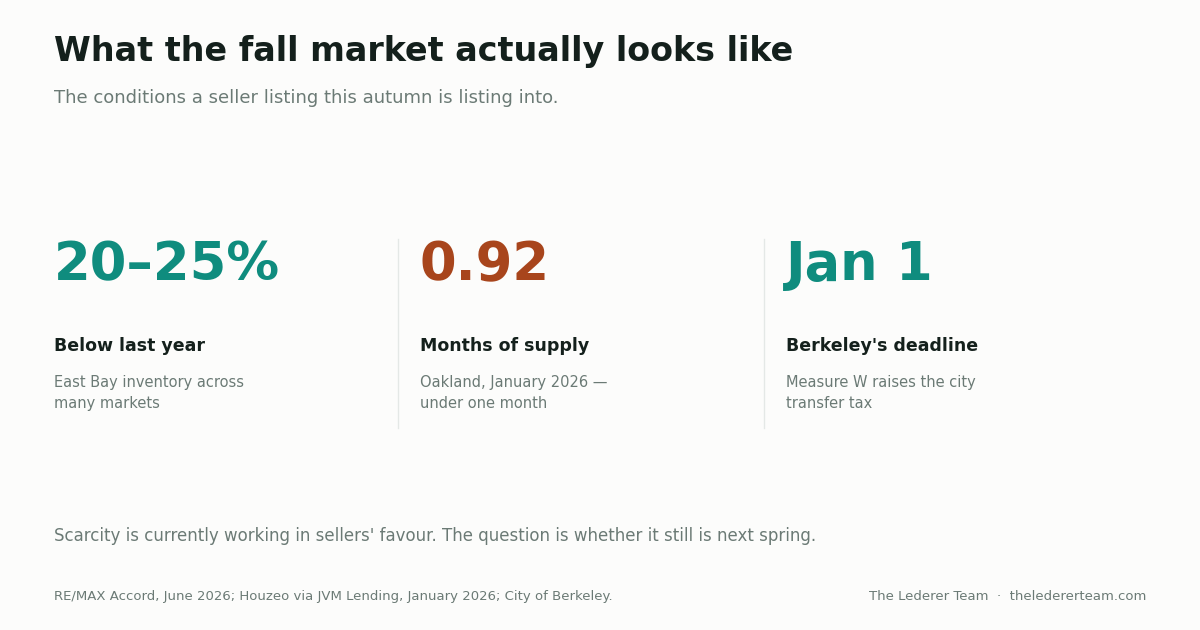
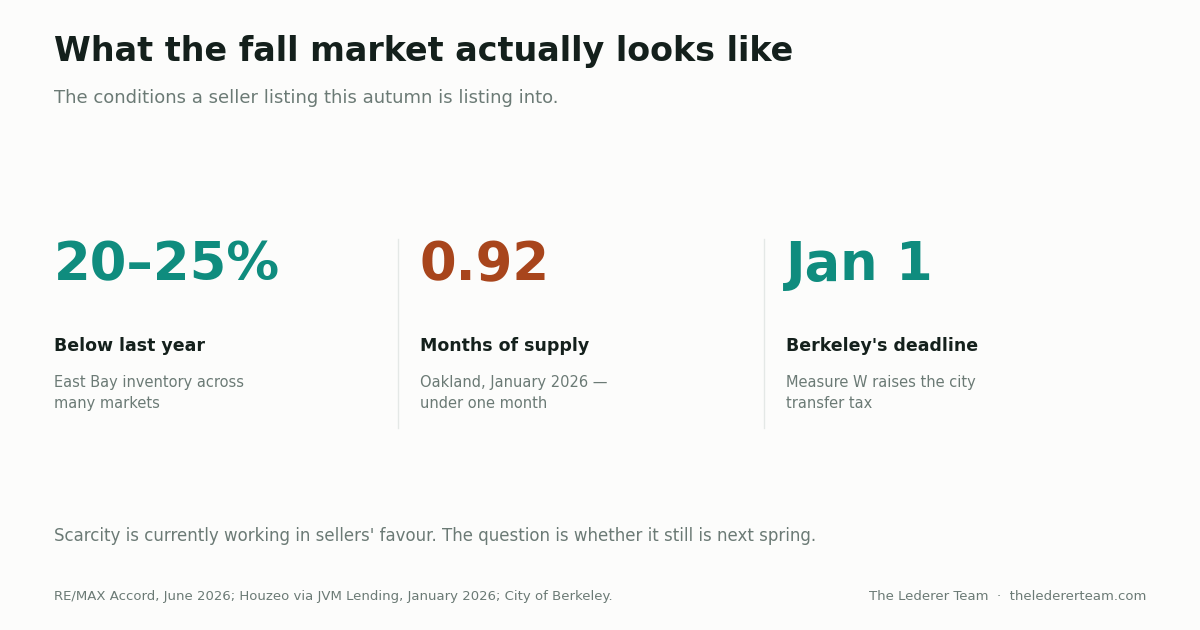
Short answer: Fall has the stronger case this year. East Bay inventory has been running 20% to 25% below last year as of June 2026, which means less competition for your listing. And for Berkeley sellers above $1.6 million, waiting past January 1, 2027 moves the sale into a higher transfer tax structure.
The case for listing this fall
The standard advice is to wait for spring because spring brings more buyers. It also brings more sellers, and in a supply-constrained market the second effect can outweigh the first.
Supply is unusually thin right now. East Bay inventory has been running 20% to 25% below last year, per RE/MAX Accord as of June 2026, and the reason is rate lock-in. The 30-year fixed averaged 6.65% in the week ending August 20, 2026, per Freddie Mac. Owners sitting on pandemic-era loans are not listing casually, and that condition does not resolve on a calendar.
Meanwhile buyers are still there. In the three months ending June 2026, East Bay homes cleared in the teens on days on market and sold above list in most cities.
Market | Median days on market | Share sold above list | Homes sold |
|---|---|---|---|
Piedmont | 13 | 91.3% | 46 |
El Cerrito | 14 | 90.4% | 52 |
Berkeley | 15 | 83.1% | 228 |
San Leandro | 15 | 69.5% | 127 |
Albany | 16 | 75.2% | 33 |
Alameda | 17 | 70.3% | 158 |
Richmond | 17 | 64.0% | 207 |
Oakland | 20 | 68.5% | 805 |
Contra Costa County | 18 | 49.9% | 992 |
Source: Redfin, three months ending June 2026, one methodology across all markets. A market where two thirds or more of listings sell above list has unmet demand. It is not one you need to wait out.
The Berkeley deadline that changes the math
If your home is in Berkeley and worth more than about $1.6 million, this is not a seasonal question. It is a deadline question.
Berkeley voters approved Measure W in November 2024. Effective January 1, 2027, it replaces the current 1.5% and 2.5% structure with 2.5% at $1.6 million and above, 3.0% at $1.9 million, and 3.5% at $3.0 million. Thresholds are adjusted annually for value and recalculated before the effective date, so confirm the final numbers with the City of Berkeley and a title officer.
As an illustration only: a $2,000,000 Berkeley sale today falls in the 2.5% band, or $50,000 in city transfer tax. The same sale on or after January 1, 2027 falls in the 3.0% band, or $60,000. The difference is $10,000. Transfer tax is customarily negotiable between buyer and seller in Berkeley, so who absorbs it depends on the deal, but the transaction costs more either way. I break it down in Berkeley's transfer tax jumps January 1, 2027.
A Berkeley listing that starts in spring 2027 is on the far side of that change. One that starts this fall, with a normal escrow, is not. That is a quantifiable reason to move, not a seasonal hunch.

What waiting until spring actually buys you
Three honest arguments:
- More buyer traffic. Spring brings more shoppers. It also brings the neighbors' listings.
- Time to prepare the property. If your house needs meaningful work, rushing it onto the market in October is worse than presenting it properly in March. Preparation outweighs season.
- Fire compliance work in the hills. On a hillside parcel with Zone 0 exposure, doing that work before listing removes a negotiating point. Winter is a reasonable time to schedule it.
What waiting does not buy you is certainty about rates or prices. Nobody can promise where either lands next spring. The thin-inventory condition, by contrast, is measurable today.

Two timing details sellers forget
Property taxes run on a fixed statewide calendar. The first installment is due November 1, delinquent after December 10, with a 10% penalty. The second is due February 1, delinquent after April 10, with a 10% penalty plus a $10 cost. A fall closing lands near that first deadline. Escrow prorates, but know which installment is yours, and confirm specifics with your CPA.
The second is capital gains. The IRC section 121 exclusion is $250,000 for a single filer and $500,000 for married filing jointly, requiring ownership and residential use for 24 of the last 60 months each. California's Franchise Tax Board treats all capital gains as ordinary income, with no preferential long-term rate. If a sale straddles tax years, the year you close matters. Have that conversation with your CPA before you list.
How to decide
Your situation | Lean |
|---|---|
Berkeley home above roughly $1.6 million | Fall, ahead of January 1, 2027 |
Market-ready today | Fall, into thin inventory |
Needs significant repair or renovation | Spring, after the work is done right |
Hillside parcel, fire compliance pending | Spring, with the work completed first |
Alameda, four indicators softening at once | Talk it through; the trend is not in your favor |
That Alameda row deserves a word. It is the only major East Bay city showing a declining median, declining price per square foot, lengthening days on market and a falling share of sales above list at once. When four indicators agree, waiting is not neutral.
Once you have a date, the work shifts to preparation, pricing and offer strategy. Read how we compare offers, because the highest number is frequently not the best deal. On choosing who runs the sale, read the seven questions that matter. For a real number rather than an estimate, request a valuation and we will show you the comps behind it.
Frequently asked questions
Is fall a good time to sell a house in the East Bay?
This fall, yes, for most sellers. East Bay inventory has been running 20% to 25% below last year as of June 2026, per RE/MAX Accord, so a well-prepared listing faces less competition than it would in spring. Demand is holding: in the three months ending June 2026, Redfin data shows homes clearing in the teens on days on market with two thirds or more selling above list in most East Bay cities.
Should Berkeley sellers close before January 1, 2027?
If your home is worth more than about $1.6 million, that date matters. Berkeley's Measure W, approved in November 2024, takes effect January 1, 2027 with rates of 2.5% at $1.6 million, 3.0% at $1.9 million and 3.5% at $3.0 million. As an illustration, a $2,000,000 sale would owe $50,000 in city transfer tax now versus $60,000 after. Thresholds are adjusted annually, so confirm final figures with the City of Berkeley and a title officer.
Will home prices be higher in spring 2027?
Nobody knows, and be skeptical of anyone who tells you otherwise. What is measurable today is that inventory is running 20% to 25% below last year and the 30-year fixed averaged 6.65% in the week ending August 20, 2026, per Freddie Mac. Those are current conditions, not forecasts. Base your timing on facts you can verify plus your own circumstances rather than on a prediction.
Does the time of year change how much a home sells for?
Less than most people assume, and less than preparation does. In the three months ending June 2026, Piedmont sold 91.3% of homes above list and El Cerrito 90.4%, while Contra Costa County as a whole was at 49.9%. Location, condition, pricing strategy and the specific block explain far more of that spread than the month a listing goes live.
What tax deadlines should I know before selling this fall?
California property taxes are due November 1, delinquent after December 10 with a 10% penalty, and February 1, delinquent after April 10 with a 10% penalty plus a $10 cost. On the sale itself, IRC section 121 excludes $250,000 of gain for single filers and $500,000 for married filing jointly, subject to ownership and residence tests. California taxes capital gains as ordinary income. Confirm all of this with your CPA.
Sources
- Redfin city data, three months ending June 2026 — link
- Freddie Mac PMMS, week ending August 20, 2026 — link
- City of Berkeley, Measure W transfer tax — link
- IRS Topic 701 — link; California Franchise Tax Board — link
Mark Lederer leads The Lederer Team at Red Oak Realty, with 25 years and more than 1,000 East Bay closings behind him, at a 2.5% seller-paid listing commission. Deciding between this fall and next spring? Call 510-774-4231 or email [email protected] and we will run your numbers.