Last week we wrote that the Fed's rate hike only lands on half of this market — that it hits the financed buyer squarely and barely touches the buyer writing checks against appreciated stock.
If you're selling, that observation isn't academic. It determines who shows up to your house, and therefore which dollars you should spend getting it ready.
Most seller advice at moments like this collapses into "price it right and make it shine." That's true and useless. Here is the more specific version.
Higher rates don't thin your buyer pool. They thin part of it.
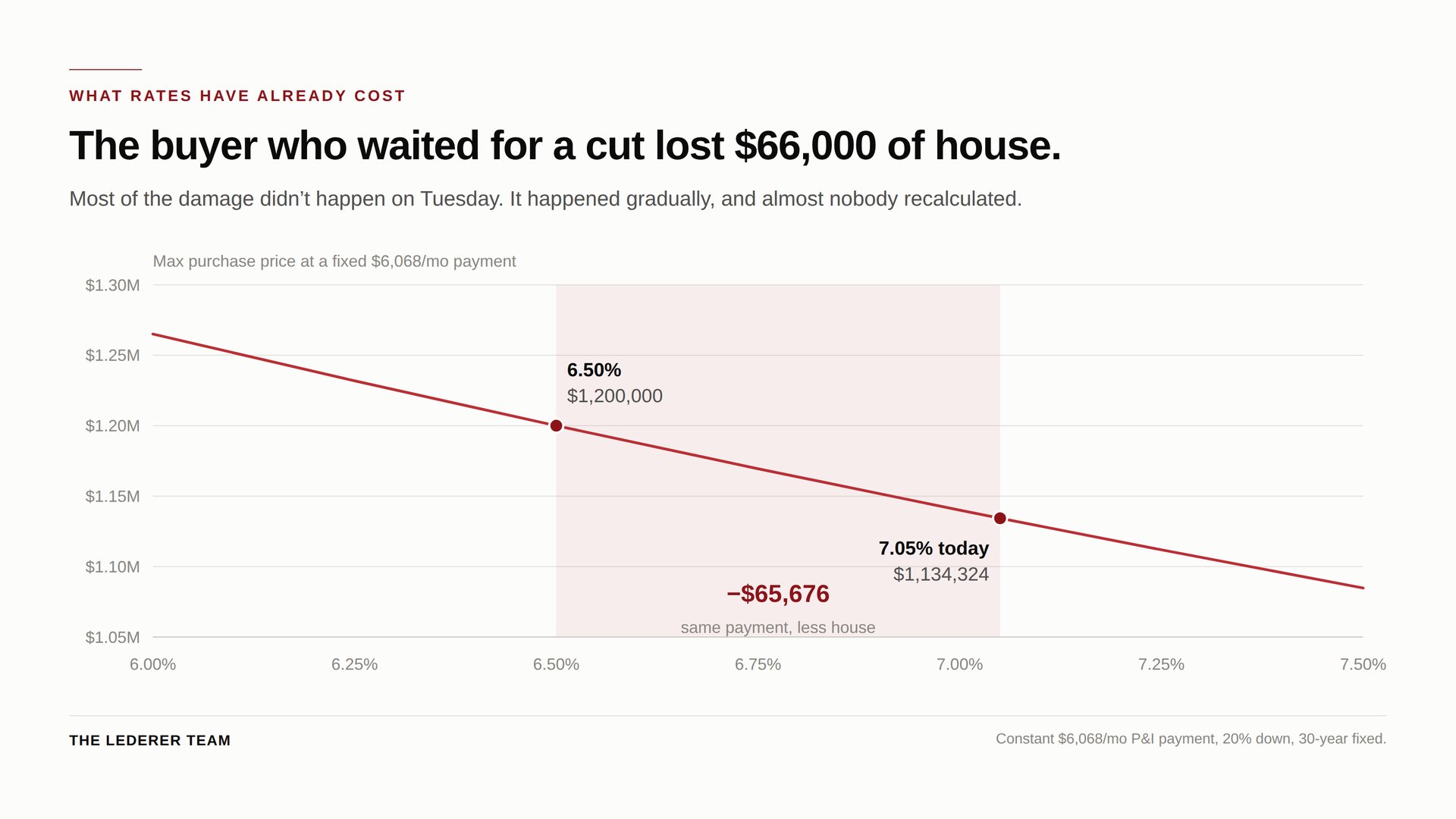
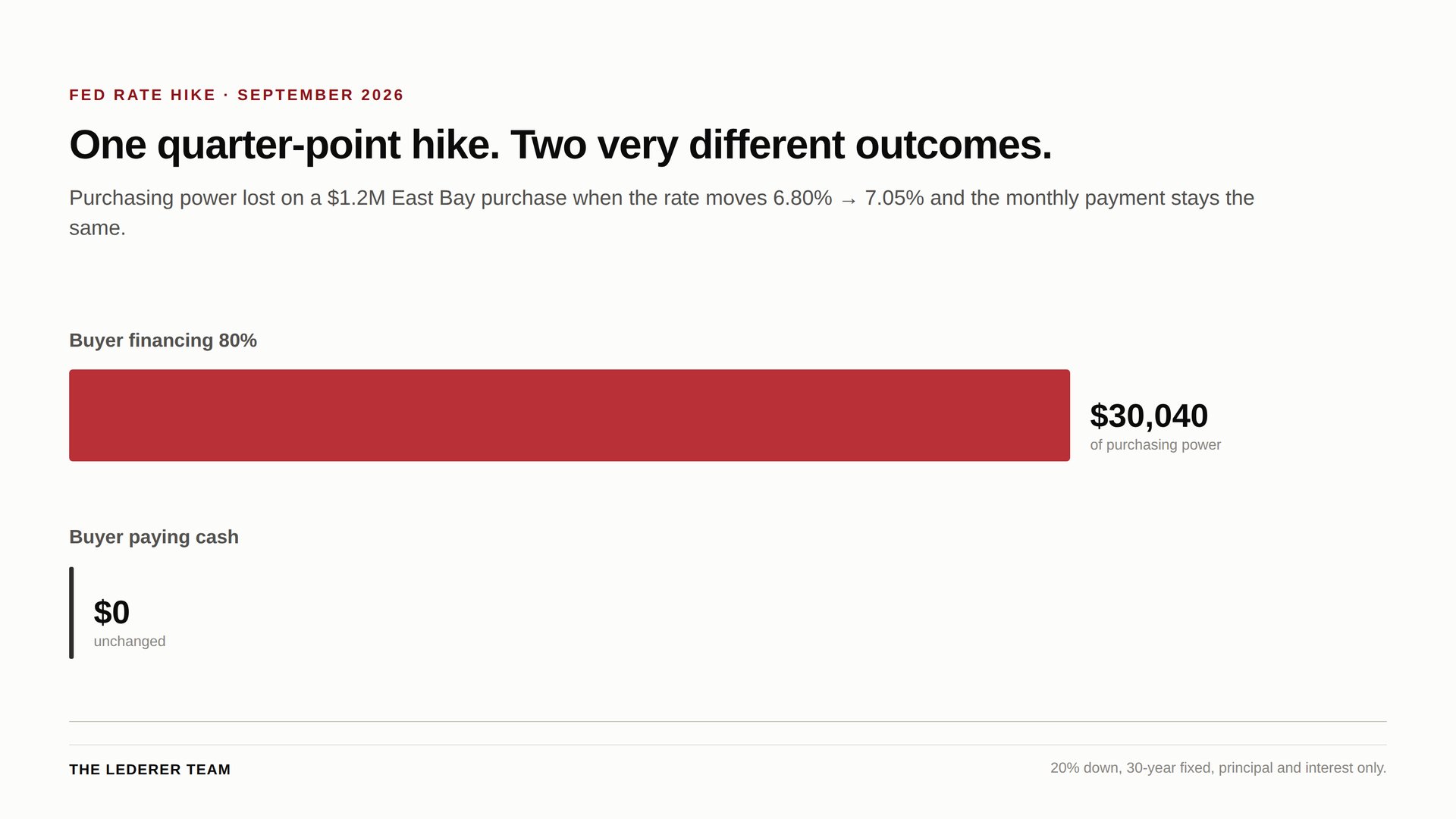
At 7.05%, a buyer holding their payment constant has roughly $30,000 less in purchasing power than they did before the hike, and about $66,000 less than at 6.50% earlier this year. That buyer is still out there. They're just shopping a notch lower than they were.
The equity buyer — lightly financed or not financed at all — hasn't moved at all.
So what happens to your specific house depends almost entirely on which of those two is your natural buyer. And in the East Bay that tracks price point closely.
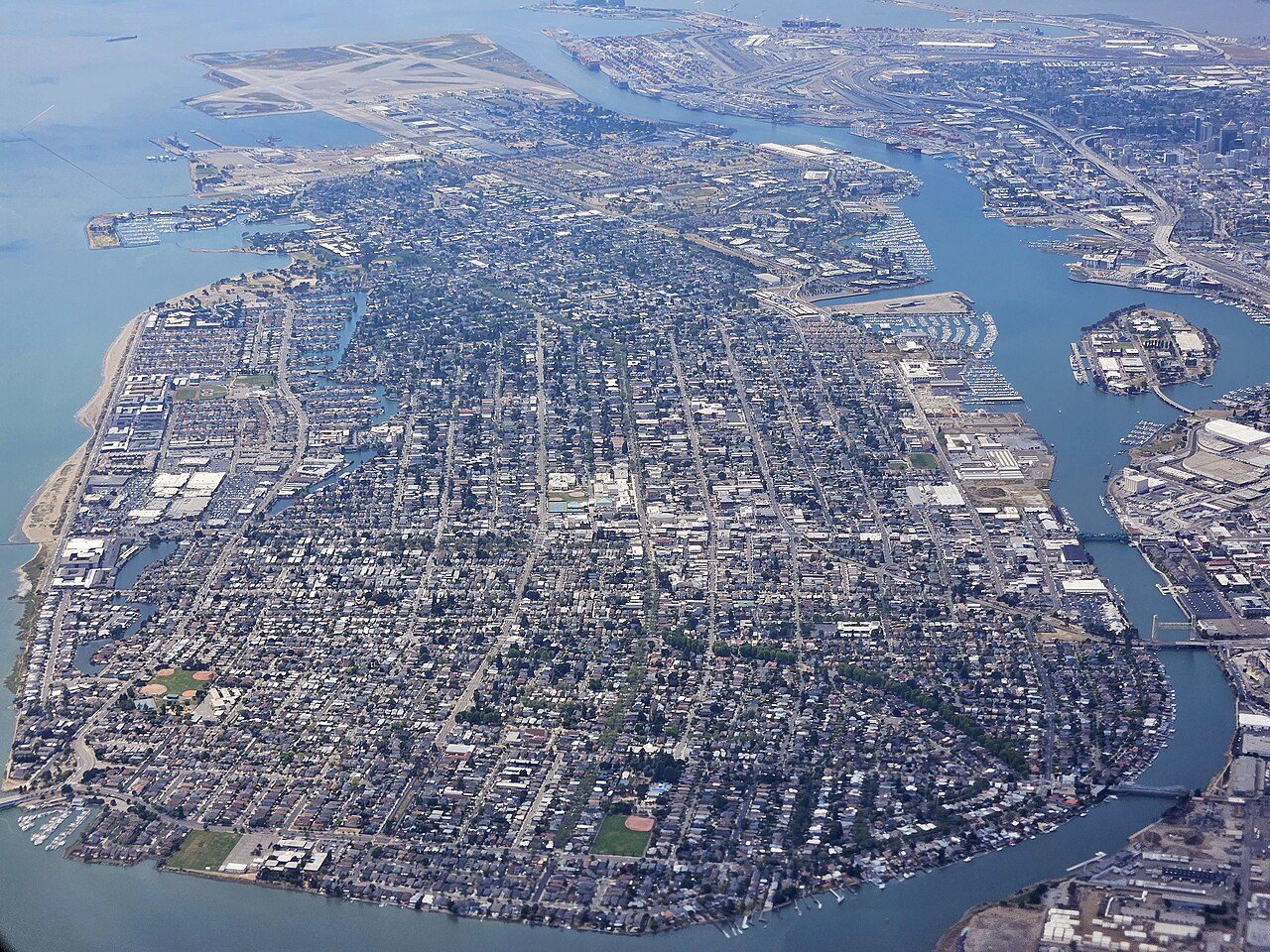
Below roughly $1.3 million — much of San Leandro, large parts of Oakland, most of El Cerrito — your buyer pool is overwhelmingly financed. They are rate-sensitive, payment-driven, and increasingly stretched. That pool is thinner than it was six months ago, and the buyers left in it are more cautious about anything that adds cost after closing.
Above that, and particularly in the Berkeley and Oakland pockets drawing equity-heavy buyers, financing is a convenience. Rate moves don't reliably change what those homes fetch.
Where your own house falls is a question worth answering before you price it. Our Quarterly Market Data map covers 106 Bay Area cities individually — days on market, percent over asking, and median price per square foot — and it will tell you more about your block than any county-level headline will.
The two buyers want different things, and they pay for different things
This is the part that changes your prep budget.
The payment-sensitive buyer is buying certainty. They have almost nothing left after the down payment and closing costs. Every visible deferred-maintenance item reads to them as a bill they'll have to pay in year one, and their agent will price it that way in the offer — usually at a multiple of what it would have cost you to fix. For this buyer, the returns sit in the unglamorous work: roof, drainage, sewer lateral, electrical panel, foundation items, anything flagged in a disclosure package. Fix the things that generate credit requests.
The equity buyer is buying the finished result. They are not doing arithmetic on a $9,000 sewer lateral. They're deciding whether they can move in and love it. For this buyer the returns sit in kitchens, baths, light, flow, landscaping, staging — the things that make a house feel resolved.
The expensive mistake — and we see it constantly — is spending the second budget on the first buyer's house. A $60,000 kitchen in a neighborhood where every buyer is financed and stretched does not return $60,000. It returns a nicer kitchen and a thinner net. Meanwhile the deferred items you skipped come back as $30,000 of credit requests during the inspection period.
In a 7% market, the ranking of prep dollars shifts. Certainty beats aspiration in the lower two-thirds of this market. It did not always.
Estimate, bid, actual — and why we insist on the middle one
The reason most sellers over-improve is that they're working from guesses. An agent walks the house, waves at a number, and the seller commits tens of thousands of dollars based on a figure nobody stands behind.
We run pre-sale preparation as a three-stage process: an estimate to frame the decision, real contractor bids on the specific scope, and tracked actuals so the next seller's estimate is better than the last one's. Scope letters go to each contractor so you're comparing identical work rather than three differently-shaped proposals.
That structure exists for one reason: so you can decide what not to do. The most valuable output of a prep plan is usually the list of items we recommend skipping, and you can only produce that list credibly when you know what each item actually costs and what it actually returns for your buyer.
Pricing in a 7% market
One more adjustment. When the financed pool thins, the cost of an aspirational list price goes up.
The buyers with the least flexibility are also the ones most likely to have set up alerts in a tight price band. Price above that band and you don't just get fewer offers — you become invisible to the exact buyers who would have competed. Then you reduce, and the reduction reads as a signal, and the offers you eventually get are worse than the ones you'd have had in week one.
The first ten days are still where the outcome is decided. That hasn't changed with rates. What's changed is how little margin for error a higher-rate market gives you.
And be honest with yourself about buydowns. Offering to buy down a buyer's rate can be efficient for the payment-sensitive buyer — it delivers more perceived value per dollar than a price cut of the same size. It does nothing at all for the equity buyer. Which one you're courting should determine whether it's on the table.
What this looks like in practice
Before we list, we want to answer three questions in writing: who is the most likely buyer for this specific house at this specific price, what will that buyer pay for and what will they ignore, and what is the smallest set of improvements that gets us the largest share of the achievable price.
Then we bid the work, track it, and stage and market to the buyer we actually identified — not to a generic one.
We charge a 2.5% seller-paid listing commission, and we coordinate the specialists you'll need along the way — design and renovation, staging, insurance, tax and planning — without accepting referral fees from any of them. There's no financial reason for us to send you to anyone but the right person.
If you're weighing a sale in the next six to twelve months, the preparation conversation is worth having well before the listing conversation — contractor scheduling in the East Bay is the constraint, not the work itself.
Start with a home valuation, read about how we represent sellers, or look at our design, renovation and repair coordination. You can see recent work in our portfolio, and check your city's current numbers on our Quarterly Market Data map.
Reach us at 510-774-4231 or [email protected].
Rate and purchasing-power figures as of September 17, 2026, based on a $1.2M purchase with 20% down; payment examples are principal and interest only. Preparation returns vary by property, neighborhood, and scope.